Skip to content
Key Steps to Filing a Baton Rouge Attack Dog Lawsuit
To successfully pursue a Baton Rouge attack dog lawsuit, an injured person must establish three core facts under Louisiana law:
- Direct harm: The dog caused actual physical injuries, trauma, or financial losses.
- Preventable risk: The owner or handler could have prevented the attack because the animal posed an unreasonable risk of harm.
- Lack of provocation: You did not tease, abuse, or provoke the animal before it attacked.
Whether your claim involves an unrestrained neighborhood dog under Louisiana Civil Code Article 2321 or an unjustified police K-9 deployment under federal civil rights statutes (Section 1983), you must act quickly. Documenting the wound, keeping itemized emergency medical bills, securing dashcam or bystander video, and proving zero provocation are essential steps to recover full compensation for your injuries.
I am Pride Doran, a Louisiana trial attorney with more than twenty years of experience standing up for injury victims against insurance companies and government agencies. Over the course of my career, I have handled complex injury litigation across the state, helping clients navigate every stage of a Baton Rouge attack dog lawsuit.

Quick Baton Rouge attack dog lawsuit definitions:
The Carlos Hernandez Case: K-9 Excessive Force and Deputy Liability
When people think about animal attacks, they usually imagine an unrestrained neighborhood pet jumping over a broken fence. However, some of the most devastating injuries in Louisiana occur when trained law enforcement animals are deployed without justification. A prime example that captured significant attention across the greater Baton Rouge area involves a federal civil rights lawsuit filed by Carlos Hernandez.
This high-profile federal lawsuit centers on serious allegations against the Livingston Parish Sheriff’s Office and Deputy Jeremy Pittman. The litigation challenges the reckless deployment of a trained police dog against an innocent individual, raising critical questions about municipal oversight, handler responsibility, and excessive force under the United States Constitution.
The Carlos Hernandez Incident and the Baton Rouge Attack Dog Lawsuit
The incident began not with a high-speed chase or an armed confrontation, but with a simple medical welfare check. Deputies responded to check on Carlos Hernandez, a Honduran man who spoke no English and was experiencing severe high blood pressure. Rather than receiving straightforward emergency medical assistance, Hernandez found himself facing an aggressive law enforcement encounter.
During the interaction, Deputy Jeremy Pittman remotely released his police K-9, named Diesel, from the patrol vehicle using an electronic door popper. The dog immediately targeted Hernandez. Dash camera footage revealed a horrifying scene: K-9 Diesel latched onto Hernandez and bit him continuously for one minute and 45 seconds (105 seconds).
Hernandez was not suspected of committing any crime. Because he did not understand English, he was completely unable to interpret the rapid verbal commands shouted by deputies while being mauled. The prolonged bite caused severe structural and muscular trauma to his arm, resulting in emergency medical bills totaling roughly $45,000.
When an animal is used in this manner, it functions essentially like a guided missile. A dog handler cannot simply unleash an attack animal on an uncomprehending, non-threatening citizen and escape accountability. If you or someone in your family has suffered a similar ordeal, speaking with a dedicated dog attack injury lawyer in Baton Rouge is the first step toward securing justice and covering extensive medical costs.
Civil Rights Claims, Qualified Immunity, and Officer Disciplinary Actions
The federal lawsuit filed on behalf of Hernandez asserts claims under 42 U.S.C. § 1983, alleging that Deputy Pittman violated Hernandez’s Fourth Amendment right to be free from excessive force. In federal civil rights cases involving law enforcement, officers routinely raise the defense of qualified immunity. Qualified immunity protects government officials from personal liability unless their conduct violated clearly established statutory or constitutional rights that a reasonable person would have known.
In this case, the defense faces major hurdles:
- Absence of a Crime: Hernandez was not suspected of any criminal activity during the medical call.
- Extreme Bite Duration: Allowing a trained attack dog to continuously maul a non-violent individual for nearly two minutes falls outside accepted law enforcement standards.
- Dismissal of Criminal Charges: Authorities initially charged Hernandez with resisting an officer with force or violence. However, prosecutors subsequently dismissed all charges, destroying any defense argument that Hernandez provoked the attack or justified the force used against him.
Internal administrative actions taken by the law enforcement agency further emphasize the severity of the misconduct. Following an internal review of the incident and video evidence, one deputy was terminated and another was demoted.
While internal disciplinary measures do not automatically guarantee a civil victory, they provide compelling factual evidence that the deputies violated departmental protocols and acted unreasonably. To better understand how public entity liability and private claims operate in Louisiana, review our detailed guide on animal liability claims.
Legal Standards: Strict Liability and Unreasonable Risk of Harm
Whether a dog attack involves a law enforcement animal or a domestic pet in a residential neighborhood, Louisiana tort law provides specific legal mechanisms to hold handlers and owners liable. The foundation of pet owner responsibility in our state is codified in the Louisiana Civil Code.
Louisiana Civil Code Article 2321 and Owner Responsibility
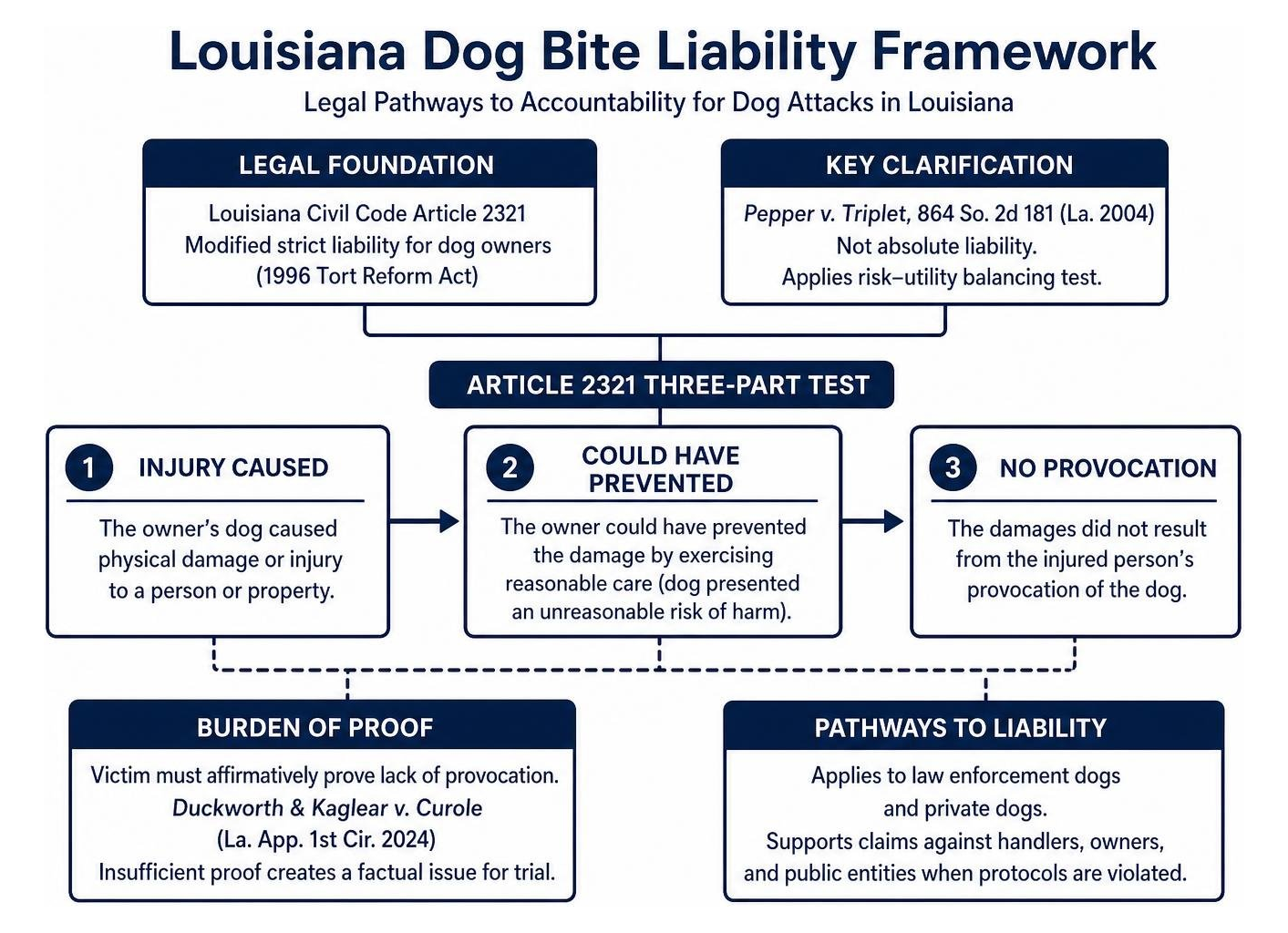
Under Louisiana Civil Code Article 2321, the law draws a clear distinction between dogs and other domestic animals. Following the 1996 Tort Reform Act, the Louisiana Legislature established a modified strict liability standard specifically for dog owners.
To hold an owner strictly liable under Article 2321, an injured plaintiff must satisfy a three-part test:
- The owner’s dog caused physical damage or injury to a person or property.
- The owner could have prevented the damage by exercising reasonable care (which requires proving the dog presented an unreasonable risk of harm).
- The damages did not result from the injured person’s provocation of the dog.
The Louisiana Supreme Court thoroughly clarified this standard in the landmark decision Pepper v. Triplet, 864 So. 2d 181 (La. 2004). In Pepper, the state Supreme Court explained that Article 2321 does not create “absolute” or “superstrict” liability that turns pet owners into automatic insurers against any conceivable harm. Instead, the statutory requirement that the owner “could have prevented” the harm incorporates a traditional risk-utility balancing test.
Courts must weigh the social utility of the animal against the gravity and likelihood of the harm it poses. When an owner fails to secure a known dangerous animal, the risk heavily outweighs any utility, establishing liability under Louisiana dangerous dog laws.
Provocation Defenses and the Burden of Proof
The third prong of Article 2321—proving that the injury did not result from provocation—is one of the most critical battlegrounds in any dog attack case. Under Louisiana procedural rules, a victim seeking summary judgment must affirmatively present evidence proving they did not provoke the dog.
This principle was clearly demonstrated in William Duckworth and Donnie Kaglear v. Susan Curole (La. App. 1st Cir. 2024). In that case, an unleashed Boxer attacked two leashed Boston Terriers and their owner in East Baton Rouge Parish. While the trial court granted partial summary judgment in favor of the victims, the First Circuit Court of Appeal reversed the ruling. The appellate court found that the plaintiffs’ initial affidavits failed to specifically and affirmatively establish the absence of provocation prior to the attack, leaving a genuine issue of material fact for trial.
To build a solid case that withstands defense motions, our team ensures every element—especially the total lack of provocation—is supported by sworn witness statements, physical evidence, and police reports. Understanding these evidentiary standards is essential when evaluating potential dog bite financial recovery.
Key Precedents Shaping Every Baton Rouge Attack Dog Lawsuit
Louisiana courts have built an extensive body of jurisprudence regarding animal attacks, fence maintenance, and handler responsibility. Reviewing past decisions helps us evaluate the strengths, risks, and potential values of current claims.
| Case Name | Court & Year | Primary Legal Issue | Key Holding & Impact |
|---|---|---|---|
| Pepper v. Triplet | La. Supreme Court (2004) | Strict liability standard under La. C.C. art. 2321 | Held that strict liability requires showing an “unreasonable risk of harm” via risk-utility balancing. |
| Karu v. Lavergne | La. App. 1st Cir. (1971) | Landlord liability and permanent disability damages | Awarded damages for a 35% permanent arm disability; ruled a dog is not a structural defect of leased premises. |
| Becker v. Keasler | La. App. 4th Cir. (2007) | Inadequate fencing and sidewalk pedestrian safety | Upheld strict liability and $37,243.59 in damages when a tethered dog bit a passerby over a low fence. |
| Johnson v. Hackley | La. App. 1st Cir. (2009) | Risk-utility test in professional care settings | Ruled that routine grooming handling does not create an unreasonable risk of harm absent known vicious propensities. |
| Duckworth v. Curole | La. App. 1st Cir. (2024) | Summary judgment evidentiary requirements | Clarified that plaintiffs must affirmatively disprove provocation in initial pleadings to secure early judgment. |
Comparing Prior Louisiana Case Law: Karu, Becker, and Johnson
In Karu v. Lavergne (La. App. 1st Cir. 1971), an international graduate student was attacked by two German shepherds on a common walkway at an apartment complex. The victim sustained severe nerve and muscle injuries resulting in a 35% permanent disability of his left arm. The court affirmed significant damages against the dog owner while clarifying that a domestic pet does not constitute a physical “vice or defect” of the leased premises under landlord-tenant law.
Physical containment was central in Becker v. Keasler (La. App. 4th Cir. 2007). In Becker, a pedestrian was walking along a public sidewalk when an Akita reached over a low iron perimeter fence and bit her arm. Even though the dog was tethered in its own yard, the court found the owner strictly liable because the low fence height and tether length combined to create an unreasonable risk of harm to innocent passersby. The court affirmed a $35,000 general damages award alongside medical compensation.
Conversely, Johnson v. Hackley (La. App. 1st Cir. 2009) highlights the boundaries of the risk-utility test. In that matter, a commercial pet groomer had a portion of her index finger severed when a terrier snapped at a bath spray hose. The First Circuit affirmed summary judgment dismissing the claim against the dog owners. The court reasoned that professional animal care provides substantial social utility, and standard handling risks during professional grooming do not constitute an unreasonable risk of harm without evidence of prior unprovoked vicious behavior.
Filing a Baton Rouge Attack Dog Lawsuit: Deadlines and Legal Steps
If you suffer an animal attack, following a clear action plan protects both your physical recovery and your legal rights:
- Obtain Immediate Medical Treatment: Emergency care cleans deep puncture wounds, prevents life-threatening rabies or bacterial infections, and creates immediate medical records.
- Preserve Objective Evidence: Photograph all bite marks, torn clothing, broken fence boards, or loose tethers. Request and secure copies of any 911 audio, body camera footage, or dashcam recordings.
- Identify Witnesses and Handlers: Obtain the contact information of animal owners, handlers, and any neighbors who witnessed the incident.
- Report the Incident: File an official report with local animal control authorities or the parish sheriff’s office to initiate an investigation.
- Monitor Filing Deadlines: You must adhere strictly to Louisiana’s prescriptive periods for filing personal injury lawsuits. Missing these statutory deadlines permanently forfeits your right to compensation, as explained in our overview on dog attack time limits.
Taking the right steps after an attack in your neighborhood ensures that vital evidence does not disappear.
Frequently Asked Questions About Baton Rouge Canine Attacks
Can police handlers be held personally liable for K-9 dog bites in Louisiana?
Yes. While police officers generally receive qualified immunity in the performance of their duties, that protection disappears when their actions violate clearly established constitutional standards. Deploying an attack dog against an unresisting, non-threatening individual—or allowing a dog to bite a person for an extended duration like 105 seconds—constitutes excessive force under the Fourth Amendment, exposing handlers and municipal agencies to direct federal claims.
What compensation is available in a Louisiana attack dog lawsuit?
Victims can seek both special (economic) and general (non-economic) damages. Recoverable damages include emergency room bills, surgical expenses, future physical therapy costs, lost wages, diminished earning capacity, compensation for physical pain and suffering, and awards for permanent scarring or disfigurement.
How does the dismissal of criminal charges affect a canine injury claim?
When criminal charges against a victim (such as resisting arrest or trespassing) are formally dismissed, it eliminates the defense’s primary argument that the victim provoked the dog or brought about their own injuries. A dismissal proves critical in establishing the lack-of-provocation requirement under Louisiana Civil Code Article 2321.
Stand Up for Your Rights with Doran & Cawthorne
A severe canine attack causes deep physical pain, emotional trauma, and overwhelming financial debt. Whether you were injured by an unleashed neighborhood pet or subjected to an unjustified law enforcement deployment, you do not have to fight insurance adjusters or government entities alone.
At Doran & Cawthorne, our team of experienced trial attorneys knows how to hold negligent pet owners and reckless handlers accountable. We thoroughly investigate the facts, preserve critical video evidence, counter bad-faith provocation defenses, and pursue every dollar of compensation you need to heal.
With office locations serving Opelousas, Lafayette, and Baton Rouge, we are prepared to stand by your side. If you need trusted legal representation to handle your claim, reach out to our dedicated Baton Rouge personal injury attorney group today for a free, confidential case evaluation.
Share this Blog

When You Need Real Talk & Results™
Louisiana Personal Injury Attorneys Committed to Advocating on Your Behalf