 Skip to content
Baton Rouge Dog Injury Statute Limitations: What You Need to Know Before Time Runs Out
Dog injury statute limitations set a strict legal deadline for how long you have to file a lawsuit after a dog attack. Miss that deadline, and your case is gone — permanently.
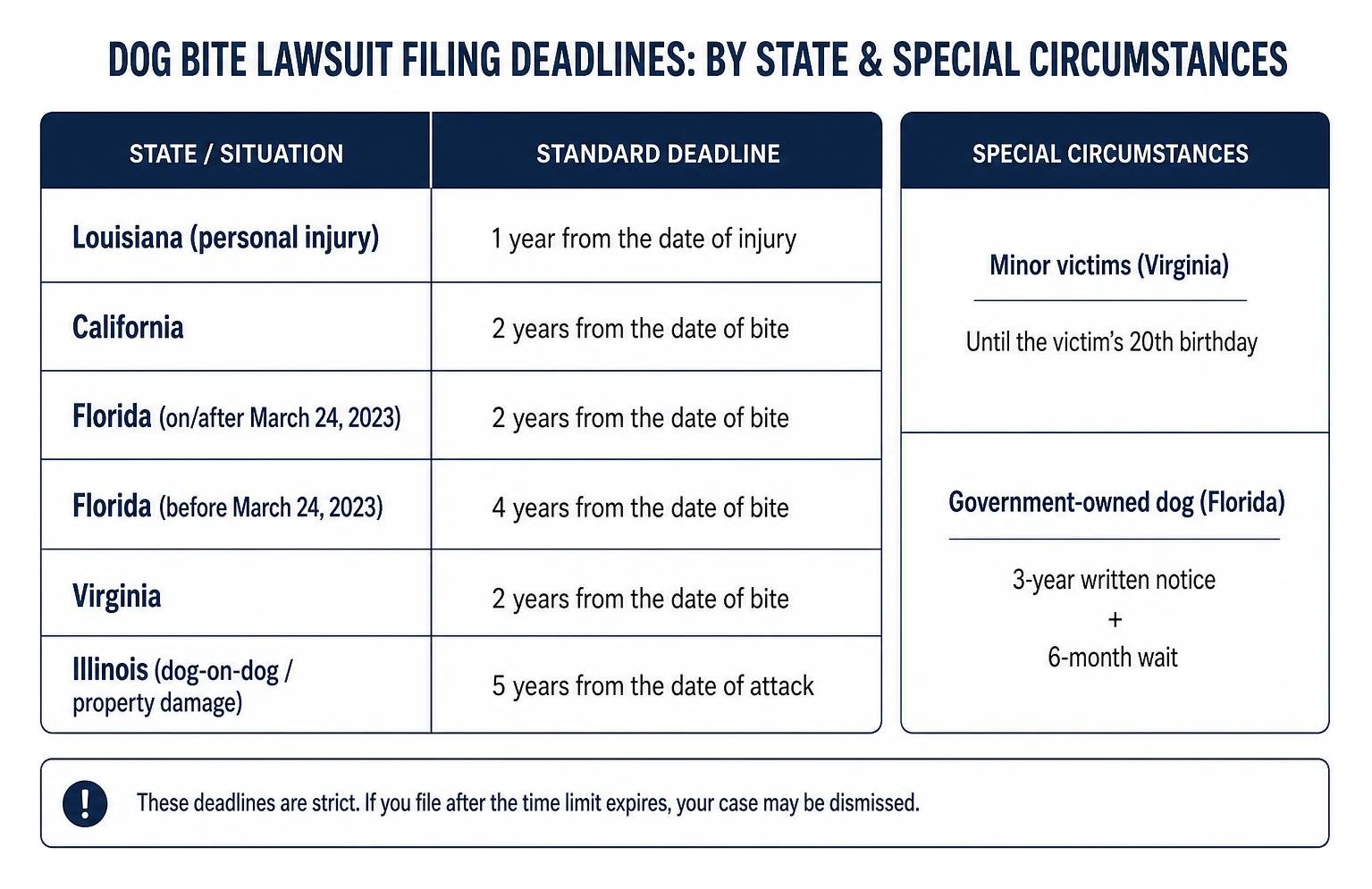
Here are the key filing deadlines at a glance:
| State / Situation | Standard Deadline |
|---|---|
| Louisiana (personal injury) | 1 year from the date of injury |
| California | 2 years from the date of bite |
| Florida (on/after March 24, 2023) | 2 years from the date of bite |
| Florida (before March 24, 2023) | 4 years from the date of bite |
| Virginia | 2 years from the date of bite |
| Illinois (dog-on-dog / property damage) | 5 years from the date of attack |
| Minor victims (Virginia) | Until the victim’s 20th birthday |
| Government-owned dog (Florida) | 3-year written notice + 6-month wait |
These deadlines matter because the financial stakes are real. The average hospital bill for a dog bite exceeds $18,000 — roughly 30% higher than other injury-related expenses. And with over 4.5 million dog bites happening every year in the United States, according to the CDC, courts see these cases constantly. Judges enforce these deadlines without exceptions.
If you are in Baton Rouge or anywhere in Louisiana, your window may be shorter than you think.
I’m Pride Doran, a trial attorney with over twenty years of experience handling personal injury cases across Louisiana, including cases that directly involve dog injury statute limitations and the strict filing rules that govern them. In the sections ahead, I’ll walk you through exactly what these deadlines mean for your case and what steps to take right now.
Understanding Dog Injury Statute Limitations Across Key States and Louisiana
A statute of limitations is a state law that imposes a strict time frame on your ability to bring a civil action against a dog owner. If you try to file a claim in civil court after that countdown clock expires, the judge will grant a motion to dismiss your claim. You will lose all legal leverage to force the dog owner or their insurance company to pay for medical care, missed work, or pain and suffering.
Understanding how state boundaries change these deadlines is essential if an attack occurs while traveling or if you are comparing laws across different jurisdictions:
- Louisiana: Under the louisiana personal injury statute of limitations, victims historically faced a strict one-year prescriptive period from the exact day of the attack.
- California: Under California law, victims have a two-year statute of limitations from the date of the bite to bring a formal court action.
- Florida: Florida updated its statutes under House Bill 837. For dog bite injuries occurring on or after March 24, 2023, the deadline is two years. Bites occurring prior to that date retain Florida’s older four-year deadline.
- Virginia: Adults bitten by a dog in Virginia have two years from the date of the bite incident to initiate legal proceedings.
- Illinois: While human injury lawsuits follow standard personal injury deadlines, property damage actions, including dog-on-dog attacks, allow five years to seek compensation.
Because Louisiana maintains one of the shortest deadlines in the nation, local injury victims cannot afford to delay taking action.
How Dog Injury Statute Limitations Apply to Minors and Wrongful Death
When a young child or a fatal attack is involved, statutory time frames can shift dramatically based on legal tolling rules or specific claim types.
In standard personal injury law, tolling pauses the statutory clock. For child victims, states frequently extend the time limit until the child reaches adulthood:
- In Virginia, if a child under eighteen is attacked, the dog injury statute limitations countdown is extended until the victim’s twentieth birthday.
- In Florida, tolling for minors or mentally incapacitated individuals is allowed, but state law caps total tolling extensions at seven years maximum under Florida Statute § 95.051(2).
- In Louisiana, specific tolling provisions exist, but relying on automatic delays without formal legal representation can risk early claim dismissal.
When a dog attack results in tragic loss of life, the nature of the lawsuit transitions into a wrongful death or survival action under general personal injury laws. Survival actions allow the deceased victim’s estate to recover damages sustained between the moment of the attack and death. Wrongful death actions belong directly to surviving family members for their emotional loss and financial hardship. The clock for these claims begins on the date of death rather than the date of the bite.
Strict Liability Versus Common Law in Dog Injury Statute Limitations
How a state assigns fault to a dog owner directly dictates the legal framework of your case and how statutory deadlines are interpreted by judges.
- Strict liability statutes: Under strict liability legal theory, a dog owner is automatically responsible for damages if their dog bites someone in a public place or lawfully on private property. The injured party does not need to prove that the owner was careless or knew the dog was aggressive. Louisiana Civil Code Article 2321 imposes legal duties on animal owners, making ownership the central anchor of liability.
- The “one bite rule” & common law: Some jurisdictions historically required victims to establish that the owner knew, or should have known, that their animal possessed vicious tendencies. Under common law, previous dangerous behaviors—such as lunging, snapping, or growling—were required to establish liability.
- Statute of limitations classification: The distinction between statutory liability and common law negligence can alter the legal time frame. In the landmark case Bora v. Kerchelich, the Ohio Supreme Court examined whether a claim brought under a state strict liability animal law was governed by the statutory liability timeline or the general bodily injury deadline. Courts often have to analyze the exact language of a complaint to determine which statutory countdown applies.
Special Rules for Pet Attacks and Government Canine Claims
When a dog attacks another pet or when the biting dog belongs to a municipal police department, standard personal injury rules change completely.
In Louisiana and across most states, domestic pets are legally classified as personal property. Because animals are categorized this way, an attack by a dog on your dog is treated as a property damage claim rather than a personal injury case.
This distinction produces significant differences in recoverable damages and filing windows:
| Claim Type | Typical Legal Classification | Focus of Damages | Statutory Deadline Example |
|---|---|---|---|
| Human dog bite injury | Personal injury / bodily damage | Emergency bills, surgeries, lost wages, pain and suffering | 1 to 2 years (LA, CA, FL) |
| Dog-on-dog attack | Personal property damage | Veterinary surgeries, physical therapy, fair market value | 4 to 5 years (FL, IL) |
Because pets are classified as personal property, courts do not allow owners to collect non-economic damages for a pet’s emotional distress or pain and suffering. However, you can recover direct veterinary expenses, rehabilitation costs, and lost earnings incurred while caring for your animal.
If you are seeking representation for an attack in Baton Rouge or surrounding areas, speaking with a dedicated dog attack injury lawyer Baton Rouge will ensure both personal injury and pet damage components are handled accurately.
Special rules apply when an injury involves government-owned animals, such as police K-9s. If a working police dog bites a bystander outside official lawful authorization, standard civil deadlines are replaced by strict administrative notice requirements.
For instance, suing a public entity often requires submitting a formal administrative claim within 90 days to three years, followed by a mandatory waiting window for agency investigation before filing a civil lawsuit. Missing these initial administrative notice windows completely bars recovery, regardless of how much time remains on the traditional personal injury statute.
Key Tolling Exceptions and What Happens When You Miss the Clock
In specific legal scenarios, state law permits the dog injury statute limitations clock to pause. These legal exceptions, called “tolling events,” prevent unfair outcomes when circumstances outside the victim’s control prevent a timely court filing.
Common recognized tolling circumstances include:
- Defendant absence: If the dog owner flees the state, conceals their identity, or leaves the jurisdiction to avoid service of process, the countdown clock freezes until they return.
- Fraudulent concealment: If a dog owner actively takes deliberate steps to trick the victim or hide key evidence regarding ownership, courts may toll the deadline. Merely failing to offer information does not qualify; active deceit is required.
- Mental incapacity: If an injured victim suffers severe brain trauma or remains in a medically induced coma following an attack, the statute of limitations pauses until legal competency is restored.
Understanding these exceptions can help preserve your rights, but relying on them as a cushion is dangerous. To understand what a claim might yield under different timelines, evaluating what is my personal injury case worth provides critical clarity on medical economic recovery.
What Happens If You Miss the Deadline?
If you file a lawsuit even one day after the applicable statute of limitations expires:
- The dog owner’s defense attorney will file a motion to dismiss under procedural court rules.
- The judge will grant the motion, dismissing your suit with prejudice.
- You forfeit all rights to pursue legal recovery, and insurance adjusters will close your file without paying a single dollar.
Frequently Asked Questions About Baton Rouge Dog Bite Deadlines
When does the statute of limitations clock start ticking after a dog bite?
In nearly every case, the dog injury statute limitations clock starts ticking on the exact date and time the bite or attack takes place.
A narrow exception known as the “discovery rule” applies only if the harm or injury could not reasonably have been detected on the day of the incident. For example, if a victim suffers a deep blunt-force trauma injury that causes latent nerve damage or a delayed tissue infection, the discovery rule may argue that the clock begins when the victim knew, or reasonably should have known, that wrongful harm occurred. However, because dog bites cause immediate visible physical trauma, courts rarely extend the filing deadline under discovery rules.
Are working police dogs subject to standard personal injury deadlines?
No, working police dogs operating under government employment fall under sovereign immunity statutes and administrative claims acts rather than basic personal injury rules. Police and military working dogs engaged in official law enforcement duties are generally exempt from standard strict liability statutes.
Furthermore, before you can bring a formal lawsuit against a city, parish, or law enforcement department, you must file a formal administrative notice with the correct government body within a strict administrative timeframe. Failing to send this written notification within the administrative notice window strips the court of jurisdiction, preventing you from bringing a lawsuit later.
Why should I consult an attorney early if I have time to file?
Waiting until the last minute to contact a attorney compromises your recovery in several ways:
- Evidence disappears: Physical scene evidence, bloodstains, torn clothing, and unmaintained fencing can be cleared away or repaired days after the incident.
- Witness memories fade: Eyewitnesses relocate, lose track of details, or forget key observations regarding owner negligence or lack of physical control.
- Surveillance video gets overwritten: Local business security systems and residential doorbell cameras often automatically overwrite digital video footage every 7 to 30 days.
- Medical documentation takes time: Building a persuasive settlement demand requires gathering complete medical treatment records, hospital bills, expert diagnostic summaries, and future care evaluations.
Reaching out to a legal professional immediately allows your legal team to secure critical proof, protect insurance claim windows, and conduct formal settlement negotiations long before statutory filing deadlines near.
Protect Your Legal Right to Compensation Before Time Runs Out
A serious dog attack leaves painful physical wounds, emotional trauma, and unexpected hospital bills. Navigating insurance negotiations while trying to heal from an injury can feel overwhelming. However, time is actively working against your case from the moment an attack happens.
Understanding local statutory time limits is the first step toward securing proper recovery for emergency care, reconstructive surgery, lost income, and emotional distress. Taking quick action ensures that essential evidence, witness accounts, and medical documentation remain fully intact.
Our firm represents victims across Louisiana, operating from convenient offices in Opelousas, Lafayette, and Baton Rouge. We understand the precise procedural timelines required to hold negligent pet owners responsible.
If you or a loved one suffered harm from a dog attack, do not wait until statutory windows expire. Connect directly with our trial team at Doran & Cawthorne today. Speak with an experienced Baton Rouge personal injury attorney to review the specifics of your case, confirm your deadlines, and protect your legal rights before time runs out.
Share this Blog

When You Need Real Talk & Results™
Louisiana Personal Injury Attorneys Committed to Advocating on Your Behalf


