 Skip to content
Injured by a neighbor’s dog in Baton Rouge? Here’s what you need to know
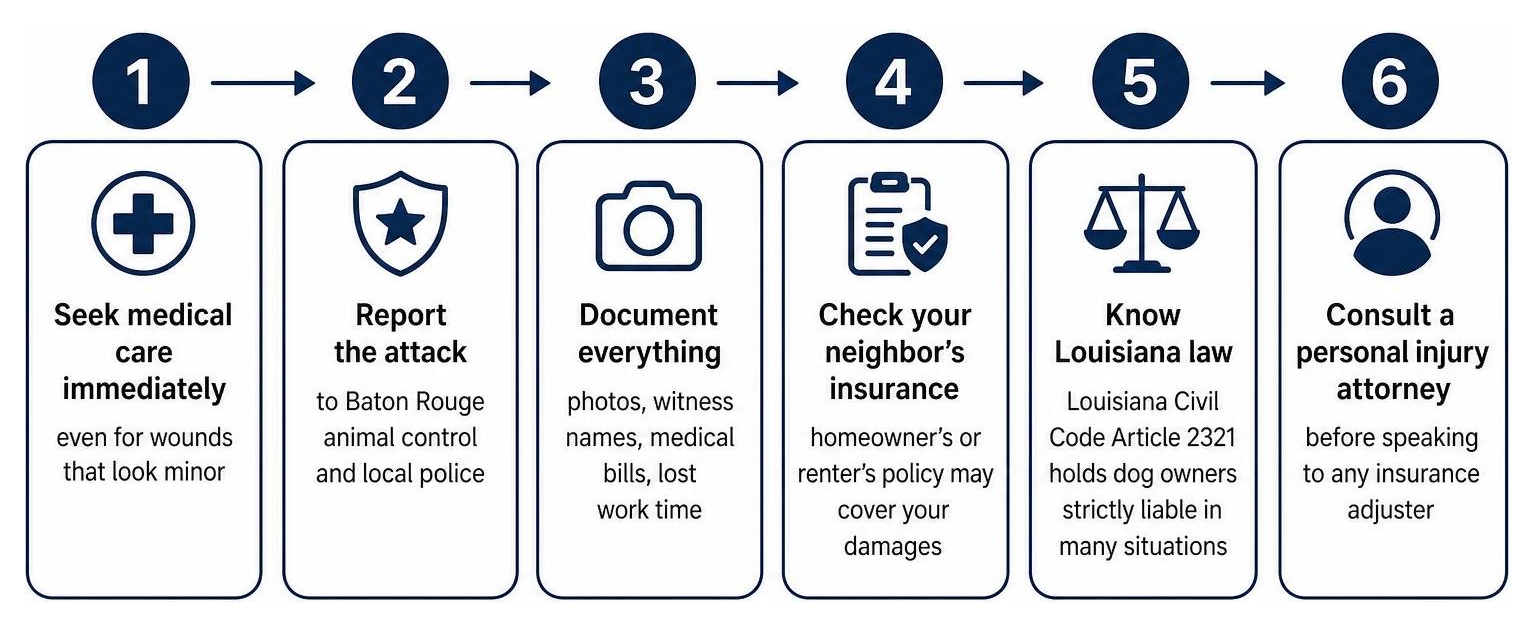
Being injured by a neighbor’s dog is more common than most people think — and the aftermath can be overwhelming. Here’s a quick overview of what to do and what your rights are in Baton Rouge:
- Seek medical care immediately, even for wounds that look minor
- Report the attack to Baton Rouge animal control and local police
- Document everything — photos, witness names, medical bills, lost work time
- Check your neighbor’s insurance — homeowner’s or renter’s policy may cover your damages
- Know Louisiana law — Louisiana Civil Code Article 2321 holds dog owners strictly liable in many situations
- Consult a personal injury attorney before speaking to any insurance adjuster
More than 4.5 million people are bitten by dogs in the United States every year, and nearly 1 in 5 of those victims need medical attention. In 2025 alone, insurers across the country paid out roughly $1.86 billion in dog-related injury claims. A dog attack can leave you facing steep medical bills, missed work, and real emotional distress — all because of someone else’s animal.
Louisiana law gives you the right to seek compensation. But the steps you take right after the attack can make or break your claim.
I’m Pride Doran, a trial attorney with over twenty years of experience handling personal injury cases — including cases where clients were injured by a neighbor’s dog in Louisiana. My background in premises liability and negligence law means I understand exactly how these cases unfold and what it takes to protect your rights from day one.
Immediate steps if you are injured by neighbor’s dog in Baton Rouge

When a dog living next door or down the block suddenly lunges, bites, or knocks you down, the adrenaline rush can make it hard to think clearly. You might want to wave off the incident to keep peace in the neighborhood, but doing so can severely jeopardize both your physical recovery and your financial stability. Taking immediate, deliberate actions protects your health and preserves key evidence.
Your first priority must always be safety and professional medical evaluation. Even a bite that appears to be a simple scratch can carry bacteria such as Pasteurella, Staphylococcus, or Streptococcus. Dog jaws exert immense pressure, causing deep puncture wounds, hidden muscle tearing, and structural nerve damage underneath intact skin.
- Wash the wound right away: Use warm water and mild soap for at least five minutes to flush out surface bacteria before heading to an urgent care clinic or emergency room.
- Seek professional emergency medical care: ER physicians and urgent care doctors in East Baton Rouge Parish will assess the wound depth, perform thorough debridement, determine whether you need tetanus booster shots, and evaluate potential rabies exposure.
- Obtain official treatment records: Ensure the treating doctor records the exact cause of your injury as an animal attack, detailing punctures, lacerations, bruising, or broken bones.
Reporting the attack to animal control and police
Reporting a dog attack isn’t about being a bad neighbor; it is a critical matter of public safety and statutory record-keeping. In Baton Rouge, local ordinances require animal bites to be reported to local authorities to protect the community from dangerous animals and manage public health risks.
Contacting East Baton Rouge Parish Animal Control and the local police department establishes official public safety documentation. When animal control officers arrive, they initiate a mandatory bite investigation. This typically includes placing the animal under a mandatory 10-day quarantine period to observe for rabies symptoms.
Furthermore, filing an official report creates an unyielding paper trail. Animal control will check local licensing databases to uncover whether the animal has a prior history of unprovoked aggression, past quarantine orders, or previous citations for running at large. This administrative bite history record serves as powerful, unbiased evidence if you eventually file an insurance claim or personal injury suit.
Preserving evidence and documenting financial losses
To secure full compensation, you must build a comprehensive paper trail starting the day of the attack. Insurance adjusters regularly challenge dog bite claims by claiming injuries were pre-existing or that the victim exaggerated their losses.
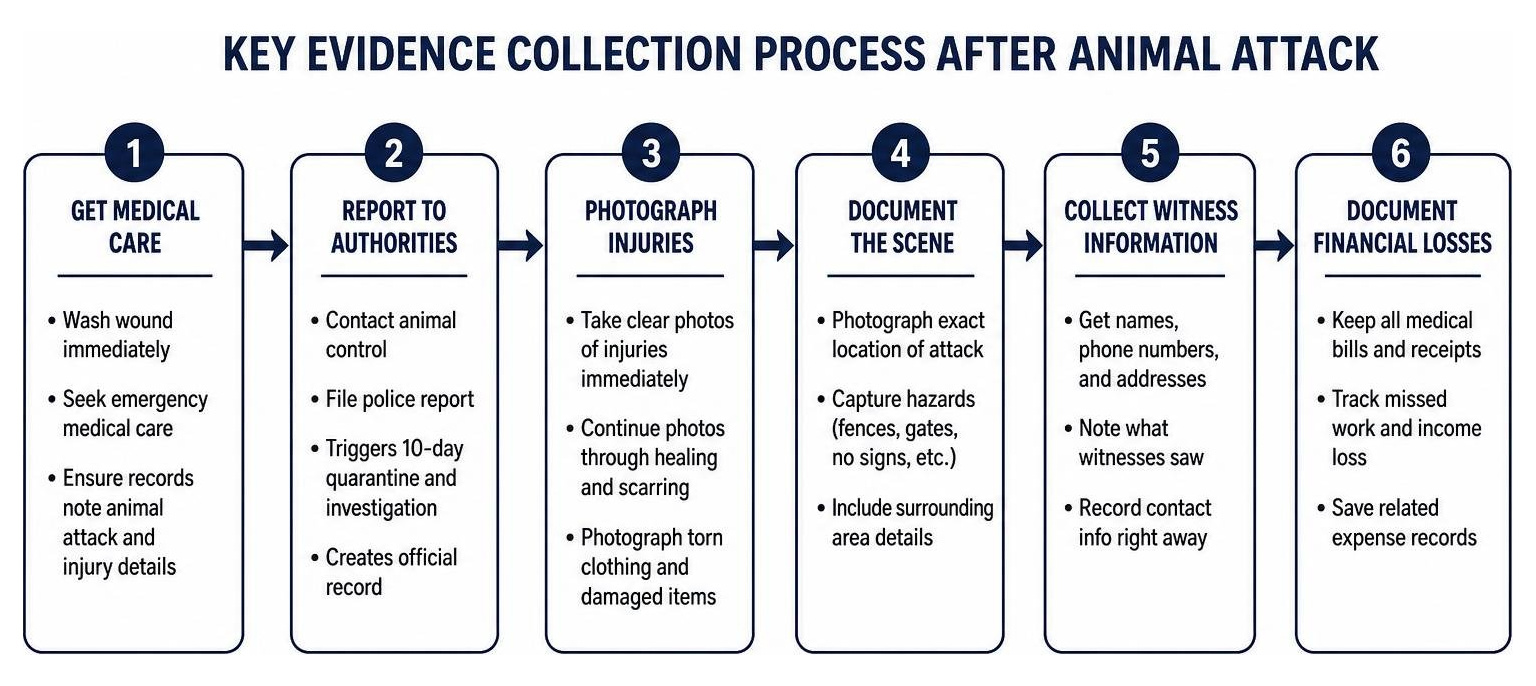
To protect yourself against these tactic moves, gather and safeguard the following evidence:
- Photographs of everything: Take clear, well-lit photos of all physical injuries immediately after the attack, throughout the stitches and wound healing process, and as scar tissue forms. Photograph torn, bloodstained clothing, broken eyeglasses, or damaged personal property.
- Scene and boundary photos: Capture images of the exact location where the attack happened, including broken fence pickets, unlatched gates, or missing warning signs.
- Witness contact details: Collect names, phone numbers, and home addresses of neighbors or passersby who saw the attack or helped pull the dog off you.
- Detailed financial records: Retain physical and digital copies of all ER bills, physical therapy invoices, prescription receipts, and receipts for wound care supplies.
- Proof of lost income: Request formal documentation from your employer showing missed work hours, lost wages, or used paid time off (PTO) during your initial recovery.
- Daily pain and symptom journal: Write down daily entries describing your physical discomfort, mobility limitations, sleep disruptions, nightmares, and emotional anxiety.
Understanding dog bite liability under Louisiana law
Navigating dog injury claims requires understanding how state laws govern animal owner responsibilities. In many states, dog bite cases center around the traditional “one-bite rule,” where an owner is only held liable if the dog had previously shown aggressive tendencies or bitten someone before. However, Louisiana takes a distinct legal approach centered on strict liability principles balanced with reasonable care standards.
Under Louisiana Civil Code Article 2321, the owner of an animal is answerable for the damage caused by that animal if the injured party can prove three fundamental elements:
- The owner knew or, in the exercise of reasonable care, should have known that his animal’s behavior was likely to cause damage.
- The damage could have been prevented by the exercise of reasonable care.
- The owner failed to exercise such reasonable care.
While Article 2321 imposes a standard of strict responsibility on pet owners, liability isn’t strictly automatic in every imaginable scenario. The law evaluates whether the dog owner took appropriate, reasonable precautions to contain, leash, or manage the animal given its size, breed tendencies, and past behavior.
Courts also evaluate whether property owners or landlords had knowledge of dangerous animals on their premises. For instance, in the appellate court ruling Stephens v. Covington, judges emphasized that property managers or third-party landlords cannot be held legally accountable for a tenant’s dangerous dog unless clear evidence proves the landlord had direct, actual knowledge of the animal’s dangerous propensities and maintained contractual control over the property to eliminate the danger.
Understanding these nuanced legal burdens is central to building a successful personal injury claim when an animal causes harm.
Legal options when injured by neighbor’s dog with no prior history of aggression
What happens if your neighbor claims, “My dog has never done this before, so I’m not responsible!”?
In strict one-bite states, an owner might escape financial responsibility for a dog’s first aggressive outburst. But under Louisiana negligence standards, an owner cannot simply hide behind a lack of prior bite history. You do not need to prove the dog was previously classified as a “dangerous animal” to recover compensation.
If a neighbor fails to secure a yard latch, leaves an aggressive pet untethered in an unfenced front yard, or walks a large dog without a sturdy leash, they have failed to exercise reasonable care. In Louisiana, failing to restrain an animal in violation of local parish leash ordinances constitutes clear evidence of negligence. Even if the animal was considered a docile family pet prior to that moment, the owner’s failure to maintain physical control creates legal liability for any resulting injuries.
What to do if you were injured by neighbor’s dog on your own property
Few situations are more disturbing than being attacked by a neighbor’s animal while standing in your own driveway, gardening in your backyard, or walking along your property line. When an attack occurs on your private land, your legal position as an injured victim is exceptionally strong.
Under property and personal injury law, you have an absolute legal right to enjoy your private property safely. If a neighbor’s dog escapes its enclosure, digs under a boundary fence, or charges onto your lawn, the owner cannot claim you were trespassing or unlawfully present.
Boundary line disputes often involve physical barriers. Understanding local fence line liability rules helps clarify legal duties when an animal attacks across a property divider. If a neighbor’s dog lunges through a broken, rotting fence panel that the owner neglected to repair, or reaches over a low property divider to bite you, the dog owner’s failure to contain their pet directly establishes negligence.
Insurance coverage and recovering financial damages
A primary worry victims face after being injured by a neighbor’s dog is how medical bills will be paid. Many victims hesitate to bring up compensation because they fear putting financial strain directly on a neighbor or damaging social ties.
In the vast majority of neighborhood dog bite claims, compensation is paid out by insurance companies, not directly out of your neighbor’s personal savings account.
When a dog attack occurs, the owner’s homeowner’s insurance policy or renter’s insurance policy typically provides liability coverage. In 2024, insurers paid out roughly $1.57 billion in dog-related injury claims nationwide, a figure that climbed to roughly $1.86 billion in 2025. Standard property insurance policies include personal liability coverage designed specifically to pay for bodily injuries caused by household pets on or off the premises.
However, insurance claims are rarely simple. Insurance carriers frequently attempt to minimize payouts or deny coverage altogether using specific policy limits and exclusions:
- Dangerous breed exclusions: Some homeowner policies specifically exclude coverage for certain dog breeds, such as Pit Bulls, Rottweilers, Dobermans, or German Shepherds.
- Animal liability caps: Certain insurance providers limit animal bite coverage to lower policy limits (e.g., $25,000 or $50,000) unless the policyholder purchased an additional liability umbrella policy.
- Off-premises exclusions: Insurance adjusters may scrutinize claims heavily if the attack occurred off the policyholder’s physical residential lot.
Navigating these complex policy terms requires deep experience. Reviewing detailed resources on everything you need to know about dog bite payouts provides valuable perspective on how policy limits influence out-of-court settlements and court judgments.
Types of compensation available for dog attack victims
When you sustain injuries from an aggressive animal, your financial recovery can encompass both direct economic losses and non-economic harm:
- Immediate and ongoing medical expenses: Coverage for emergency care, surgical fees, hospital stays, prescription antibiotic medications, rabies vaccine series, and follow-up clinical visits.
- Reconstructive and plastic surgery costs: Animal bites frequently leave jagged lacerations on the face, hands, or limbs, requiring specialized plastic surgery to minimize severe scarring and disfigurement.
- Physical therapy and rehabilitation: Comprehensive treatment to restore lost range of motion, repair damaged nerve function, or rebuild torn muscle tissue.
- Lost wages and lost earning capacity: Full reimbursement for income lost while recovering, as well as compensation if physical injuries permanently impair your ability to earn a living.
- Pain and suffering: Compensation for acute physical pain endured during the attack, initial emergency treatment, and subsequent recovery procedures.
- Emotional distress and psychological trauma: Dog attacks frequently trigger severe, long-lasting emotional trauma, post-traumatic stress disorder (PTSD), anxiety, sleep disruptions, and intense phobias of animals—especially in young children.
Medical payments coverage vs. bodily injury liability coverage
Understanding the difference between the medical payments portion and the bodily injury liability portion of an insurance policy is essential when filing a claim.
| Coverage feature | Medical payments (Med-Pay) coverage | Bodily injury liability coverage |
|---|---|---|
| Fault Requirement | No-fault benefits (pays regardless of who caused the attack) | Requires proof of owner negligence or strict liability |
| Covered Expenses | Direct medical bills and immediate emergency care only | Full medical costs, lost wages, pain and suffering, scarring |
| Policy Limits | Typically low limits ($1,000 to $5,000 max) | High limits (typically $100,000 to $300,000+) |
| Settlement Process | Quick payment of invoices directly to healthcare providers | Requires formal legal claim, demand letter, or litigation |
| Impact on Rights | Does not require releasing full legal claims | Final settlement requires signing a liability waiver |
Owner defenses and statutory deadlines in Louisiana
When an injured neighbor files an insurance claim or lawsuit, dog owners and their insurance representatives rarely accept full responsibility without a fight. Defense legal teams often raise specific defenses to avoid paying damages:
- Victim provocation: Under Louisiana law, if the dog owner proves you deliberately teased, tormented, hit, or physically provoked the animal immediately prior to the bite, their financial liability may be reduced or eliminated entirely.
- Trespassing or unlawful presence: If you unlawfully entered locked private property without permission or ignored prominent warning signs, the defense will argue you were a trespasser.
- Comparative fault: Louisiana operates under a pure comparative fault system (Louisiana Civil Code Article 2323). If a jury finds you partially responsible for the incident—for example, by attempting to break up a dog fight with your bare hands—your final financial recovery will be reduced by your percentage of fault.
In addition to defeating owner defenses, you must keep strict legal deadlines in mind. In Louisiana, personal injury lawsuits are governed by a very tight deadline known as liberative prescription.
Under Louisiana law, you generally have one year from the exact date of the dog attack to file a formal personal injury lawsuit in court.
If you miss this mandatory one-year prescription window, Louisiana courts will almost certainly dismiss your case permanently, stripping away your legal right to recover compensation regardless of how severe your injuries are. Because investigating animal control records, gathering medical files, and negotiating with insurance adjusters takes time, contacting an attorney quickly after the attack is vital.
Frequently asked questions about neighborhood dog bites
Who pays my medical bills if my neighbor does not have insurance?
If your neighbor does not hold homeowner’s or renter’s insurance, or if their policy explicitly excludes dog bites, recovering compensation becomes more complex, but options still exist.
First, our attorneys investigate whether the neighbor holds an umbrella insurance policy or separate personal liability coverage. If no insurance applies, you can pursue direct financial recovery against the pet owner’s personal assets (such as real estate, financial investments, or bank accounts) through a court judgment. Additionally, your own health insurance or health coverage plan may pay initial medical costs while your legal team works to enforce financial recovery options.
Should I accept a quick settlement offer from my neighbor’s insurance adjuster?
No, you should never sign a settlement offer or release of liability without having an attorney review it first. Insurance adjusters frequently reach out to unrepresented dog bite victims shortly after an attack, offering a small cash sum (often a few hundred or thousand dollars) to resolve the claim quickly.
These early offers rarely account for future surgical costs, scar revision treatments, physical therapy needs, or long-term psychological therapy. Once you sign a release waiver, you forfeit your legal right to ask for additional compensation forever, even if severe medical complications develop down the road.
Do I need a lawyer if my neighbor is a friend or close acquaintance?
Hiring a lawyer when dealing with a neighbor, friend, or relative is actually one of the best ways to protect your personal relationship. When you retain an attorney, all legal communications, financial negotiations, and formal paperwork flow directly through your legal team and the neighbor’s insurance company.
This takes personal emotion out of the process. You don’t have to awkwardly ask your neighbor for money over the back fence; instead, your lawyer handles the insurance company professionally, making sure your medical bills and lost wages are covered by the insurance policy your neighbor has already paid premiums to maintain. For experienced local counsel, speaking with a dedicated dog attack injury lawyer baton rouge allows you to navigate these delicate situations seamlessly.
Protect your rights after a neighborhood dog attack
Sustaining an injury from a neighbor’s dog can turn your life upside down, leaving you dealing with physical pain, scarring, unexpected medical bills, and strain within your neighborhood community. You should never have to shoulder the heavy financial burden of someone else’s failure to control their animal.
At Doran & Cawthorne, our team brings decades of legal knowledge to personal injury claims across Louisiana, maintaining offices in Opelousas, Lafayette, and Baton Rouge. We understand the physical pain and emotional turmoil an animal attack causes, and we know how powerful insurance companies operate to minimize payouts. We stand up to insurance adjusters on your behalf, handling all communications and building a comprehensive claim so you can focus entirely on healing.
If you or a family member was injured by a neighbor’s dog, contact our office today to schedule a free, confidential case evaluation. We will analyze your incident, explain your rights under Louisiana law, and help you chart a clear path toward the full compensation you deserve for your injuries. Get in touch with our team today for trusted Baton Rouge legal representation.
Share this Blog

When You Need Real Talk & Results™
Louisiana Personal Injury Attorneys Committed to Advocating on Your Behalf


