 Skip to content
Grounds for Liability Under Louisiana Duty-Risk Analysis
When pursuing compensation through a personal injury claim, Louisiana courts do not simply ask who hit whom. Instead, judges and juries apply a legal framework known as the duty-risk analysis under Louisiana Civil Code Article 2315. To succeed in your claim and secure fair Opelousas car accident compensation, we must prove five specific elements:
- Duty: The defendant owed a duty to conform their conduct to a specific standard of care.
- Breach: The defendant failed to conform their conduct to that standard.
- Cause-in-Fact: The defendant’s substandard conduct was a necessary cause of your injuries (the collision would not have occurred without it).
- Legal Cause (Scope of Protection): The risk and harm caused fell within the scope of protection afforded by the duty breached.
- Actual Damages: You sustained real, measurable losses, such as medical bills, lost wages, or physical pain.
Proving these elements requires concrete evidence rather than speculation. For instance, in Landry v. State, Dept. of Transp. and Dev., an appellate court reversed a wrongful death judgment against the state because the plaintiff relied on speculative theories that headlights from an intersecting parish road created a visual illusion of a straight roadway. The court made it clear that establishing liability requires demonstrable, factual proof linking a specific hazard directly to the driver’s loss of control.
Filing a St. Landry Car Accident Lawsuit Against Negligent Drivers
Most motor vehicle claims begin with driver error. In St. Landry Parish, common acts of driver negligence include traveling at an excessive speed, failing to yield at uncontrolled crossings, crossing over the center line on narrow rural roads, and driving while distracted.
When an at-fault motorist causes a crash, their insurance carrier often attempts to avoid liability by asserting affirmative defenses, such as the sudden emergency doctrine. This doctrine claims the driver was faced with an unforeseen hazard that left no time for normal deliberation.
However, courts closely examine these claims. In Edward James vs. Adam Landry, the Louisiana Court of Appeal reversed a summary judgment in a rear-end collision because conflicting witness testimony and accident reconstruction data regarding stopping distances created genuine issues of material fact. A driver cannot claim a sudden emergency if their own speeding or lack of attentiveness contributed to the crisis.
Governmental Liability for Defective Roadways and Signage
Liability in Opelousas and surrounding parish corridors is not always limited to private motorists. Public entities, such as the St. Landry Parish Police Jury or the Louisiana Department of Transportation and Development (DOTD), have a legal duty to maintain public roadways in a reasonably safe condition. This responsibility includes installing adequate traffic control devices under the Manual on Uniform Traffic Control Devices (MUTCD) and trimming overgrown brush that blinds drivers at rural intersections.
To hold a public body accountable for a roadway defect under Louisiana law, we must establish that the entity had custody of the road, the condition posed an unreasonable risk of harm, the public body had actual or constructive notice of the defect, and it failed to take corrective action within a reasonable timeframe.
In Johnson v. State, the appellate court affirmed a verdict holding the DOTD 60% at fault for maintaining an unreasonably hazardous roadside condition. The court applied a risk-utility balancing test, confirming that government bodies cannot ignore severe physical hazards that put motorists and nearby pedestrians at foreseeable risk.
Key Steps in a St. Landry Car Accident Lawsuit
Navigating the local court system in Opelousas requires precision and strict adherence to civil procedure. Lawsuits arising in St. Landry Parish are generally filed in the 27th Judicial District Court.
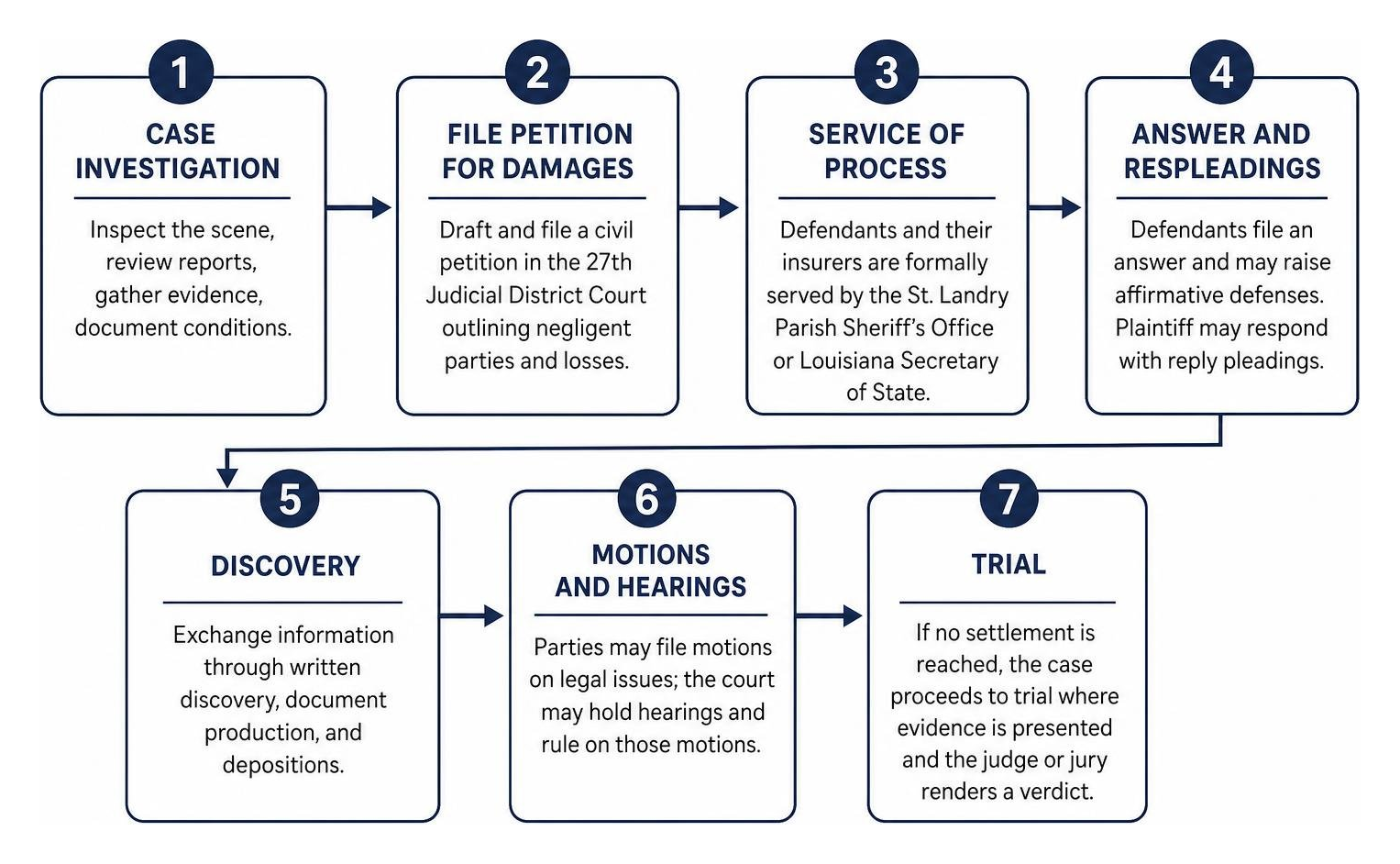
When you partner with our legal team at Doran & Cawthorne, we guide your claim through each critical phase of litigation:
- Comprehensive Case Investigation: We inspect the crash site, review initial police reports, secure dashcam or surveillance footage, and document roadway conditions.
- Filing the Petition for Damages: We draft and file a formal civil petition outlining all negligent parties and your resulting losses, officially filing an accident injury claim within the parish court.
- Service of Process: The defendants and their respective insurers are formally served through the St. Landry Parish Sheriff’s Office or the Louisiana Secretary of State.
- Written Discovery & Depositions: Both sides exchange formal interrogatories, requests for production of documents, and sworn witness depositions to uncover key facts.
- Independent Medical Assessments: We document the full extent of your physical trauma, connecting your medical records and future rehabilitation needs directly to the collision.
- Mediation & Settlement Negotiations: We present comprehensive settlement packages to insurance adjusters to demand policy-limit recoveries.
- Trial in the 27th Judicial District Court: If insurers refuse to offer fair compensation, we present your case before an Opelousas judge or jury.
Evidence Collection and Establishing Causation
Building an airtight case requires moving quickly to gather perishable evidence. Physical skid marks fade, parish road crews trim back hazardous weeds after a wreck occurs, and electronic vehicle data can be erased if not preserved.
Knowing how to handle an intersection crash in Opelousas involves pairing objective crash scene photographs with official law enforcement documentation and treating physician records. Medical documentation must tie your physical injuries directly to the force of the collision. Insurers frequently scrutinize gaps in care or argue that musculoskeletal damage stemmed from pre-existing conditions, making early and consistent medical evaluations vital to your claim.
Navigating Insurance Limits and Uninsured Motorist Coverage
Louisiana law only mandates a minimum automobile bodily injury liability limit of $15,000 per person and $30,000 per accident. In severe collisions involving emergency room visits, surgery, or lengthy hospital stays, these basic liability limits are exhausted almost immediately.
When a negligent driver’s primary insurance coverage falls short, we look to uninsured/underinsured motorist (UM/UIM) coverage policies. A clear example of how insurance layers operate is seen in Gerami v. Dupuis, where a defendant admitted 100% liability for an illegal turn. The at-fault driver’s primary insurer exhausted its $50,000 policy limit, allowing the injured party to seek recovery under a commercial $1,000,000 UM policy.
| Coverage Type | Primary Purpose | How It Pays |
|---|---|---|
| Primary Bodily Injury Liability | Pays for damages caused by the at-fault driver to third parties. | Pays first up to the defendant’s policy limits (e.g., $15,000 minimum). |
| Uninsured/Underinsured Motorist (UM/UIM) | Protects you when the at-fault driver has no insurance or insufficient limits. | Activates after primary liability limits are fully exhausted. |
| Commercial Umbrella / Fleet Policies | Provides extended liability protection for corporate or rideshare vehicles. | Covers catastrophic losses beyond standard primary auto insurance. |
Proving Damages and Overcoming Comparative Fault Defenses
Under Louisiana Civil Code Article 2323, civil injury cases are governed by a pure comparative fault system. This means that if you are found partially responsible for an accident, your financial recovery is reduced by your allocated percentage of fault. For example, if your total damages equal $100,000 but a jury finds you were 20% at fault for driving slightly over the speed limit, you will recover $80,000.
Insurance adjusters regularly exploit comparative negligence rules to devalue valid claims, attempting to assign blame to innocent motorists. Understanding how adjusters calculate settlement figures is a crucial part of evaluating car crash settlement value and protecting your final recovery.
How Intersection Defects Impact a St. Landry Car Accident Lawsuit
Obstructed sightlines and absent traffic control devices significantly impact how fault is apportioned under Louisiana law. A critical benchmark in St. Landry Parish jurisprudence is Thibodeaux v. St. Landry Parish Police Jury. In that case, a 15-year-old motorist approached an uncontrolled rural T-intersection where six- to seven-foot-tall weeds completely blocked the view of oncoming traffic. The intersection lacked a stop sign, and the driver was unfamiliar with the route.
When a collision occurred with another driver traveling left-of-center at approximately 58 mph, the defense argued the young motorist was contributorily negligent for failing to stop. The Louisiana Court of Appeal affirmed that the decedent was completely free of fault. Because the intersection was obscured by overgrown vegetation and lacked proper warning signs, an unfamiliar driver could not reasonably recognize the hazard. The parish police jury was held liable for failing in its fundamental duty to maintain safe, visible roadways.
Recovering Damages for Wrongful Death and Severe Injuries
When a collision results in a tragic loss of life, surviving family members can pursue a wrongful death action under Louisiana Civil Code Article 2315.2. These claims allow surviving spouses, children, or parents to seek compensation for:
- Loss of love, affection, companionship, and guidance
- Emotional distress and grief
- Loss of financial support and household services
- Funeral and burial expenses
- Survival damages for the conscious pain and suffering experienced by the decedent prior to death
In the Thibodeaux ruling, the appellate court affirmed wrongful death general damage awards of $115,000 to the father and $125,000 to the mother for the loss of their son’s companionship. When catastrophic crashes occur, working with a compassionate Opelousas wrongful death attorney ensures that your family’s rights are protected and that all liable parties—from reckless motorists to negligent public bodies—are held fully accountable.
Frequently Asked Questions About St. Landry Parish Auto Injury Claims
What is the deadline to file an auto accident claim in Louisiana?
In Louisiana, the prescriptive period (statute of limitations) to file a personal injury or wrongful death lawsuit is generally two years from the date the accident occurred. Failing to file your petition in the appropriate court before this deadline permanently bars your right to recover damages.
Can I sue the local parish or city for an obstructed intersection?
Yes. You can hold a municipal entity or parish police jury liable if you can prove that a roadway condition (such as missing stop signs or overgrown vegetation) created an unreasonable risk of harm, the government body had notice of the issue, and it failed to correct the hazard within a reasonable time.
What if the at-fault driver’s insurance does not cover all my medical bills?
If your damages exceed the at-fault driver’s liability coverage limits, you can file a claim against your own policy’s Uninsured/Underinsured Motorist (UM/UIM) coverage. You may also investigate whether other negligent parties, such as vehicle manufacturers or public road authorities, share legal responsibility for the crash.
Demand Full Justice for Your St. Landry Parish Accident
Recovering from a severe automobile collision is physically and emotionally draining. You should not have to face powerful insurance companies or complex government entities on your own. At Doran & Cawthorne, our dedicated car accident attorneys are committed to standing up for injured victims throughout Opelousas and St. Landry Parish. We understand the local court systems, we know how to investigate complicated intersection collisions, and we work tirelessly to secure the maximum compensation you need to rebuild your life.
Contact our Opelousas office today to schedule your free case consultation and take the first step toward securing the justice you deserve.
Share this Blog

When You Need Real Talk & Results™
Louisiana Personal Injury Attorneys Committed to Advocating on Your Behalf

