 Skip to content
What Determines an Opelousas Car Crash Settlement?
An Opelousas car crash settlement should cover losses caused by another driver’s negligence, including medical bills, lost income, vehicle damage, and pain and suffering. Its value depends on clear proof of fault, prompt and consistent medical records, the seriousness and duration of injuries, available insurance coverage, and any share of fault assigned to you.
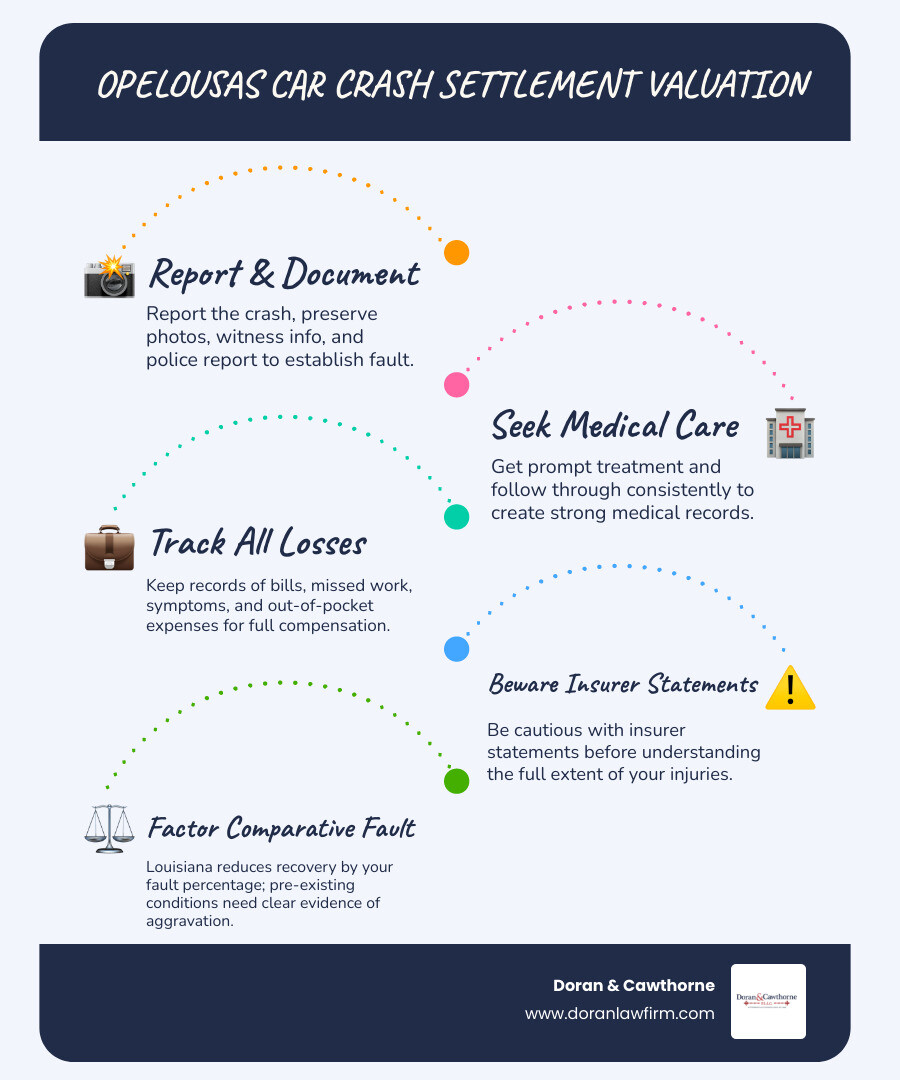
To protect a claim, take these early steps:
- Report the crash and preserve photos, witness information, and the police report.
- Get medical care promptly and follow through with recommended treatment.
- Keep records of bills, missed work, symptoms, and out-of-pocket costs.
- Be careful with insurer statements before you understand the full extent of your injuries.
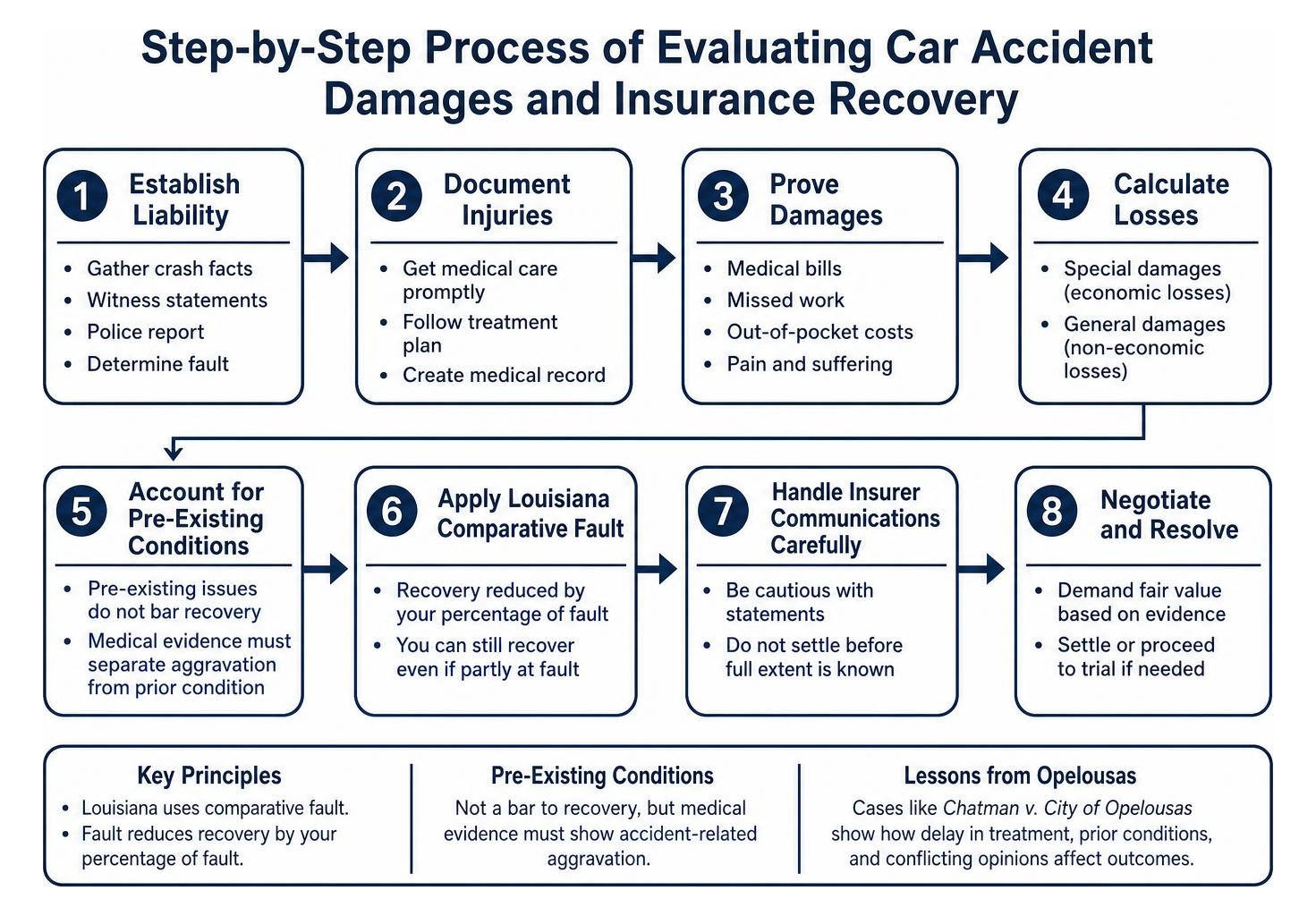
Louisiana uses comparative fault. That means a recovery can be reduced by the percentage of fault assigned to the injured person. Pre-existing back, neck, or other health problems do not automatically bar compensation, but medical evidence must distinguish an accident-related aggravation from the condition that existed before the collision.
The Opelousas case Chatman v. City of Opelousas shows why these details matter. In that low-speed intersection crash, disputed witness accounts, a two-week delay before treatment, prior spinal problems, and conflicting medical opinions all affected fault and damages.
I am Pride Doran, a trial lawyer with more than 20 years of experience handling automobile and other injury claims in Louisiana. My work on Opelousas car crash settlement matters includes evaluating the evidence that insurers and courts use to measure fair compensation.
Common Opelousas car crash settlement vocab:
- Opelousas car accident compensation
- Opelousas auto accident attorney
- Opelousas accident injury claim
Key Factors That Determine an Opelousas Car Crash Settlement

Securing full financial recovery after a motor vehicle collision requires looking at the facts through the lens of Louisiana personal injury law. Insurance carriers do not simply write checks based on the damage to a bumper; they calculate risk based on concrete evidence. In St. Landry Parish, settlement valuations come down to proving liability, establishing measurable economic losses, and demonstrating how physical trauma has altered your daily life.
Compensation in Louisiana car crash claims is divided into two primary categories:
- Special Damages (Economic Losses): These are quantifiable, out-of-pocket financial expenses caused by the crash. They include emergency room fees, hospital bills, physical therapy, diagnostic MRIs, prescription medications, past lost wages, and loss of future earning capacity if you cannot return to your prior occupation.
- General Damages (Non-Economic Losses): These compensate for intangible harms. General damages encompass physical pain and suffering, mental anguish, loss of enjoyment of life, physical impairment, and disfigurement.
Because general damages do not come with an itemized invoice, insurance adjusters frequently attempt to minimize them. To counter lowball offers, we work with medical providers to ensure your diagnostic charts, physical limitations, and subjective pain levels are thoroughly documented. For a deeper breakdown of how local legal standards guide these claims, check our comprehensive Opelousas auto collision attorneys guide.
Evaluating Pre-Existing Injuries in an Opelousas Car Crash Settlement
One of the most frequent disputes in Opelousas collision claims involves pre-existing medical conditions, particularly degenerative disc disease, prior neck trauma, or lumbar fusions. Insurance companies routinely argue that if you experienced back pain prior to a collision, the crash itself caused no new harm.
Under Louisiana law, a negligent defendant takes the victim as they find them—commonly known as the eggshell skull doctrine. You are entitled to recover full compensation for any trauma-induced worsening or activation of a dormant condition. However, the burden of proof rests on the injured claimant.
To overcome insurer pushback regarding prior back or neck injuries, we focus on establishing a clear medical timeline:
- Pre-Crash Baseline: Securing older medical records from local clinics or regional Veterans Affairs (VA) hospitals to show your functional capacity before the impact.
- Acute Diagnostic Changes: Utilizing modern imaging (such as post-collision MRIs or CAT scans) to identify new structural damage, disc herniations, or acute nerve root impingement versus baseline degenerative wear.
- Treating Physician Causation Reports: Obtaining detailed medical opinions explaining how the mechanical forces of the collision converted an asymptomatic or manageable condition into an active, debilitating injury.
How Louisiana Comparative Fault Reduces an Opelousas Car Crash Settlement
Louisiana operates under a pure comparative fault system, codified in Louisiana Civil Code Article 2323. Under this statute, any degree of fault attributed to the injured claimant proportionally reduces their final financial recovery.
For instance, if a court determines that your total damages equal $100,000, but finds that you were 20% at fault for failing to maintain a proper lookout at an intersection, your recovery is reduced by 20%, leaving you with $80,000.
In many Opelousas intersection collisions—such as those occurring along major local routes or neighborhood crossings—adjusters actively look for ways to assign partial blame to the non-fault driver. They may argue you were speeding, distracted, or failed to take evasive action. Preserving physical crash site evidence and witness statements immediately after a collision is essential to preventing unfair fault apportionment. When you need immediate advocacy to protect your claim against aggressive adjusters, getting trusted Opelousas car wreck lawyer help makes a significant difference.
Case Study Analysis: Chatman v. City of Opelousas and Comparative Fault
To understand how Louisiana trial judges and appellate courts resolve disputes over fault, pre-existing back conditions, and medical testimony, we can examine a notable local case: Chatman v. City of Opelousas (95-0950 La.App. 3 Cir. 12/6/95, Chatman v. City of Opelousas, 670 So.2d 211 (La. App. 1995)) – vLex United States.
This case illustrates the critical interplay between crash-scene testimony, medical delays, and defense independent medical examinations (IMEs).
| Dispute Category | Plaintiff / Treating Physician Position | Defense / IME Position | Trial & Appellate Court Finding |
|---|---|---|---|
| Fault Allocation | Plaintiff had right-of-way; city truck ran/encroached past stop sign. | Plaintiff failed to keep proper lookout while traveling 10–15 mph. | Plaintiff assigned 20% comparative fault; city assigned 80% fault. |
| Injury Severity | Crash aggravated pre-existing spinal fusion, requiring new surgery. | Collision caused only minor, temporary soft-tissue strain; surgery unrelated. | Accepted IME view: crash caused only temporary aggravation, not major structural damage. |
| General Damages | Claimed major long-term disability and significant general damages. | Argued minimal impact force could not cause lasting spine injury. | Awarded $2,500 in general damages, reduced by 20% comparative fault. |
Collision Facts and Witness Credibility at South Washington Street
The incident occurred at the intersection of South Washington Street and West Jefferson Street in Opelousas. Arthur Chatman was driving a 1970 Buick Electra northbound on South Washington Street at approximately 10 to 15 mph. At the same time, an employee of the City of Opelousas was operating a municipal GMC truck on West Jefferson Street, approaching the intersection controlled by a stop sign.
The city truck entered the intersection at approximately 4 mph, colliding with the side of Chatman’s vehicle roughly seven feet from the corner. While the city vehicle clearly failed to yield the right-of-way, the court closely evaluated the testimony of all individuals present:
- The Plaintiff: Chatman testified he did not see the city truck until the moment of impact.
- The Passenger: Chatman’s passenger testified that she saw the city truck approaching before it entered the intersection.
- The Investigating Police Officer: Documented the physical point of impact and noted vehicle speeds and positions.
Because the passenger saw the vehicle approaching and Chatman did not, the trial judge concluded that Chatman failed to maintain a proper lookout while proceeding through the intersection. As a result, the court allocated 80% of the fault to the City of Opelousas and 20% comparative fault to Chatman. Working with a dedicated Opelousas auto accident attorney helps drivers present consistent evidence to minimize these comparative negligence reductions.
Medical Evidence, IME Disputes, and Pre-Existing Condition Aggravation
The medical dispute in Chatman centered around whether the low-speed impact aggravated the plaintiff’s severe, pre-existing lumbar spine issues.
Chatman had undergone a spinal fusion back in 1977 and had a history of chronic lower back complaints treated through the local VA hospital. Crucially, Chatman did not seek medical treatment immediately following the collision; he waited nearly two weeks before visiting a physician.
When litigation ensued, two distinct medical perspectives emerged:
- Treating Physician (Dr. Jackson): Believed the collision aggravated the pre-existing spinal instability, accelerating disc slippage (spondylolisthesis) and justifying spinal fusion surgery.
- Defense Independent Medical Examiner (IME – Dr. Blanda): Testified that a low-speed impact traveling at just a few miles per hour could not generate the mechanical force necessary to cause disc slippage in a solid, pre-existing fusion. The IME concluded that the accident caused only a temporary muscular strain that resolved within several months, and that the subsequent surgery was purely the result of long-term degenerative disease.
The trial court chose to accept the IME’s testimony over the treating physician’s conclusions, largely because of the two-week delay in initial treatment and the lack of objective proof showing acute structural failure immediately following the crash.
Appellate Review Under Manifest Error and Abuse of Discretion Standards
On appeal to the Louisiana Third Circuit Court of Appeal, Chatman challenged both the 20% comparative fault assignment and the $2,500 general damages award.
The appellate court affirmed the trial court’s judgment in full, emphasizing two foundational principles of Louisiana appellate review:
- The Manifest Error Standard: Louisiana appellate courts will not overturn a trial court’s factual findings—including the credibility of witnesses and the allocation of comparative fault—unless the record demonstrates that the trial judge was “manifestly erroneous” or “clearly wrong.” Because evidence supported the finding that Chatman could have observed the truck, the 20% fault ruling stood.
- Abuse of Discretion in Damage Awards: The assessment of general damages is afforded vast discretion by the trial court. The appellate court found no abuse of discretion in awarding $2,500, as the trial judge was within legal bounds to conclude the collision caused only a temporary soft-tissue sprain rather than a permanent surgical injury.
This decision serves as an enduring reminder: delaying medical care and failing to clearly separate acute collision trauma from pre-existing degenerative conditions can drastically diminish the final value of an injury claim.
Insurance Policy Limits and Maximizing Recovery in St. Landry Parish
A critical factor that dictates settlement recovery is the structure and limits of the available insurance policies. Even if a plaintiff proves catastrophic injuries, recovery from an individual driver may be constrained by Louisiana’s minimum liability insurance requirements ($15,000 per person / $30,000 per accident for bodily injury).
When injuries exceed basic auto policy limits, experienced trial lawyers search for additional layers of coverage, such as:
- Commercial Auto Liability Policies: When an at-fault driver is operating a company car, delivery vehicle, or municipal truck.
- Umbrella and Excess Liability Policies: Secondary policies designed to cover catastrophic losses once primary limits are exhausted.
- Uninsured/Underinsured Motorist (UM/UIM) Coverage: Policies maintained by the injured driver or host vehicle that provide excess recovery when the at-fault driver has insufficient insurance.
For collisions involving large commercial carriers or heavy trucks, legal representation from focused Opelousas truck collision attorneys is vital to uncover multi-million dollar corporate coverage towers.
Primary Policy Exhaustion and Commercial UM Coverage Layers
The interplay between primary liability exhaustion and commercial underinsured motorist (UM) coverage is well illustrated in the Louisiana federal court case Gerami v. Dupuis (trial court document), District Court, W.D. Louisiana, 2020.
In Gerami, passengers in a commercial rideshare vehicle sustained severe injuries when a third-party driver executed an illegal turn. The at-fault driver’s primary liability insurer quickly tendered its full policy limit of $50,000, exhausting primary coverage.
The injured passengers then pursued excess recovery under the rideshare company’s commercial UM policy, which carried a $1,000,000 combined single aggregate limit. The court confirmed that once primary policy limits are properly exhausted and contractual definitions of an “insured” (such as occupying the vehicle) are satisfied, the commercial UM policy is fully triggered to compensate the injured claimants.
Securing Partial Summary Judgment on Liability
One powerful procedural strategy to maximize car accident settlements is filing a Motion for Partial Summary Judgment on the issue of liability under Federal Rule of Civil Procedure 56 (or Louisiana Code of Civil Procedure Article 966).
When deposition testimony or indisputable crash reports establish that the defendant was 100% at fault—such as when a driver admits to making an illegal turn or running a red light—securing a formal court judgment on liability accomplishes two critical goals:
- Eliminates Comparative Negligence Arguments: It legally blocks the defense from attempting to shift blame to the plaintiff at trial.
- Forces Insurers to Focus on Full Damages: With liability established as a matter of law, settlement negotiations shift entirely to the fair valuation of medical costs, lost income, and pain and suffering.
Frequently Asked Questions About Car Accident Claims in Opelousas
How does waiting to see a doctor affect my settlement?
Delaying medical evaluation after a car crash is one of the most common reasons insurance companies reduce or deny settlement payouts. When you wait days or weeks to see a doctor, insurance adjusters argue that your injuries were either caused by an unrelated intervening event or were not serious enough to warrant compensation. Immediate medical documentation creates an indisputable link between the collision and your physical symptoms.
Can I receive compensation if I had prior spinal surgeries before the crash?
Yes. Under Louisiana’s eggshell skull doctrine, a negligent party is legally responsible for worsening or aggravating a pre-existing medical condition. To secure compensation, you must present objective medical imaging (such as MRIs) and physician testimony that clearly distinguishes your pre-accident health baseline from the new pain, structural instability, or limitations caused by the crash.
What is the deadline to file a car accident lawsuit in Louisiana?
In Louisiana, the deadline to file a personal injury lawsuit for a motor vehicle collision is governed by the state’s prescriptive period under Louisiana Civil Code Article 3492. Generally, you have a limited statutory timeframe from the exact date of the accident to file a formal petition for damages in court. Missing this strict legal filing deadline permanently forfeits your right to recover financial compensation.
Protecting Your Right to Fair Compensation After an Opelousas Collision
Navigating the financial and legal aftermath of a car crash requires an understanding of comparative fault, medical causation, and complex insurance policies. Whether your claim involves soft-tissue injuries, the aggravation of a long-standing back condition, or multi-layered commercial insurance policies, building a claim on solid, objective evidence is essential.
At Doran & Cawthorne, we stand up to powerful insurance companies to ensure injured individuals receive the full compensation they deserve for medical expenses, lost wages, and physical pain. We represent clients throughout Louisiana from our offices in Opelousas, Lafayette, and Baton Rouge.
If you or a loved one has been injured in a collision, contact our experienced car accident attorneys today to discuss your case and begin building your legal strategy.
Share this Blog

When You Need Real Talk & Results™
Louisiana Personal Injury Attorneys Committed to Advocating on Your Behalf


