 Skip to content
How long Does Insurance Have to Pay a Claim in Louisiana?
By Pride Doran, Managing Attorney at Doran & Cawthorne
If an insurer is delaying your claim, contact Doran & Cawthorne for a free evaluation. Under La. R.S. § 22:1892(A)(1), insurers generally must pay the full amount of a claim within 30 days after receiving satisfactory written proof of loss. If an insurer arbitrarily fails to pay within this statutory window, it faces penalties and attorney fees under Louisiana law.
What Are the Mandatory Timelines for Claim Adjustments and Settlements in Louisiana?
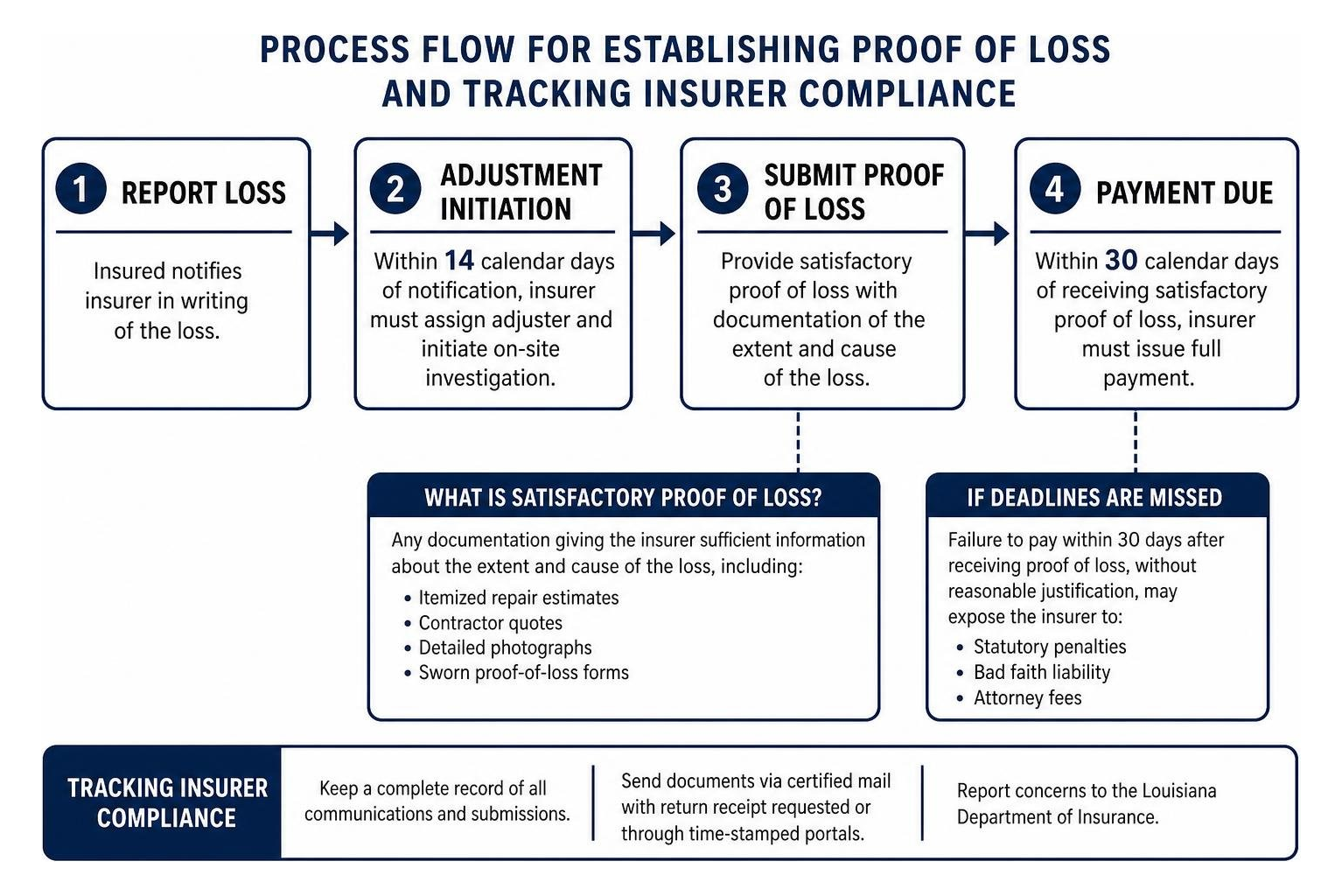
Under Louisiana law, insurers must begin adjusting a property damage claim within 14 calendar days of receiving notification of loss. Once the insurer receives satisfactory proof of loss, it has 30 calendar days to issue full payment. Missing these statutory deadlines without reasonable justification exposes the carrier to bad faith penalties.
Insurers cannot sit on property damage files in Opelousas or across St. Landry Parish. The carrier must assign an adjuster and initiate loss adjustment within 14 days of your notice. If you request a copy of the field adjuster’s report in writing, state law requires the carrier to send it within 15 days.
For third-party property damage claims, such as collision damage on Interstate 49, insurers must make a written settlement offer within 30 days of receiving satisfactory proof of loss. When a crash causes a first-party total vehicle loss and your policy includes rental coverage, the insurer must provide a rental vehicle within three business days of written request. Failing to provide that rental vehicle arbitrarily exposes the carrier to statutory penalties under La. R.S. § 22:1892(B)(4).
Establishing satisfactory proof of loss does not require a formal judicial filing. Louisiana courts hold that any documentation giving the carrier sufficient information about the extent and cause of the loss qualifies. This includes itemized repair estimates, contractor quotes, detailed photographs, and sworn proof-of-loss forms.
Attorney Insight: In our Opelousas practice, we regularly see carriers issue repeated, redundant documentation requests solely to reset their statutory payment clock. We advise policyholders to submit all proof of loss via certified mail with return receipt requested or through time-stamped online carrier portals. Policyholders can also review regulatory standards via the Louisiana Department of Insurance.
What Legal Penalties Apply When an Insurer Delays or Denies Payment in Bad Faith?
When an insurer fails to pay within 30 days after receiving proof of loss without probable cause, it faces statutory penalties. Under Louisiana law, the mandatory penalty is 50% of the amount owed or $1,000, whichever is greater, plus reasonable attorney fees and proven economic damages.
Louisiana law provides two distinct statutory remedies against insurance companies that use bad faith delay tactics:
- La. R.S. § 22:1892: Penalizes carriers that fail to pay within 30 days of satisfactory proof of loss. The mandatory penalty is 50% of the total damages due, plus all reasonable attorney fees and litigation costs.
- La. R.S. § 22:1973: Imposes a broad duty of good faith and fair dealing on insurers. If an insurer breaches this duty by failing to pay an undisputed claim within 60 days, courts can award two times the damages sustained or $5,000, whichever is greater.
Louisiana courts define arbitrary and capricious conduct as actions that are vexatious, unjustified, and not based on a reasonable interpretation of policy terms. If an adjuster ignores submitted contractor estimates or refuses to inspect damaged property in Opelousas, the delay is arbitrary.
With offices in Opelousas, Baton Rouge, and Lafayette, our team helps policyholders enforce these statutory remedies through an insurance claim denial lawyer in Baton Rouge or our local Opelousas office. Carriers frequently reconsider unreasonable delays once they realize they face mandatory 50% penalties and legal fees.
| Statutory Provision | Trigger Deadline | Mandatory Penalty | Attorney Fees Awarded? | Standard of Proof |
|---|---|---|---|---|
| La. R.S. § 22:1892 | 30 Days post-proof of loss | 50% of amount due (or $1,000 minimum) | Yes (Mandatory) | Arbitrary, capricious, or without probable cause |
| La. R.S. § 22:1973 | 60 Days post-proof of loss | Two times actual damages (or $5,000 minimum) | Discretionary / Limited | Knowing breach of good faith duty |
How Do Catastrophic Disasters and Storms Alter Statutory Payment Deadlines?
During catastrophic storms and declared emergencies, the initial loss adjustment period expands from 14 days to 30 days under Louisiana law. However, the requirement to pay claims within 30 days of receiving satisfactory proof of loss remains intact unless the Commissioner issues an official emergency extension.
When the Governor or President declares a state of emergency for hurricanes or severe weather, carriers receive operational leeway to manage high claim volumes. Under La. R.S. § 22:1892(A)(3), insurers have 30 days rather than 14 days to initiate loss adjustments for property damage.
The Louisiana Commissioner of Insurance also holds emergency authority to suspend administrative deadlines by up to an additional 30 days. However, emergency declarations do not give insurance companies permission to ignore policyholders for months.
Dispute delays remain a major challenge across south Louisiana following catastrophic weather events. A commercial property dispute reported by Insurance Business Magazine documented a 317-day carrier delay before initial storm benefits were issued. That extensive timeline illustrates how carriers test regulatory limits and why prompt legal action is critical.
In disaster situations, insurers must promptly disburse undisputed advance payments for Additional Living Expenses (ALE) and commercial business interruption. Policyholders can consult a Baton Rouge settlement negotiation lawyer through our firm’s regional offices to ensure storm damages are properly calculated and submitted without delay.
How Long Do You Have to Sue an Insurance Company Under Louisiana Prescription Rules?
Under Louisiana Civil Code Article 3499, general contract lawsuits carry a 10-year prescriptive period. However, most insurance policies include a valid two-year “Suit Against Us” limitation clause authorized by La. R.S. § 22:868(B), shortening your lawsuit filing deadline to two years from the loss date.
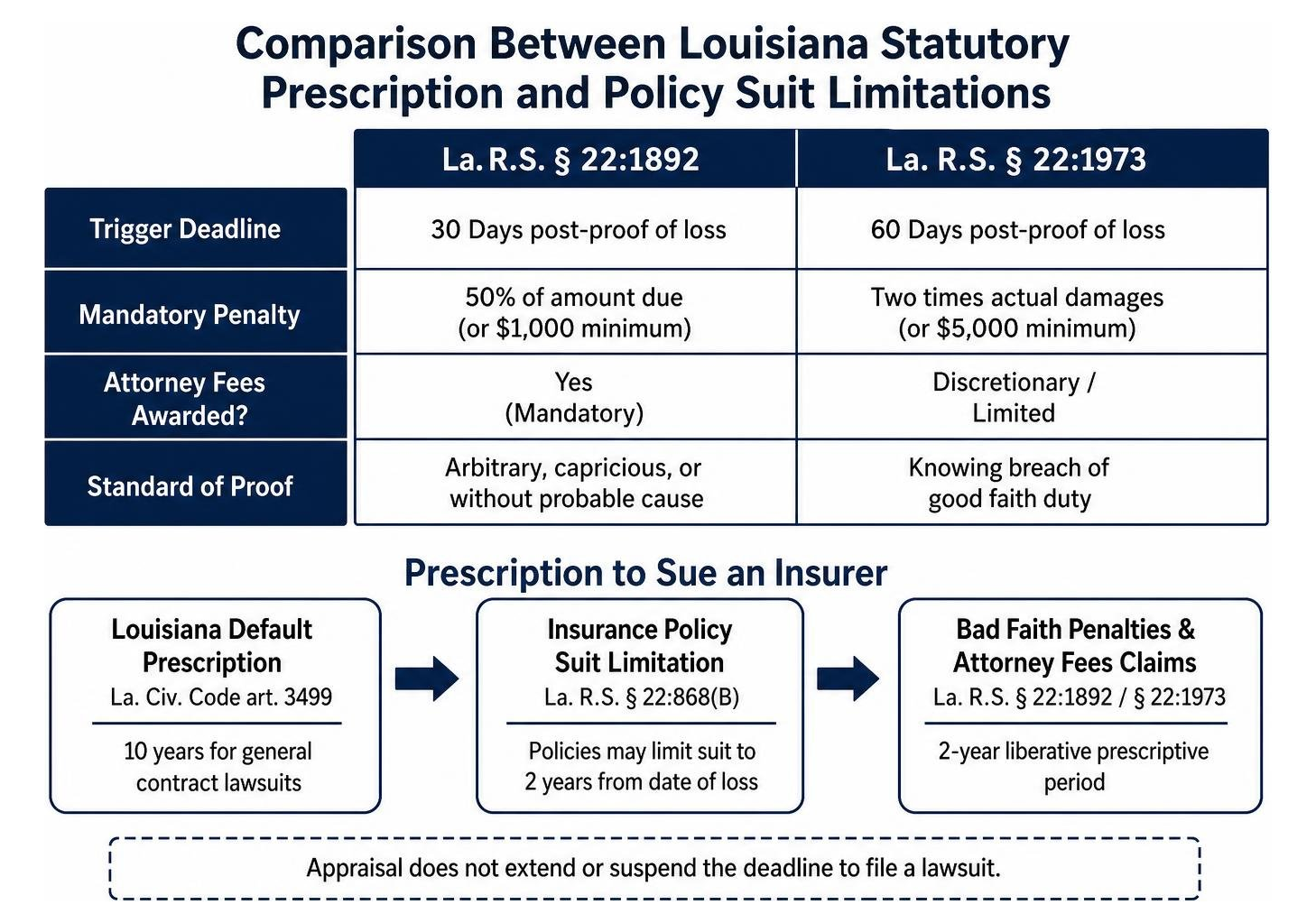
While the default Louisiana prescriptive period for personal contracts is 10 years under La. Civ. Code art. 3499, insurance policies almost always shorten this window. Louisiana law expressly allows insurers to write a two-year limitation clause into residential and commercial property policies. Any clause attempting to limit your right to sue to less than two years is void under state statute.
Claims for bad faith penalties and attorney fees under Louisiana claim-handling statutes are subject to a liberative prescriptive period of two years. This timeline differs from personal injury cases, where winning a Louisiana car accident settlement involves distinct prescriptive periods handled across our firm’s Lafayette, Baton Rouge, and Opelousas offices.
Policyholders often wonder if invoking the policy appraisal process extends the deadline to file a lawsuit. It does not. An appraisal determines only the monetary value of a disputed loss and does not suspend your two-year prescription deadline.
To protect your legal rights, review the Louisiana claim deadline complete guide (2026) and confirm your filing dates before the prescriptive window expires.
How Are Deductibles, Depreciation, and Replacement Cost Holdbacks Handled Under Louisiana Timelines?
Insurers must pay undisputed Actual Cash Value (ACV) within 30 days of receiving satisfactory proof of loss. If your policy includes Replacement Cost Value (RCV), the carrier holds back recoverable depreciation and must release those funds within 30 days of receiving completed repair invoices.
When you file a property claim in Opelousas, the insurer divides your settlement into two primary parts:
- Actual Cash Value (ACV): The value of the damaged property minus physical depreciation, payable within 30 days of proof of loss.
- Recoverable Depreciation Holdback: The remaining funds necessary to cover the total Replacement Cost Value (RCV), released once repairs are completed.
Policy deductibles also impact your immediate settlement funds. In south Louisiana parishes, policies frequently include named-storm deductibles calculated as a percentage (typically 2% to 5% of insured value) rather than a flat dollar amount.
If contractors discover hidden structural defects during reconstruction, you must submit a supplemental claim. The 30-day payment timeline applies to all supplemental proofs of loss once submitted with proper documentation.
To trigger immediate release of your depreciation holdback, submit the following items to your carrier:
- Final signed contractor invoices showing completion of all approved repairs.
- Clear photographs documenting the finished restoration work.
- Proof of paid deductibles along with a formal written demand for the release of holdback funds.
Why Should You Hold Non-Compliant Insurers Accountable in Opelousas?
When an insurance company delays or underpays your claim, your recovery and financial stability are put at risk. Whether you are dealing with property damage in Opelousas, commercial losses in St. Landry Parish, or collision claims near Interstate 49, you do not have to accept unfair delay tactics.
At Doran & Cawthorne, we represent policyholders across Louisiana from our offices in Opelousas, Lafayette, and Baton Rouge. We handle insurance disputes and bad faith claims on a contingency fee basis, meaning you pay no upfront legal fees unless we secure compensation for you.
Our legal team evaluates your claim documentation, calculates statutory bad faith penalties, and files decisive legal actions to enforce your rights under Louisiana law.
Contact Pride Doran,
Frequently Asked Questions About Louisiana Insurance Claim Timelines
How long does an insurance company have to inspect property damage in Louisiana?
Under La. R.S. § 22:1892(A)(1), an insurer must initiate loss adjustment within 14 calendar days of receiving notification of property damage. During catastrophic events declared by the Governor or President, this adjustment initiation window extends to 30 calendar days.
What happens if an insurer misses the 30-day payment deadline in Louisiana?
If an insurer fails to pay within 30 days after receiving satisfactory written proof of loss without reasonable justification, it is subject to statutory penalties under La. R.S. § 22:1892. The penalty equals 50% of the damages owed or $1,000 (whichever is greater), plus reasonable attorney fees and court costs.
Can an insurance company delay payment while investigating suspected fraud?
An insurer can take reasonable time to investigate genuine indicators of fraud, but it must have probable cause and verifiable evidence. Raising unfounded suspicions without a factual basis to avoid paying a valid claim within 30 days constitutes bad faith under Louisiana law.
Does demanding an appraisal stop the Louisiana statute of limitations clock?
No. Demanding an insurance appraisal does not pause or toll the prescriptive period to file a lawsuit in Louisiana. Policyholders must ensure a lawsuit is filed within the two-year “Suit Against Us” limitation window even if the appraisal process remains ongoing.
Contact Pride Doran,
Share this Blog

When You Need Real Talk & Results™
Louisiana Personal Injury Attorneys Committed to Advocating on Your Behalf

