 Skip to content
Understanding Your Louisiana Car Accident Settlement Under 2026 Laws
Navigating a personal injury claim in Lafayette has shifted significantly this year. The passage and implementation of Louisiana Senate Bill 231 (SB 231) changed how courts and insurance adjusters evaluate economic losses. To understand the current landscape, drivers need to know how the state previously handled healthcare billing compared to the present environment.
For decades, Louisiana operated under the collateral source rule, allowing plaintiffs to present the full amount billed by hospitals and physicians to a jury. Under SB 231, the state adopted the “insured-paid-amount rule.” This statute limits recoverable past medical expenses to the amounts actually paid by health insurers, Medicare, Medicaid, or the patient, plus any remaining patient responsibility.
Healthcare provider write-offs—the negotiated discounts between your health insurance plan and your medical providers—are no longer recoverable as compensatory damages. When building a claim, understanding personal injury claims requires looking at net payouts rather than gross billing statements. For a deeper breakdown of this statutory shift, review this Louisiana car accident settlement SB 231 impact analysis.
Calculating Medical Expenses: Billed vs. Paid Amounts
The core of SB 231 is the divergence between billed charges and paid charges. In a typical hospital visit after a Lafayette crash, an emergency room might bill $15,000 for imaging, triage, and physician fees. However, private health insurance contracts usually stipulate that the insurer pays a deeply discounted rate—often 30% to 50% below standard charges—while writing off the remainder.
Under the former billed-amount precedent, your claim presented $15,000 in economic losses. Under SB 231, your recoverable medical expense is strictly $7,000 ($6,200 paid by insurance plus your $800 out-of-pocket obligation). The $8,000 write-off disappears from the economic damage tally. Working with an auto injury settlement negotiation professional helps ensure you account for all out-of-pocket copays, deductibles, and future treatment costs that insurers might try to overlook.
Evaluating the Retroactive Application of SB 231
A frequent point of confusion for local motorists involves the timing of their collision versus the timing of their legal action. SB 231 applies based on the lawsuit filing date, not the date the collision occurred.
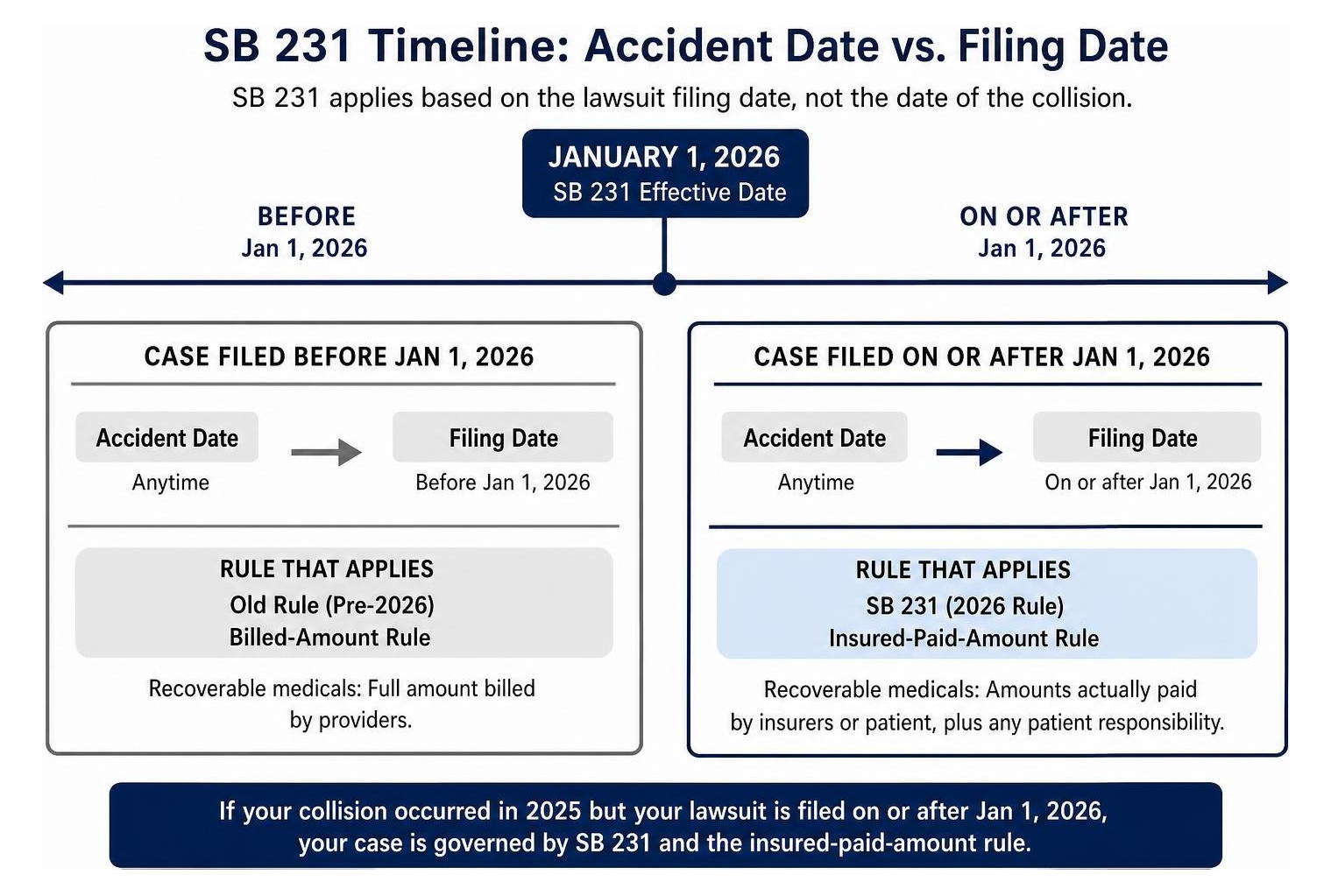
If your collision occurred in Lafayette during 2025, but your formal petition for damages was filed on or after January 1, 2026, your case is governed by the new insured-paid-amount rule. This makes managing your timeline critical. Louisiana civil claims are subject to strict filing deadlines; learn more about these prescriptive periods in our guide on the Louisiana personal injury statute of limitations.
Factors Influencing Average Settlement Payouts in Lafayette
Statewide data in 2026 shows that the average car accident settlement in Louisiana sits at roughly $30,416. This trails the national settlement average of approximately $52,900. Several factors drive this regional difference, including state minimum insurance requirements, local court tendencies, and the immediate impact of SB 231 on claim valuations.
In Lafayette, heavy commuter traffic along the Ambassador Caffery Parkway, Johnston Street, and the I-10/I-49 interchange regularly leads to collisions ranging from low-speed rear-end impacts to high-speed commercial crashes. Identifying and documenting common car accident injuries—such as cervical strains, lumbar herniations, and joint trauma—remains the baseline for establishing claim value.
How SB 231 Compresses a Louisiana Car Accident Settlement
The elimination of medical write-offs creates an estimated 20% to 40% reduction in total compensation payouts across moderate-to-severe injury claims. Insurance adjusters take advantage of lower baseline medicals to compress their initial settlement offers.
| Claim Metric | Pre-SB 231 Standard | Post-SB 231 Standard (2026) |
|---|---|---|
| Gross Hospital & Therapy Billed | $85,000 | $85,000 |
| Insurer Contracted Payments | $38,000 | $38,000 |
| Patient Out-of-Pocket Balance | $4,000 | $4,000 |
| Recognized Medical Damages | $85,000 | $42,000 |
| Pain & Suffering (Multiplier: ~2.5x) | $105,000 | $65,000 |
| Lost Wages & Documented Expenses | $37,500 | $38,000 |
| Estimated Total Gross Settlement | $227,500 | $145,000 |
| Net Variance | Baseline | -$82,500 (-36.3%) |
When evaluating personal injury case worth, understanding these discount margins is essential. Patients treated by out-of-network providers may face complex billing situations where the spread between billed rates and collections creates substantial exposure during settlement talks.
The Multiplier Method and Non-Economic Damages
Insurance companies often calculate general damages—such as pain, suffering, physical impairment, and emotional distress—using a multiplier formula. Historically, adjusters applied a number (typically between 1.5 and 5, depending on severity) to the total billed medical expenses.
Because SB 231 slashes the baseline medical number by 30% to 50%, applying the traditional multiplier produces a much smaller dollar figure for pain and suffering. To counter this automatic devaluation, claimants must build independent proof of non-economic harm.
This makes it crucial to highlight daily lifestyle limitations, chronic pain, and subtle medical issues early. Review our insights on identifying delayed car crash injuries to ensure all physical damage is properly documented on the record.
Comparative Fault and Policy Limits in Louisiana Crash Claims
Louisiana applies a modified comparative fault rule with a strict 51% bar. If you are found to be 51% or more at fault for a crash, you cannot recover any compensation from the other driver. If your responsibility is determined to be 50% or less, your total financial award is reduced by your specific percentage of fault.
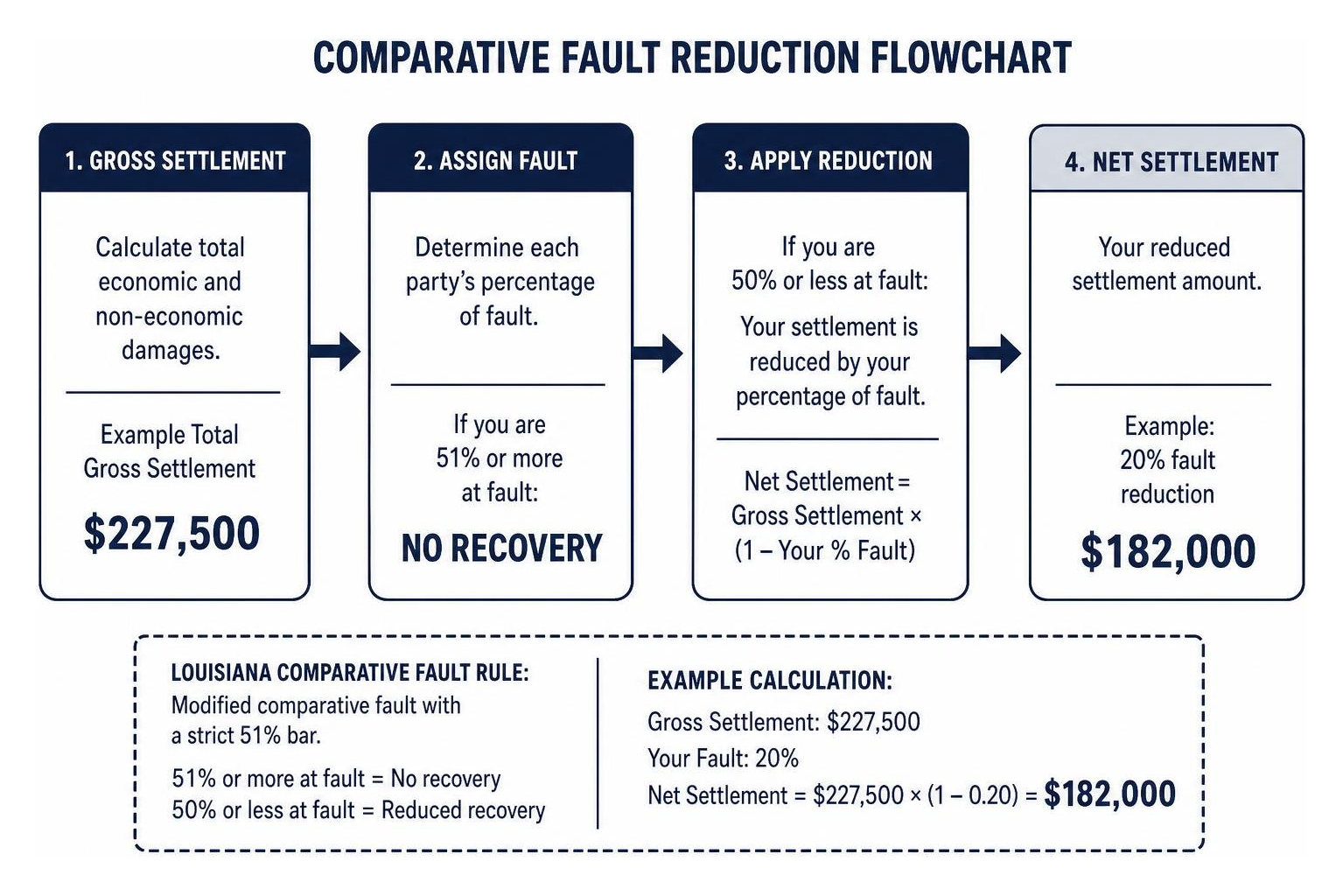
When combined with SB 231, comparative fault can drastically lower an injured party’s net recovery. For instance, if an adjuster assigns 20% comparative negligence to you for a junction crash on Evangeline Thruway, that reduction applies directly to your already compressed medical base and general damages. Understanding local negligence standards is essential; read more about how liability is assessed under Louisiana negligence laws.
Med-Pay and Exceptions to Medical Expense Reductions
Certain forms of coverage and claims are explicitly exempted from SB 231’s paid-amount limitations:
- Medical Payments (Med-Pay) Coverage: Optional first-party med-pay coverage under your own auto policy is governed by contract terms rather than tort-reduction statutes. Med-pay benefits are paid out to cover qualifying bills directly up to your selected policy limit.
- Medical Malpractice Actions: SB 231 specifically excludes medical malpractice proceedings, which remain under their own separate statutory framework in Louisiana.
- Uninsured Healthcare Expenses: For motorists without health insurance coverage, treatment rendered on a lien or self-pay basis requires careful legal structuring to prevent insurers from arbitrarily discounting billed charges without contractual cause.
Maximizing a Louisiana Car Accident Settlement with Key Evidence
Recovering fair compensation in 2026 requires meticulous preparation. You cannot simply hand an adjuster a hospital bill and expect fair value. At Doran & Cawthorne, we help clients establish robust claim files to withstand aggressive defense tactics.
Follow these steps to protect your claim:
- Dual-Record Medical Tracking: Retain both the original provider billing statements and every corresponding Explanation of Benefits (EOB) from your health plan.
- Track Direct Out-of-Pocket Payments: Keep precise logs of co-pays, prescription receipts, medical equipment purchases, and travel mileage to physical therapy.
- Document Wage Losses Early: Secure tax returns, W-2s, and employer verification letters detailing missed work, lost overtime, and used paid time off.
- Secure Objective Imaging: Obtain prompt MRIs, CT scans, and physician narratives detailing objective structural injuries rather than relying solely on subjective pain reports.
- Follow Established Crash Protocols: Review the essential steps to take after an accident to prevent mistakes in communication with insurers.
Frequently Asked Questions About Louisiana Car Accident Settlements
Does Louisiana SB 231 apply to my case if the crash happened in 2025 but I filed in 2026?
Yes. SB 231’s statutory language applies to all civil lawsuits filed on or after January 1, 2026. The date you initiate formal court proceedings determines whether the insured-paid-amount rule governs your medical expense calculations, regardless of whether the wreck occurred in 2025.
How much does the insured-paid-amount rule reduce final settlement payouts?
Mid-2026 settlement figures show average total payout reductions between 20% and 40%. Because health insurer negotiated discounts eliminate 30% to 50% of gross billed medical expenses, the baseline number used to calculate pain and suffering damages drops, lowering overall offers.
Does SB 231 limit medical payments (med-pay) coverage under my auto insurance?
No. Med-pay is a first-party contractual benefit included in your personal auto insurance policy. SB 231 regulates third-party tort recovery in civil claims; it does not cap or reduce the contractual med-pay limits you purchased to cover immediate medical expenses.
Protecting Your Recovery in the 2026 Legal Landscape
The changes introduced by Louisiana SB 231 mean Lafayette motorists must approach settlement negotiations with organized documentation and clear legal strategies. Insurance carriers are using lower recognized medical expenses to depress total claim payouts. Our team at Doran & Cawthorne represents injured drivers across our offices in Lafayette, Opelousas, and Baton Rouge, fighting to protect client rights against aggressive insurance companies.
If you have questions about calculating your losses or need help handling an insurer, contact our team for trusted Lafayette car accident legal representation to safeguard your financial recovery.
Share this Blog

When You Need Real Talk & Results™
Louisiana Personal Injury Attorneys Committed to Advocating on Your Behalf


