 Skip to content
A Truck Accident Compensation Lawyer Can Protect Your Claim
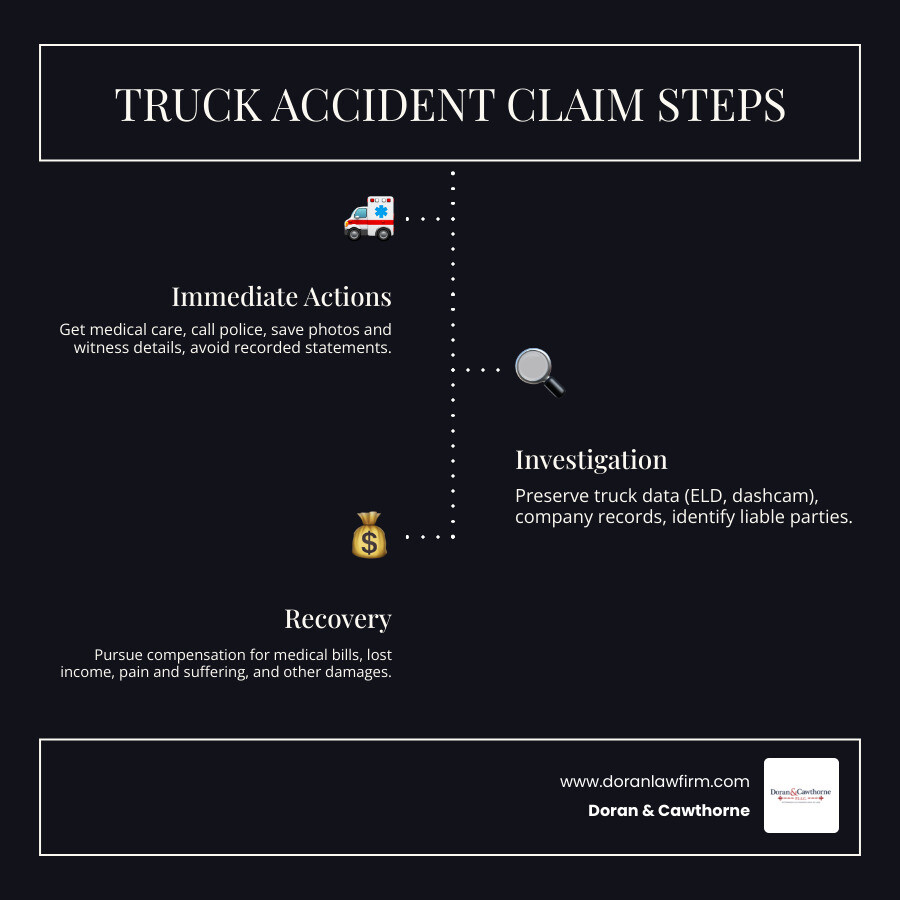
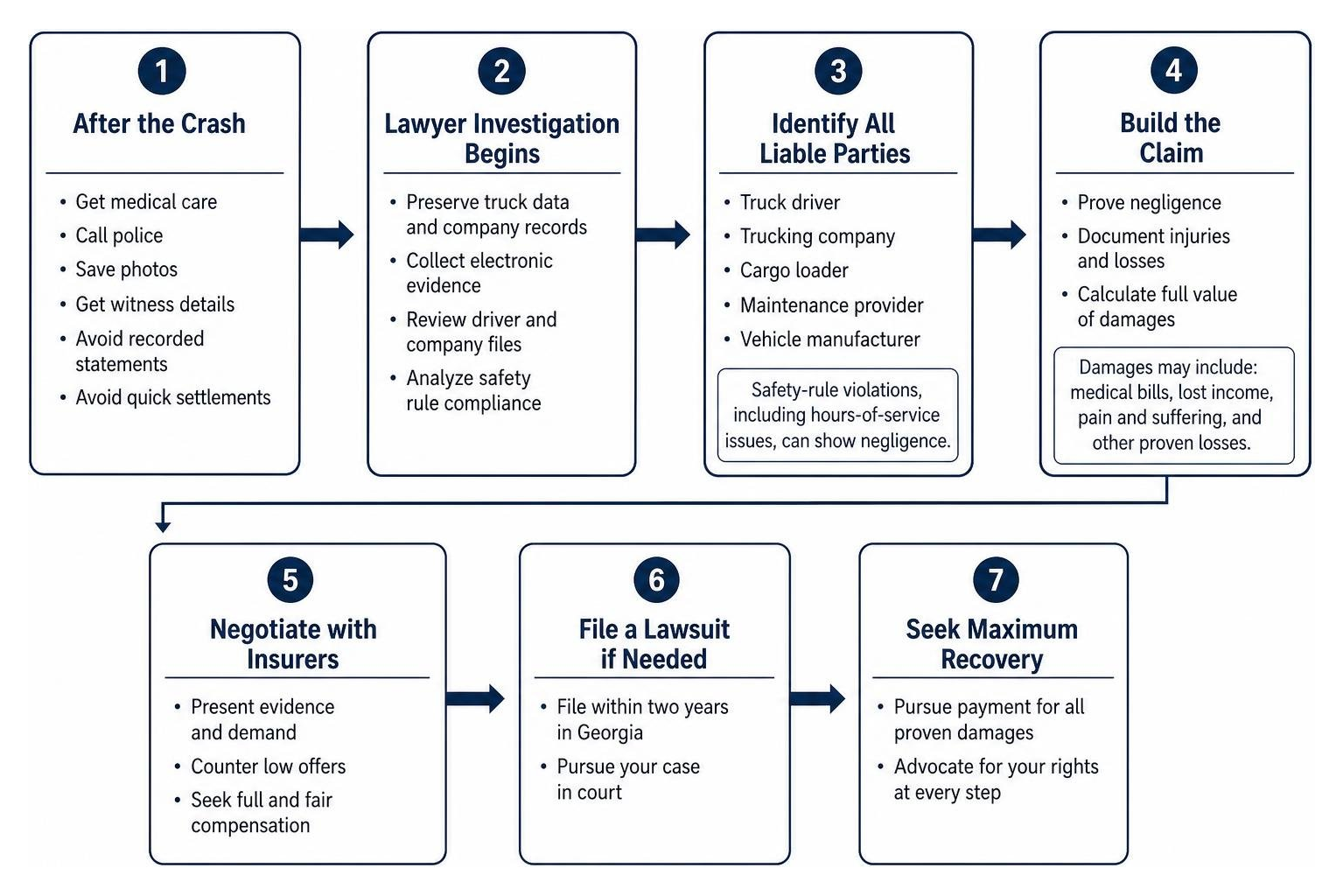
After a commercial truck crash, get medical care, call police, save photos and witness details, and avoid giving a recorded statement or accepting a quick settlement before you understand your losses. A truck accident compensation lawyer can investigate the crash, preserve truck data and company records, identify every liable party, and pursue payment for medical bills, lost income, pain and suffering, and other proven damages.
Truck claims are often more complex than car accident claims. A tractor-trailer may weigh up to 80,000 pounds, and a crash can involve the driver, trucking company, cargo loader, maintenance provider, or vehicle manufacturer. Safety-rule violations, including hours-of-service issues that lead to fatigue, can also help show negligence.
If your crash happened in Louisiana, personal injury lawsuits generally have a two-year prescriptive period for accidents occurring on or after July 1, 2024, although some claims and older accident dates may have shorter deadlines. Acting quickly matters because key evidence, such as electronic logging data, dashcam footage, and maintenance records, may not be available for long.
I am Pride Doran, a trial lawyer with more than 20 years of experience handling automobile and trucking injury claims, negotiations, trials, and alternative dispute resolution. As a truck accident compensation lawyer, I have seen how early action and a careful investigation can help injured people pursue a fair recovery.
Why You Need an Experienced Truck Accident Compensation Lawyer

A collision involving an 80,000-pound commercial vehicle is rarely a minor event. When a fully loaded semi-truck collides with a standard passenger car weighing roughly 3,000 to 4,000 pounds, basic physics dictates the outcome. The occupants of the smaller vehicle absorb the brunt of the kinetic force, leading to severe, life-altering injuries and catastrophic property damage. Navigating the aftermath requires a deep understanding of federal regulations, commercial insurance policies, and corporate liability structures.
Understanding what are the most common causes of truck accidents in injury claims is essential when building a compelling case. Unlike standard passenger vehicle collisions, commercial truck wrecks involve multiple layers of corporate oversight, strict federal operating mandates, and aggressive insurance defense teams trained to minimize payouts from the moment a crash occurs. We work to hold negligent trucking companies and their insurers accountable, ensuring your legal rights remain protected throughout every stage of the legal process.
How a Truck Accident Compensation Lawyer Investigates Complex Liability
Proving negligence in a commercial vehicle wreck demands a thorough, systematic investigation that extends far beyond standard police reports. Every modern commercial truck is equipped with sophisticated technology that records critical data before, during, and after an impact. Uncovering this electronic evidence is often the difference between a denied claim and full financial recovery.
When we investigate a commercial collision, we examine a wide range of technical and corporate records:
- Engine Control Modules (Black Boxes): These devices record vehicle speed, braking patterns, engine RPMs, seatbelt usage, and steering inputs in the seconds leading up to a crash.
- Telematics and GPS Systems: Satellite tracking data reveals exact routes, travel speeds, and whether the driver was attempting to make up lost time by speeding.
- Driver Qualification Files: Federal law requires motor carriers to maintain detailed records regarding a driver’s background, medical certifications, drug screening history, and past moving violations.
- Maintenance and Inspection Logs: Commercial carriers must regularly service their fleets. We examine repair records to detect brake failures, worn tires, or ignored safety recalls.
- Hours-of-Service (HOS) Records: Electronic logging devices (ELDs) track driving shifts to expose instances where drivers exceeded legal limits and operated while fatigued.
Overcoming Corporate Defense and Insurance Tactics
Commercial trucking companies maintain dedicated rapid-response teams consisting of independent adjusters, accident reconstructionists, and defense attorneys who often arrive at the crash scene within hours. Their primary goal is simple: collect evidence that shields the motor carrier from liability and limits the financial recovery of injured victims.
Insurers frequently use aggressive strategies to undervalue or dismiss claims entirely. They may argue that your pre-existing conditions caused your current medical issues, mischaracterize statements you made in the hospital, or offer a fast, lowball settlement before the full extent of your long-term medical needs is known. As your legal advocates, we take over all communications with insurance adjusters, counter bad-faith settlement tactics, and build an evidentiary record that demonstrates the true value of your losses.
Types of Financial Recovery and Damages in Semi-Truck Accidents
The financial impact of a serious collision can quickly overwhelm an injured individual and their family. From mounting intensive care invoices to months of missed paychecks, understanding the high cost of truck accidents: seeking compensation for your injuries helps you pursue every dollar necessary for comprehensive healing and future security.
Economic and Non-Economic Damages Available to Victims
Compensation in personal injury claims is divided into two primary categories: economic damages, which cover direct financial losses, and non-economic damages, which address intangible, human losses.
| Damage Category | Description | Common Examples |
|---|---|---|
| Economic Damages | Verifiable, out-of-pocket financial losses resulting directly from the accident. | • Emergency room care and surgeries • Ongoing physical therapy and rehabilitation • Prescription medications and medical devices • Past and future lost wages • Loss of future earning capacity • Vehicle replacement or repair costs |
| Non-Economic Damages | Non-monetary losses related to the physical and emotional toll of the crash. | • Physical pain and suffering • Emotional distress and trauma • Post-traumatic stress disorder (PTSD) • Loss of enjoyment of life • Permanent scarring or physical disfigurement • Loss of consortium and companionship |
In cases where a commercial carrier or driver acted with gross negligence, willful misconduct, or total indifference to safety—such as driving under the influence of illicit substances or intentionally altering driver logs—punitive damages may also be pursued to punish wrongdoers and deter similar conduct across the industry.
Key Factors Determining Case Settlement Value
No two commercial vehicle collisions are identical, and settlement amounts vary significantly based on the unique facts of each claim. Significant outcomes, such as a $3,450,000 settlement for a heavy commercial collision, a $2,250,000 recovery for a fatal wreck, or a $2,750,000 result for an incident involving falling equipment, reflect the deep impact of catastrophic injuries.
Key elements that influence case valuation include:
- Severity and Permanence of Injuries: Traumatic brain injuries, spinal cord damage, compound fractures, and amputations demand ongoing medical care and substantially increase claim value.
- Commercial Insurance Limits: Federal regulations mandate that commercial trucks carry liability policies ranging from $750,000 to $5,000,000 or more, depending on the type of cargo transported.
- Shared Liability and Multi-Party Fault: Cases involving multiple defendants often allow access to multiple corporate insurance policies, expanding available compensation.
- Impact on Professional Life: Complete inability to return to work or a significant reduction in future earning potential substantially increases economic damage calculations.
How Trucking Regulations and Negligence Impact Your Claim
Commercial motor carriers operate under strict oversight from the Federal Motor Carrier Safety Administration (FMCSA) alongside state transportation agencies. Reviewing trucking accidents: causes & liability highlights how regulatory violations serve as powerful evidence of legal negligence under the doctrine of negligence per se.
Hours-of-Service Violations and Driver Fatigue
Fatigue is among the most dangerous safety hazards on modern highways. To prevent driver exhaustion, FMCSA Part 395 establishes strict Hours-of-Service (HOS) rules:
- Drivers cannot operate for more than 11 hours after 10 consecutive hours off duty.
- Drivers cannot drive beyond the 14th consecutive hour after coming on duty.
- Drivers must take a 30-minute break after 8 cumulative hours of driving.
- Drivers cannot exceed 60 hours on duty in 7 consecutive days, or 70 hours in 8 consecutive days.
Despite these rules, unreasonable delivery schedules and financial incentives from motor carriers sometimes push drivers to violate mandatory rest periods or manipulate electronic logs. When a fatigued driver causes a crash, both the driver and the employer may face direct liability for the resulting injuries.
Identifying Liable Parties Across the Supply Chain
Unlike standard passenger car wrecks where fault typically lies solely between individual motorists, commercial shipping networks involve numerous entities. Working with a Baton Rouge truck accident attorney allows victims to examine the entire commercial logistics chain and hold every responsible party accountable.

- The Commercial Driver: Directly liable for operational errors such as speeding, distraction, intoxication, aggressive lane changes, or failing to yield.
- The Motor Carrier / Trucking Company: Liable for negligent hiring, inadequate background checks, failure to train, poor vehicle maintenance, and encouraging HOS violations.
- Third-Party Maintenance Providers: Liable if poorly performed repairs, skipped brake checks, or improper tire servicing caused mechanical failure.
- Cargo Loading Companies: Liable when overloaded, unbalanced, or improperly secured freight shifts in transit, causing jackknifes or rollovers.
- Equipment and Parts Manufacturers: Liable through product liability claims if defective brakes, blown steering components, or faulty tires triggered the crash.
Critical Steps to Take Immediately Following a Commercial Truck Crash
The moments following a highway crash can feel overwhelming. Following practical steps outlined in how every Baton Rouge trucking victim can protect their rights helps safeguard your physical health and protects your legal claim from the start.
Protecting Vital Evidence and Documenting the Scene
Taking proactive steps after a collision ensures that critical evidence is preserved before physical marks fade and corporate records disappear. Reviewing guides on understanding the common types of truck accidents can also help you understand how crash mechanics influence evidence gathering:
- Seek Immediate Medical Attention: Always allow emergency personnel to examine you at the scene and follow up at an emergency room or trauma center. Some life-threatening injuries, such as internal bleeding or concussions, do not show obvious symptoms immediately.
- Call Law Enforcement: Ensure a responding officer files an official accident report documenting the scene, driver statements, and any traffic citations issued.
- Document the Scene Thoroughly: If you can do so safely, take wide-angle and close-up photos and videos of vehicle positions, skid marks, road debris, property damage, license plates, and US DOT numbers on the truck cab.
- Collect Witness Details: Secure the full names, phone numbers, and physical addresses of any eyewitnesses before they leave the area.
- Keep an Injury Journal: Track your daily pain levels, medical appointments, missed shifts, and ways your injuries disrupt your daily life.
Understanding Deadlines and the Role of a Truck Accident Compensation Lawyer
One of the most important actions an attorney takes is issuing formal spoliation letters to the motor carrier, cargo broker, and vehicle maintenance facility. A spoliation letter legally compels these entities to preserve critical evidence—such as black box records, ELD data, dashcam footage, and internal inspection files—that might otherwise be routinely deleted or overwritten within 30 to 90 days.
We handle every technical aspect of your claim: managing insurance communications, securing crash reconstructions, calculating future medical damages, and preparing your case for trial if the insurer refuses to make a fair settlement offer.
Frequently Asked Questions About Commercial Truck Accident Claims
What is the statute of limitations for filing a truck accident claim in Louisiana?
In Louisiana, the legal deadline for filing a personal injury lawsuit is called a prescriptive period. For many commercial vehicle collision injury claims arising from accidents on or after July 1, 2024, that deadline is generally two years from the date the accident occurred. Crashes before that law change and certain special circumstances may involve shorter or different deadlines, so prompt legal guidance is important.
If you fail to file a lawsuit within the applicable deadline, the court may dismiss your case, permanently barring you from recovering financial compensation. Because critical black box data and video evidence can be erased long before filing deadlines expire, contacting legal representation as soon as possible is vital.
How does a commercial truck accident differ from a standard passenger car crash?
Commercial truck collisions differ from passenger vehicle accidents in several key ways:
- Mass and Severity: Fully loaded tractor-trailers can weigh up to 80,000 pounds, causing far more catastrophic injuries and extensive property damage than two standard cars colliding.
- Extensive Regulatory Frameworks: Commercial drivers and carriers must comply with strict federal rules governing service hours, vehicle inspections, physical fitness, and cargo securement.
- Multiple Liable Entities: A single wreck may involve claims against the driver, trucking company, freight broker, cargo loader, maintenance contractor, and parts manufacturer.
- Higher Insurance Coverage: Commercial trucks carry policies with limits reaching into the millions, leading corporate insurers to defend claims far more aggressively.
What should I do if the trucking company’s insurance adjuster contacts me?
If the trucking company’s insurance adjuster contacts you, remain polite but decline to give a recorded statement or discuss the specifics of your injuries. Insurance adjusters are trained to ask questions designed to elicit responses that downplay your pain or shift fault away from the truck driver.
Do not sign medical authorization releases or accept an early settlement offer without legal review. Instead, inform the adjuster that your legal representative will handle all communications on your behalf.
Securing Your Financial Recovery After a Serious Truck Collision
Recovering from a commercial truck collision requires dedicated focus on your health, medical treatments, and family. Dealing with corporate claims adjusters, complex federal compliance records, and bad-faith insurance strategies should not be an additional burden during your recovery.
At Doran & Cawthorne, we stand up to commercial carriers and corporate insurers to demand full financial recovery for your medical expenses, lost wages, and personal pain and suffering. We proudly assist injured individuals across our offices in Opelousas, Lafayette, and Baton Rouge. If you or a loved one has suffered injuries in a commercial vehicle collision, consult a dedicated Baton Rouge truck accident lawyer today for a free case evaluation to protect your rights and pursue the justice you deserve.
Share this Blog

When You Need Real Talk & Results™
Louisiana Personal Injury Attorneys Committed to Advocating on Your Behalf


