 Skip to content
Big rig accident settlement in Opelousas: What you need to know
A big rig accident settlement in Opelousas can mean the difference between financial survival and financial ruin after a crash with an 80,000-pound 18-wheeler. Here is what you need to know right away:
Quick answers for Opelousas truck accident victims:
| Your question | Short answer |
|---|---|
| How long do I have to file? | 2 years from the date of injury (for injuries after July 1, 2024) |
| Who can I sue? | The driver, trucking company, cargo loaders, maintenance contractors, and parts makers |
| What is my case worth? | Depends on medical costs, lost wages, pain and suffering, and fault allocation |
| What should I do first? | Call 911, get medical care, photograph the scene, and contact an attorney before talking to any insurer |
| How much does a lawyer cost? | Nothing upfront — attorneys work on contingency and only get paid if you win |
St. Landry Parish is a busy freight corridor. I-49 and US-190 run through Opelousas and carry heavy commercial traffic every day. In one recent year alone, those roads saw 76 trucking accidents in St. Landry Parish, leaving 81 people injured and 3 dead.
When a crash happens, the trucking company’s insurer moves fast. They send adjusters to the scene, preserve evidence that helps them, and may call you within 24 hours with a settlement offer. That offer is almost never fair.
You deserve to know your rights before you sign anything.
I’m Pride Doran, a trial attorney and graduate of Tulane Law School with over twenty years of experience handling automobile and trucking claims across Louisiana, including big rig accident settlements in Opelousas and throughout St. Landry Parish. I’ve represented thousands of injured individuals — many through trial — and I know exactly how trucking companies and their insurers fight these claims.
Factors shaping a big rig accident settlement in Opelousas
When an 18-wheeler or commercial dump truck collides with a standard passenger car, the sheer physics are overwhelmingly one-sided. A fully loaded tractor-trailer can weigh up to 80,000 pounds, while the average car weighs around 3,000 to 4,000 pounds. This massive inequality in weight and size often leads to severe, life-altering injuries or fatalities. Evaluating a big rig accident settlement in Opelousas requires looking far beyond immediate vehicle repairs.
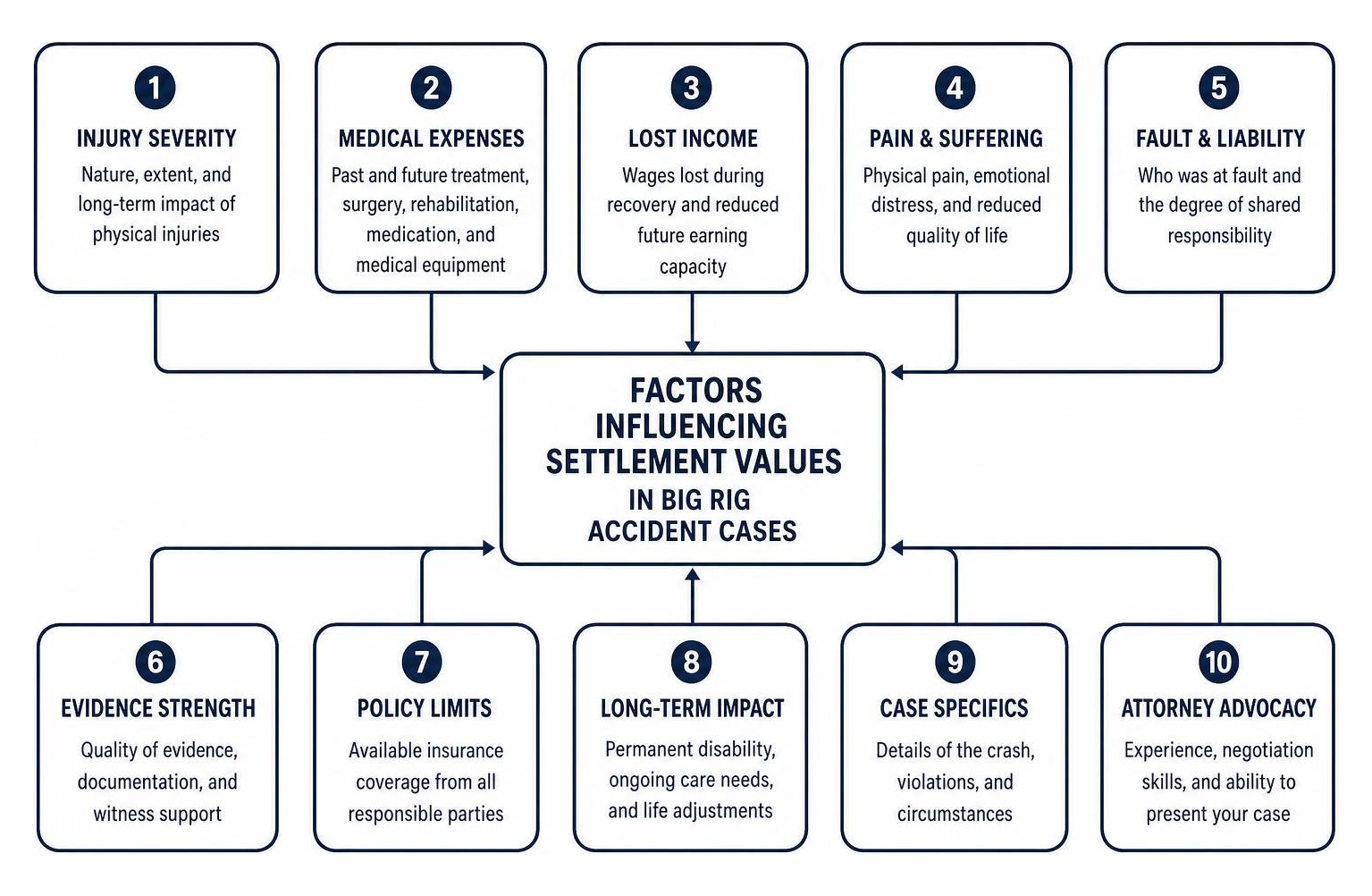
Every case hinges on distinct facts, including the severity of physical trauma, long-term care requirements, income loss, and clear proof of liability. Insurance carriers look at these claims through a cold mathematical lens, aiming to minimize payout. To counter this, we compile concrete evidence showing the full picture of how the crash destroyed your health and daily life.
Calculating valuations in a big rig accident settlement in Opelousas
Determining a fair settlement value begins by dividing your total losses into economic and non-economic damages. Economic damages cover exact, out-of-pocket financial costs caused by the wreck:
- Emergency and hospital bills: Immediate care at facilities like Opelousas General Health System, ambulance transport, surgeries, and intensive care unit stays.
- Future medical care: Long-term physical therapy, secondary surgeries, specialized medical equipment, and home care modifications.
- Lost wages and earned income: Total lost income during your physical recovery.
- Diminished earning capacity: Compensation for long-term disability or reduced physical ability to return to your previous occupation.
Non-economic damages represent the physical and emotional impact of the crash. These include physical pain, mental anguish, loss of enjoyment of life, emotional trauma, and permanent scarring or disfigurement. In fatal crashes, surviving family members can pursue wrongful death claims to recover loss of companionship, financial support, and funeral expenses.
Louisiana also uses a system called comparative fault (La. C.C. art. 2323). Under these rules, if an injured party is found partially responsible for the crash, their compensation is reduced by their percentage of fault. For example, if your total damages are calculated at $1,000,000, but a jury decides you were 10% responsible for the collision, your net settlement or award would be $900,000. Trucking insurance companies regularly attempt to manufacture partial fault against local drivers to slash payout obligations. Our work on truck accidents focuses on gathering clear evidence to block these tactics and establish full carrier responsibility.
Federal regulations impacting a big rig accident settlement in Opelousas
Commercial trucking operations are governed by federal safety laws managed by the Federal Motor Carrier Safety Administration (FMCSA). These regulations exist to prevent fatigue, mechanical failures, and dangerous road conditions. When an operator or trucking line violates FMCSA rules, that violation serves as strong proof of negligence in an Opelousas personal injury claim.
Critical federal safety mandates include:
- Hours-of-service (HOS) regulations: Drivers are strictly capped on daily driving hours to prevent driver fatigue. For example, property-carrying drivers may drive a maximum of 11 hours after 10 consecutive hours off duty.
- Electronic logging devices (ELD): Modern tractor-trailers must use electronic hardware connected directly to the engine to log driving times automatically, preventing manual logbook falsification.
- Mandatory inspection and maintenance: Carriers must keep comprehensive service, brake inspection, and tire maintenance logs for every fleet vehicle.
- Driver qualification files: Trucking companies must keep detailed records verifying driver background checks, drug test results, and clean commercial driving licenses (CDLs).
When we investigate a commercial collision along I-49 or Highway 190, we review electronic logging records and fleet files. Uncovering falsified logbooks, skipped vehicle maintenance, or known safety violations creates clear leverage that drives settlement numbers up.
Establishing multi-party liability and corporate negligence
Unlike standard auto accidents involving two private drivers, commercial vehicle collisions frequently involve multiple companies and contractors. Simply suing the truck driver rarely covers the true damages of a catastrophic crash. Finding all responsible parties is essential to opening up sufficient insurance policy limits.
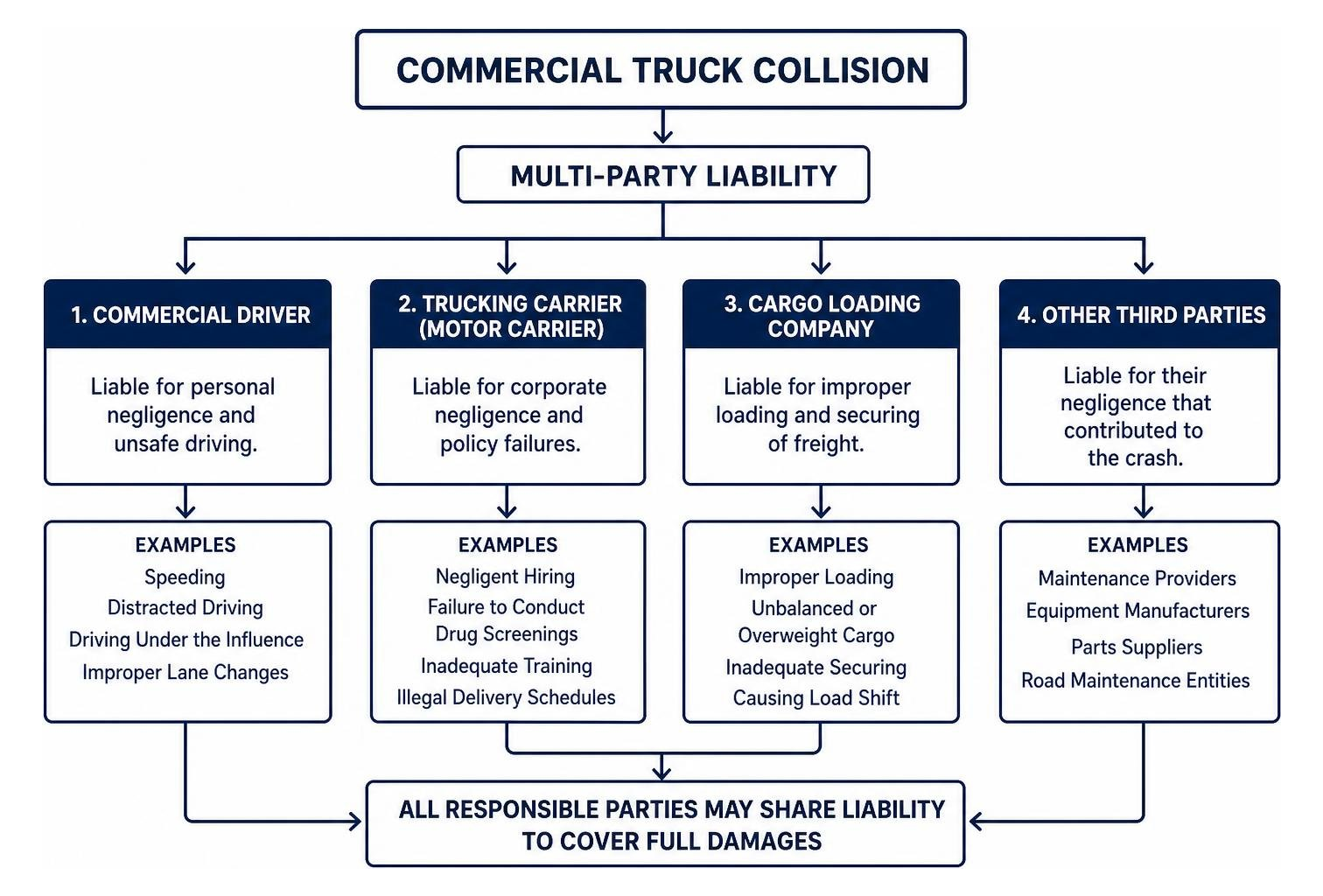
Liability in an Opelousas 18-wheeler crash can extend to several entities:
- The commercial driver: For personal actions like speeding, distracted driving, driving under the influence, or improper lane changes.
- The trucking carrier (motor carrier): Responsible for dangerous hiring practices, failure to conduct drug screenings, lack of safety training, or demanding illegal delivery schedules that force drivers to exceed hours-of-service rules.
- Cargo loading companies: Third-party warehouse vendors who improperly pack, secure, or balance freight inside a trailer, leading to shifting weight, jackknife events, or rollovers.
- Maintenance contractors: Third-party repair shops that failed to correct faulty brake assemblies, worn tires, or broken steering components.
- Parts manufacturers: Companies that produced defective tires, failed braking systems, or unsafe hitching mechanisms.
Landowner immunity and highway safety under Louisiana law
Complex trucking accidents in rural parts of St. Landry Parish often involve non-standard road factors, such as steep ditch drop-offs, agricultural mud accumulation, or modified highway shoulders. Understanding how land rights and state highway responsibilities overlap is critical when building a claim.
A clear example of these legal challenges is shown in the decision Daigre v. Int’l Truck case details. In that case, a commercial truck driver died when his rig left the shoulder of a rural road and rolled down a steep drop-off where nearby agricultural operations had altered the slope. The driver’s family pursued action against multiple parties, securing a $450,000 consent judgment settlement from the Louisiana Department of Transportation and Development (DOTD) due to dangerous road conditions, alongside confidential settlements from equipment fabricators.
However, the court also examined Louisiana Revised Statute 9:2800.4, which grants statutory immunity to owners and lessees of agricultural or forest land against claims by individuals not lawfully on the property, unless gross negligence or intentional acts are proven. This case highlights why every physical detail of a crash scene—from highway right-of-way boundaries to altered shoulders—must be documented immediately by legal professionals who understand local land laws.
Systemic carrier failures and punitive damage precedents
When a corporate motor carrier operates with total disregard for public safety, settlements and jury verdicts often reflect that systemic failure. Juries look beyond individual driver mistakes to punish motor carriers that run illegal or unchecked operations.
Consider the benchmark Texas $49M verdict analysis, where a fatal collision led to a $49 million award against OPG Logistics. Evidence introduced at trial showed that the carrier operated without safety manuals, conducted zero driver safety meetings, ignored driver duty records, and allowed the driver to exceed 15 consecutive hours on duty. The jury allocated 65% of the fault directly to the trucking company for corporate failures and 35% to the driver. The jury’s total award included $8.5 million in punitive damages specifically targeting gross corporate safety omissions.
While Louisiana law restricts punitive damages (exemplary damages) to specific statutory situations—such as collisions caused by drivers intoxicated by alcohol or illegal drugs under La. C.C. art. 2315.4—demonstrating gross corporate negligence remains vital. Proving that a carrier permitted illegal driving schedules or knowingly put defective trucks on roads like US-190 forces commercial insurance carriers to make real compensatory settlement offers to avoid major trial exposure.
Louisiana legal deadlines and immediate evidence preservation
Time works directly against crash victims. While you are focusing on medical treatment, commercial insurance companies begin building their defense within hours of a wreck. Taking fast, decisive action preserves critical electronic data before it is lost or routinely overwritten.
Crash protocol on Interstate 49 and Highway 190
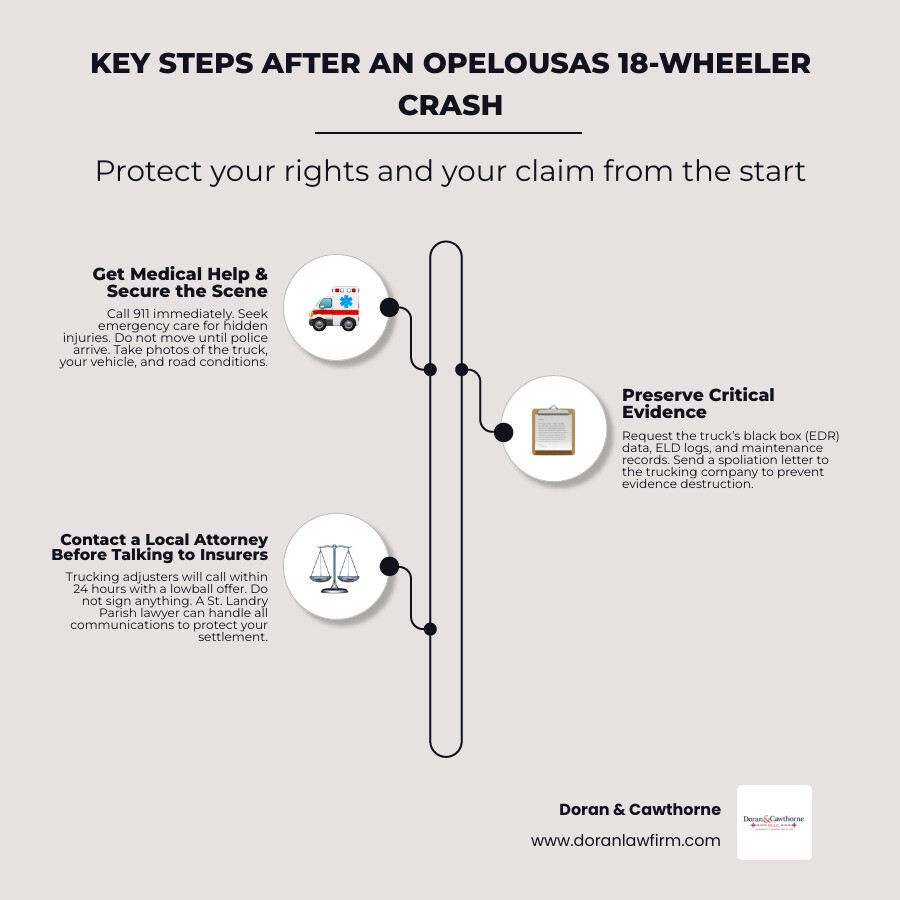
If you are involved in a collision with an 18-wheeler along I-49, US-190, or LA-182, taking these immediate steps protects both your health and your legal rights:
- Call 911 immediately: Ensure law enforcement officers from the Opelousas Police Department, St. Landry Parish Sheriff’s Office, or Louisiana State Police respond to document the official collision report.
- Seek emergency medical evaluation: Go directly to an emergency department or urgent care facility, such as Opelousas General Health System. Delaying care gives insurance adjusters an excuse to argue your injuries were caused by something else.
- Document the scene: If physically able, take detailed photos and video of vehicle damage, road skid marks, cargo spills, nearby street signs, and visible injuries.
- Identify eyewitnesses: Collect names, phone numbers, and contact details from any bystanders or passing drivers who witnessed the crash.
- Refuse recorded statements: Do not provide recorded audio statements or sign medical releases for the trucking company’s insurance adjuster without legal guidance.
- Contact legal representation: Engage an attorney quickly to issue formal evidence preservation demands.
Preserving physical evidence is crucial. Commercial motor vehicles carry event data recorders (EDRs), commonly known as truck “black boxes.” These units record speed, throttle application, brake activation, steering angles, and engine status in the seconds surrounding an impact. Additionally, satellite communication units and ELD hardware track real-time locations and duty hours. Because this electronic data can automatically overwrite itself within 30 to 90 days, we issue formal spoliation letters to motor carriers right away to legally require them to preserve all vehicle records. See our past work on an 18-wheeler interstate collision result to understand how fast evidence preservation changes case outcomes.
Enforcing Louisiana statute of limitations
In Louisiana, the deadline to file a personal injury or wrongful death lawsuit is governed by the state’s prescriptive period. Missing this deadline permanently destroys your right to seek financial recovery in court.
Critical legal notice: For personal injuries and fatal accidents occurring on or after July 1, 2024, Louisiana extended its personal injury statute of limitations (prescriptive period) from one year to two years (La. C.C. art. 3492).
If your injury occurred before July 1, 2024, the previous one-year prescriptive period still applies. Because verifying exact dates and statutory application can be complicated, speaking with an attorney as soon as possible ensures your legal rights stay fully protected.
Hiring local representation for St. Landry Parish injury claims
Commercial freight lines handle personal injury claims using teams of corporate risk adjusters and defense lawyers. Fighting back requires equal legal strength and deep local knowledge of the area where your crash took place.
Strategic advantages of local legal counsel
National car wreck law firms that advertise heavily on regional television often process cases in high volumes far from where the crash happened. Local representation provides key operational advantages when handling an St. Landry Parish crash:
- Geographic and corridor familiarity: We know the exact layout, speed drops, and high-risk zones along I-49, the intersection of US-190 and Highway 182, and local rural routes across St. Landry Parish.
- Court and judicial experience: Understanding local court procedures in the 27th Judicial District Court in Opelousas allows us to navigate motion filings efficiently.
- Local professional resources: We collaborate directly with local law enforcement, medical doctors, and crash reconstruction teams to quickly gather clear, credible evidence.
Read our breakdown on when trucks rollover in Opelousas to see how local roadway knowledge strengthens rollover and jackknife claims.
Countering insurance tactics and lowball offers
Commercial insurance adjusters are skilled at reducing payouts. Shortly after a major wreck, an adjuster might call you offering a quick cash settlement. While a $25,000 or $50,000 offer might sound helpful when medical bills arrive, signing a settlement release closes your claim forever. If you later require a $150,000 spinal surgery, you cannot ask for more money.
Insurance companies frequently use tactics such as:
- Exploiting early stress: Offering quick settlements before doctors determine the full, long-term impact of your injuries.
- Disputing medical causation: Claiming your neck, back, or joint injuries are from pre-existing conditions rather than the truck crash.
- Delaying claim reviews: Dragging out investigations to run down legal filing deadlines and pressure you into accepting less.
We combat these methods by thoroughly documenting your losses before entering settlement negotiations. We calculate total current bills, work with vocational and medical planners to estimate future medical costs, and quantify lost career growth. We handle claims on a contingency fee structure, meaning you pay no legal fees or out-of-pocket costs unless we successfully recover money for you through a settlement or trial verdict. Review our collection of truck accident results to see how comprehensive preparation forces corporate insurers to treat claims fairly.
Frequently asked questions about Opelousas truck claims
How long do I have to file a commercial truck injury lawsuit in Louisiana?
For personal injuries or fatalities occurring on or after July 1, 2024, Louisiana law gives you two years from the date of the crash to file a personal injury or wrongful death lawsuit. For injuries that occurred prior to July 1, 2024, the prescriptive period was one year. It is important to consult legal counsel early to preserve all evidence and meet all court deadlines.
Who can be held liable in a big rig accident besides the truck driver?
Beyond the individual truck driver, liability often extends to:
- The motor carrier/trucking company (for dangerous hiring, poor driver training, or forcing illegal duty schedules).
- Third-party cargo loading vendors (for improper cargo tie-downs or unbalanced trailer loads).
- Maintenance and repair contractors (for failing to fix known brake or steering defects).
- Commercial vehicle component manufacturers (for defective tires, brakes, or trailer hitches).
What evidence is most vital to protect a truck crash claim?
The most critical evidence includes the truck’s event data recorder (black box) data, electronic logging device (ELD) hours-of-service records, dashcam footage, driver qualification files, post-crash drug test results, vehicle maintenance logs, and physical scene evidence like tire skid marks and wreckage photos.
Take command of your financial and physical recovery in Opelousas
A major 18-wheeler crash can turn your life upside down in seconds. When dealing with heavy physical injuries, rising medical bills, and lost paychecks, you should not have to fight corporate insurance adjusters alone.
At Doran & Cawthorne, we put decades of trial experience to work fighting for injured individuals across St. Landry Parish. We stand up to powerful trucking companies and corporate insurers to secure maximum financial compensation while you focus on your health and family.
If you or a loved one was injured in a commercial vehicle collision, contact our office today to schedule a free, confidential case evaluation. Learn more about our comprehensive Opelousas personal injury services and get real talk, clear guidance, and dedicated legal representation for your recovery.
Share this Blog

When You Need Real Talk & Results™
Louisiana Personal Injury Attorneys Committed to Advocating on Your Behalf

