 Skip to content
What a Baton Rouge Animal Liability Claim May Involve
A Baton Rouge animal liability claim may help an injured person seek payment for medical bills, lost income, pain, and other losses after a dog, hog, cattle, or another animal causes harm. The legal rule depends largely on the animal involved and the facts of the incident.
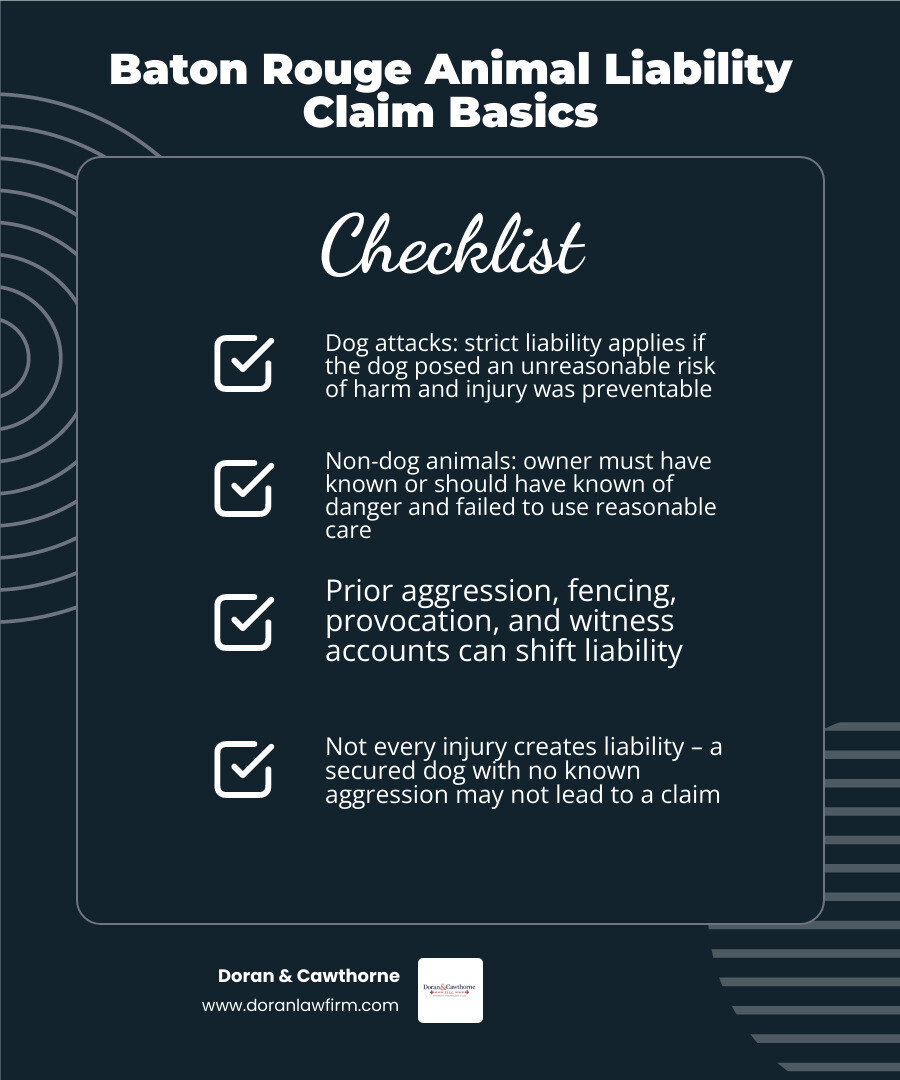
- Dog attacks: Louisiana Civil Code Article 2321 can hold a dog owner strictly liable when the dog created an unreasonable risk of harm, the injury could have been prevented, and the victim did not provoke the dog.
- Other animals: Claims involving livestock and non-dog animals usually require proof that the owner knew, or reasonably should have known, of a danger and failed to use reasonable care.
- Important facts: Prior aggressive behavior, fencing or restraints, permission to be on the property, provocation, witness accounts, and medical records can all affect a claim.
- Not every injury creates liability: A secured dog with no known aggression, or an animal reacting during a confrontation, may lead to difficult questions about preventability and unreasonable risk.
Louisiana courts do not treat animal owners as automatic insurers for every injury. In Pepper v. Triplet, the Louisiana Supreme Court explained that a dog claim requires more than proof of a bite; the court must also consider whether the dog presented an unreasonable risk of harm under the circumstances.
I am Pride Doran, a trial lawyer with more than 20 years of experience representing injured people in Louisiana personal injury matters, including cases involving negligence and serious injuries. This guide explains the legal questions that can shape a Baton Rouge animal liability claim and the evidence that may matter from the start.
Simple Baton Rouge animal liability claim word guide:
Understanding Louisiana Civil Code Article 2321: Strict Liability vs. Negligence
When an animal injures someone in Baton Rouge, legal liability turns on Louisiana Civil Code Article 2321. Following the 1996 Louisiana tort reform, the legislature modified how animal liability works. Under the updated Civil Code Article 2321, Louisiana distinguishes between injuries caused by dogs and injuries caused by all other animals, such as horses, cattle, or hogs.
For dogs, strict liability remains intact, but with important statutory limitations. For non-dog animals, strict liability was eliminated entirely. Claims involving non-dog animals require proving traditional negligence under Louisiana’s duty-risk framework.
If you are dealing with an injury, working with a dog attack injury lawyer in Baton Rouge can help clarify how these dual legal standards apply to your specific facts.
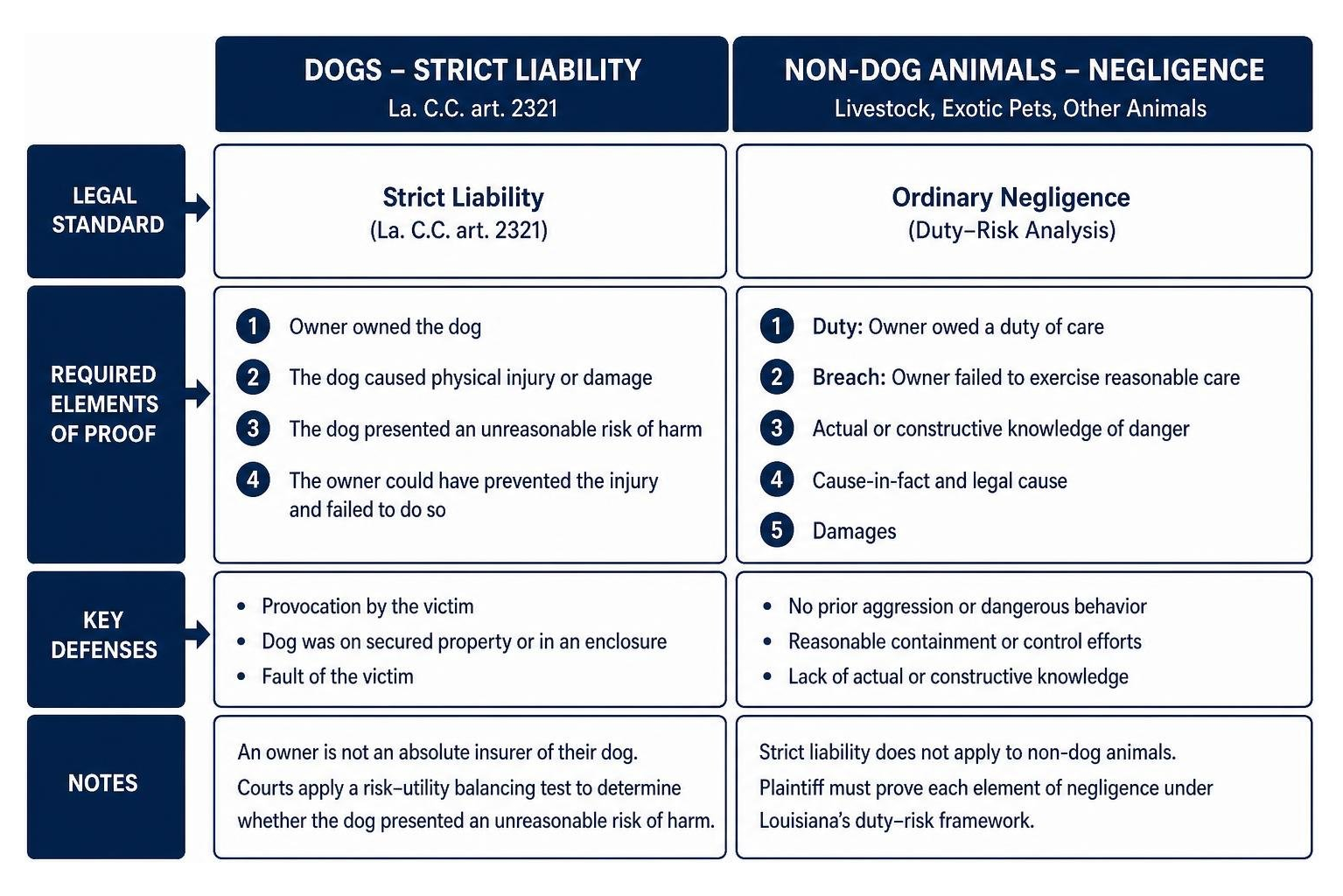
| Animal Type | Legal Standard Applied | Required Elements of Proof | Key Defenses |
|---|---|---|---|
| Dogs | Strict Liability (La. C.C. art. 2321) | Unreasonable risk of harm, preventability, causation, damages | Provocation, secured property/enclosure, victim fault |
| Non-Dog Animals (Livestock, Pets) | Ordinary Negligence | Duty, breach, actual/constructive knowledge of danger, cause-in-fact, legal cause, damages | Lack of prior aggression, reasonable containment efforts |
Strict Liability Standards for Dog Attacks
To establish strict liability against a dog owner under Article 2321, an injured victim must prove four essential elements:
- The defendant owned the dog.
- The dog caused physical injury or damage.
- The dog presented an unreasonable risk of harm.
- The owner could have prevented the injury and failed to do so.
Furthermore, strict liability will not apply if the owner proves the injury resulted from provocation by the victim.
Determining whether a dog presented an unreasonable risk of harm requires a risk-utility balancing test. Louisiana courts weigh the likelihood and severity of potential harm against the social utility of keeping domestic pets. As established by the landmark Louisiana Supreme Court ruling in Pepper v. Triplet, 864 So. 2d 181 (La. 2004), an owner is not an absolute insurer of their pet. A dog does not automatically present an unreasonable risk of harm simply because a bite occurred; context, behavior history, and containment play critical roles.
Proving Negligence in a Baton Rouge Animal Liability Claim
When non-dog animals—such as farm livestock or exotic pets—cause injury, strict liability does not apply. Instead, we must satisfy the five elements of Louisiana’s duty-risk analysis:
- Duty: The owner owed a duty of care to protect others from injury.
- Breach: The owner failed to exercise reasonable care under the circumstances.
- Cause-in-fact: The owner’s conduct was a direct cause of the injury.
- Legal cause: The risk and harm fell within the scope of protection extended by the legal duty.
- Actual damages: The victim suffered measurable physical or economic harm.
To prove a breach of duty, an injured party must show that the owner had actual or constructive knowledge that the animal presented a danger. Constructive knowledge means the owner reasonably should have known of the animal’s dangerous propensities or escape tendencies through ordinary observation.
This standard was highlighted in the appellate ruling Andrew Johnson and Rhonda Johnson v. Anthony Battise and Angela Battise, Louisiana Court of Appeal, 2023. In that case, an escaped 4-H show hog injured a neighbor. However, the court affirmed summary judgment for the owners because the hog had always been gentle, tame, and raised as a family pet without any prior aggressive behavior. Without actual or constructive knowledge of dangerous traits, escaping an enclosure did not make the owners negligent under Article 2321.
Key Defenses and Evidentiary Thresholds in Animal Liability Cases

Defending against a Baton Rouge animal liability claim often comes down to statutory defenses and comparative fault arguments. Property owners and insurance carriers frequently argue that an animal was provoked, properly enclosed, or that the injured person had no legal right to enter the premises.
Understanding how local property rights interact with animal ownership rules is essential. For comparison on land-use duty standards, see how property claims operate regarding proving hazardous conditions on commercial property.
Provocation, Property Enclosures, and Trespasser Status
Under Article 2321, provocation acts as a complete bar to strict liability for dog bites. Provocation can include physically abusing an animal, cornering it, tormenting it, or intervening aggressively in an ongoing altercation.
In Tammy Carlton and David Carleton v. Michelle Vought and Foremost Insurance Company, Louisiana Court of Appeal, 2020, the court addressed a dog bite during a heated front-porch altercation over karaoke equipment. Because the dog had never exhibited prior aggression, was kept safely indoors, and reacted during an chaotic argument, the court concluded the dog did not present an unreasonable risk of harm, defeating both strict liability and negligence claims.
Similarly, an animal’s location and property boundaries matter significantly:
- Locked Enclosures: Securing a dog behind a locked fence or inside a private home typically shows the owner exercised reasonable care.
- Trespasser Status: If a person opens a latched gate or enters enclosed private property without permission, courts rarely find that a secured dog created an unreasonable risk of harm to an uninvited visitor. In Pepper v. Triplet, the supreme court denied recovery to a neighbor who opened a pipe latch to retrieve a stray football and was bitten by an enclosed dog.
Surviving Summary Judgment and Proving Preventable Injury
In animal liability litigation, defendants frequently file motions for summary judgment, seeking dismissal before trial. To survive summary judgment and reach a jury, a plaintiff must produce sufficient evidence creating a genuine issue of material fact regarding preventability or owner knowledge.
Key evidence needed to build a strong claim includes:
- Depositions of neighbors and handlers: Establishing whether the animal had growled, lunged, snapped, or escaped in the past.
- Animal control records: Uncovering prior citations, quarantine orders, or neighborhood complaints.
- Fence and restraint inspection logs: Showing broken latches, inadequate fence heights, or rotten posts that allowed escape.
- Medical and veterinary records: Documenting bite patterns and physical trauma.
Timeliness is also vital. Under the Louisiana personal injury statute of limitations, personal injury lawsuits must be filed within statutory deadlines, making early evidence collection critical.
Navigating Your Baton Rouge Animal Liability Claim
Recovering from an animal attack involves managing immediate medical care while preserving legal remedies. Taking organized steps following an incident strengthens your ability to secure fair recovery for medical expenses, lost wages, and pain and suffering.
For a step-by-step breakdown of immediate post-incident care, consult our guide on steps to take following a dog attack in your neighborhood.
Filing a Baton Rouge Animal Liability Claim After a Dog Bite
When a dog attack occurs in Baton Rouge, taking swift action helps build a solid factual foundation:
- Seek immediate medical attention: Clean and treat all puncture wounds and lacerations at a local emergency room or urgent care clinic to reduce infection risks.
- Report the incident to Animal Control: Contact local Baton Rouge animal control officers to file an official bite report and initiate mandatory rabies quarantine tracking.
- Photograph injuries and the scene: Take clear, high-resolution photos of bite marks, torn clothing, bloodstains, and the physical area where the attack occurred (including fences or gates).
- Obtain witness contact information: Secure names and phone numbers of neighbors or bystanders who saw the bite or can testify about the dog’s history.
- Calculate economic and non-economic losses: Document emergency bills, surgical costs, prescription expenses, lost wages from missed work, and emotional trauma.
To understand potential case valuations and settlement ranges, read everything you need to know about dog bite payouts.
Livestock and Non-Dog Animal Attack Considerations
Claims involving escaping livestock present distinct legal challenges. When cattle, horses, or hogs roam onto roadways or adjoining properties, two main legal paths exist:

- La. R.S. 3:2803 (Livestock at Large on Public Highways): Governs situations where farm animals wander onto designated public highways, creating traffic collisions.
- La. Civ. Code art. 2321 (General Civil Negligence): Governs injuries occurring on private land or non-highway locations.
Because livestock cases require proving ordinary negligence, you must demonstrate that the owner breached their duty of care by maintaining faulty enclosures, ignoring prior escapes, or failing to secure gates. Working alongside a dedicated Baton Rouge negligence attorney ensures your case targets the correct statutory framework and preserves vital physical evidence before fences are repaired.
Frequently Asked Questions About Animal Liability Claims in Louisiana
Can I hold a dog owner strictly liable if the attack occurred inside a locked fence?
Generally, no. Under Pepper v. Triplet, a dog enclosed inside a securely locked fence or backyard usually does not present an unreasonable risk of harm to individuals who enter without permission or invitation. If an uninvited guest or trespasser unlatches a gate and enters, Louisiana courts typically find that the owner exercised reasonable care and that the animal did not pose an unreasonable risk under Civil Code Article 2321.
Does Louisiana follow a “one-bite rule” for dog bites?
No, Louisiana does not adhere to a traditional common law “one-bite rule.” An owner cannot automatically avoid liability simply because their dog had never bitten anyone before. However, the absence of prior bites or aggressive tendencies remains a major factor when courts apply the unreasonable risk of harm test. If a dog with no history of aggression acts predictably during an unusual confrontation, strict liability may not apply.
What must be proven to hold livestock owners liable for animal attacks?
To hold a livestock owner liable under La. Civ. Code art. 2321, you must prove ordinary negligence under the duty-risk standard. You must show that the owner knew or should have known the animal posed a danger or was prone to escaping, that the owner failed to exercise reasonable care in containing the animal, and that this failure directly caused your injuries, as demonstrated in Johnson v. Battise.
Protecting Your Legal Rights After an Animal Attack in Baton Rouge
Navigating a Baton Rouge animal liability claim requires evaluating statutory frameworks, strict liability requirements, and negligence standards. Whether dealing with a dog bite in a suburban neighborhood or an encounter with escaped livestock, recovering compensation depends on gathering evidence early and presenting clear proof of fault.
Our legal team understands how insurance companies attempt to minimize animal attack claims by alleging provocation or downplaying injury severity. At Doran & Cawthorne, we help clients across Louisiana stand up to insurance adjusters and secure the financial recovery they deserve. We operate convenient office locations in Opelousas, Lafayette, and Baton Rouge to serve injured individuals across the region.
If you or a family member suffered injuries from an animal bite or attack, contact a knowledgeable Baton Rouge personal injury attorney at Doran & Cawthorne today for a personalized evaluation of your rights and legal options.
Share this Blog
When You Need Real Talk & Results™
Louisiana Personal Injury Attorneys Committed to Advocating on Your Behalf

