 Skip to content
How to Start a Baton Rouge Truck Claim
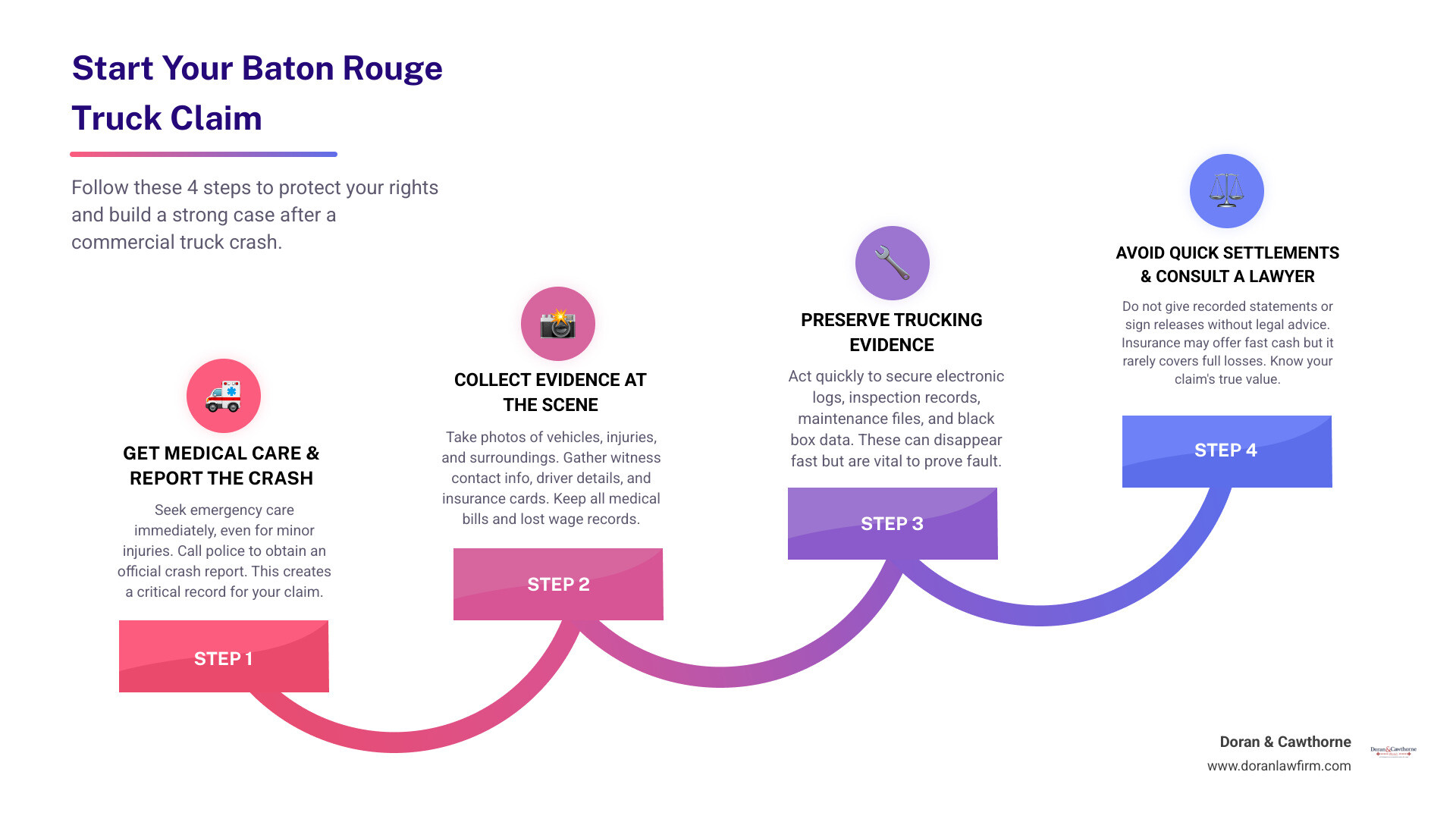
After a truck crash, protect your Baton Rouge truck claim by getting medical care, calling police, saving evidence, and reporting the crash to the insurer without accepting a quick settlement. Truck cases can involve the driver, trucking company, cargo company, maintenance provider, and more, so early records matter.
- Get emergency care and follow up with a doctor, even if symptoms seem minor.
- Obtain the crash report and keep photos, witness information, medical bills, and missed-work records.
- Avoid recorded statements or settlement releases until you understand the full value of your injuries.
- Act promptly to preserve trucking evidence, such as electronic logs, inspection records, maintenance files, and onboard data.
A serious commercial wreck can create two separate problems at once: repairing damaged vehicles and seeking payment for injuries, lost income, pain, and future care. Insurance companies may move quickly, but you do not have to decide your claim before you know the extent of your losses.
I am Pride Doran, a trial lawyer with more than 20 years of experience handling automobile and trucking cases in Louisiana. My work on Baton Rouge truck claim matters includes helping injured people pursue fair treatment when insurers and trucking companies challenge responsibility or damages.
Relevant articles related to Baton Rouge truck claim:
Immediate Steps to Protect Your Baton Rouge Truck Claim

The moments immediately following an 18-wheeler crash on Interstate 10, Airline Highway, or Florida Boulevard can feel overwhelming. Traffic is backed up, emergency lights are flashing, and adrenaline is running high. However, the actions you take right at the scene establish the foundation for your entire legal and financial recovery.
First and foremost, assess your physical safety. If your vehicle is operational and lingering in an active lane of travel creates an immediate hazard, move to the shoulder if possible. Otherwise, stay inside your vehicle with your seatbelt fastened until emergency personnel arrive. Dial 911 immediately so the Baton Rouge Police Department, the East Baton Rouge Sheriff’s Office, or the Louisiana State Police can secure the scene, coordinate medical response, and generate an official crash report.
Once the physical scene is stabilized, prioritize your medical condition. Even if you walk away feeling only slightly stiff, internal injuries, concussions, and soft-tissue trauma can take hours or days to produce intense pain. Tell the responding paramedics about every ache or point of impact, and allow them to transport you to an emergency room if they recommend it. Seeking immediate medical care creates an indisputable timeline linking your injuries directly to the wreck.
If your physical condition permits, begin gathering evidence before the vehicles are moved and the debris is cleared:
- Take comprehensive photographs and videos: Capture the resting positions of all vehicles, skid marks on the pavement, gouge marks in the asphalt, damage to highway guardrails, cargo spills, weather conditions, and all visible physical damage.
- Photograph commercial markings: Make sure you get clear photos of the truck’s license plates, the US DOT registration numbers on the tractor door, company logos, and trailer identification numbers.
- Gather witness information: Request names, phone numbers, and brief recorded or written statements from any independent bystanders who saw the incident unfold.
- Collect driver and carrier details: Note the truck driver’s commercial driver’s license (CDL) number, insurance carrier, policy number, and employer details.
- Document the responding officer’s information: Ask for the officer’s name, badge number, and the police report incident number so you can obtain the official file later.
Understanding how every Baton Rouge trucking victim can protect their rights means recognizing that trucking companies deploy rapid-response teams within hours of a major collision. Having your own contemporaneous records ensures that vital details are not obscured or lost during their early investigation.
How to Determine Liability and Establish Fault in a Commercial Wreck
Establishing fault in an 18-wheeler wreck is significantly more complex than sorting out an everyday fender-bender between two passenger cars. In standard car wrecks, liability usually rests entirely on one of the drivers. In commercial motor vehicle collisions, liability frequently spans multiple corporate entities, federal regulatory violations, and complex contractual relationships.
Commercial trucking operations are governed by both Louisiana traffic laws and strict standards established by the Federal Motor Carrier Safety Administration (FMCSA). When a heavy truck causes an accident, the investigation must determine whether safety rules were compromised at any point in the supply and maintenance chain.
Multiple parties may share legal responsibility under Louisiana law:
- The commercial driver: For direct acts of reckless driving, speeding, tailgating, or operating while impaired or distracted.
- The motor carrier (trucking company): Under the doctrine of vicarious liability (respondeat superior), employers are responsible for the negligent acts of their employees. Furthermore, carriers can be held directly liable for negligent hiring, improper training, or coercing drivers to exceed legal driving hours.
- Cargo loading companies: If freight is improperly secured, unbalanced, or overloaded, shifting cargo can cause jackknife accidents, rollovers, or catastrophic cargo spills on Baton Rouge roadways.
- Third-party maintenance providers: Many fleets outsource mechanical maintenance. If faulty repairs, skipped inspections, or unaddressed brake wear caused the crash, the service shop can share legal liability.
- Equipment manufacturers: When defective tires blow out or steering mechanisms fail due to design or manufacturing flaws, product liability claims come into play.
Untangling these overlapping webs of responsibility requires examining trucking accidents causes liability from every operational angle.
Investigating Driver and Fleet Negligence
Investigating a commercial wreck requires looking deep into corporate practices. Driver fatigue remains one of the leading contributors to major tractor-trailer wrecks across Louisiana. Under FMCSA Hours of Service (HOS) rules, commercial operators are legally limited in how many consecutive hours they can drive and how much mandatory rest they must take between shifts.
Unfortunately, tight delivery deadlines and financial incentives sometimes lead drivers or their dispatchers to cut corners. By reviewing historical trip records and dispatch communication logs, we can identify patterns of deliberate logbook falsification, chronic fatigue, and safety shortcuts.
Beyond fatigue, fleet maintenance failure is a common root cause of preventable disasters. Commercial tractors and trailers require continuous mechanical monitoring. Skipping required pre-trip and post-trip inspections or running worn brake pads down to the metal puts everyone on the road in severe danger. Exploring understanding the common types of truck accidents highlights how undiagnosed steering defects, brake failures, and worn tires turn massive vehicles into unguided missiles on our highways.
Securing Evidence for Your Baton Rouge Truck Claim
Commercial trucks are rolling data centers, continuously recording mechanical performance and driver behavior. Securing this digital and physical footprint before it is overwritten, repaired, or discarded is critical to establishing liability.
Key evidence that must be formally preserved includes:
- Electronic Logging Devices (ELDs): Provide a digital timeline of driving hours, duty status changes, and rest breaks.
- Engine Control Modules (ECMs) or “Black Boxes”: Record vehicle speed, throttle position, engine RPM, brake application, and sudden deceleration in the seconds leading up to impact.
- Fleet telematics and GPS data: Track precise routing, average transit speeds, and historical driving patterns.
- Driver Qualification Files (DQFs): Reveal the driver’s background check, commercial driving record, medical certifications, and previous safety violations.
- Maintenance and repair records: Document recent work orders, component replacements, and formal annual inspections.
- Bills of lading and weight tickets: Verify cargo distribution, gross vehicle weight, and loading protocols.
Because motor carriers are only required to retain certain electronic records for limited timeframes under federal law, taking prompt legal action to send formal preservation letters prevents critical data from disappearing. Reading what you need to know after a Baton Rouge tractor-trailer wreck provides greater insight into how this perishable evidence makes or breaks an injury case.
Navigating the Commercial Insurance and Property Damage Process
Dealing with a commercial insurance company is fundamentally different from filing a claim with your personal auto insurer. Commercial policies often feature policy limits ranging from $750,000 to several million dollars. Because the financial stakes are substantial, commercial claims adjusters and third-party administrators are trained to minimize payouts, dispute fault, and challenge the medical necessity of your treatment.
Immediately after an incident, insurance adjusters may reach out with friendly inquiries, offering rapid settlements or asking you to provide a recorded statement. Always remember that their primary goal is protecting their company’s bottom line. Providing unguided statements or signing broad medical record authorizations can inadvertently damage your personal injury truck accidents claim before you even know your long-term medical prognosis.
Managing Collision Repairs, DOT Inspections, and State Property Claims
In addition to personal injury claims, commercial wrecks often leave heavy property damage in their wake. When large commercial vehicles, fleet trucks, or personal vehicles suffer structural damage, resolving the property damage aspect requires detailed assessments and dedicated repair facilities.

Commercial fleets and heavy vehicle owners involved in wrecks must navigate technical body repairs. Dedicated commercial collision centers handle everything from frame straightening and full cab rebuilds to scratch repairs. Commercial-grade facilities utilize large heated paint booths to cure industrial coatings evenly, restoring the structural and aesthetic integrity of heavy- and medium-duty trucks.
Following a major collision or structural repair, commercial vehicles must undergo rigorous Department of Transportation (DOT) safety inspections to confirm roadworthiness. This includes thorough testing of essential safety systems, such as:
- Brake chamber integrity, checking both single and dual brake chambers for proper pressure and stroke length.
- Steering linkage alignment and suspension components.
- Coupling devices, fifth wheels, and trailer safety chains.
- DOT lighting, conspicuity tape, and emergency equipment.
Furthermore, if a truck crash causes damage to public infrastructure—such as highway guardrails, traffic signals, road signs, or bridge abutments—the state may pursue compensation. In our state, highway maintenance and state-owned infrastructure repairs fall under the purview of the Louisiana Department of Transportation and Development. When state property is compromised during a wreck, claims must be formally processed through Louisiana DOTD damage claims to coordinate reimbursement for infrastructure repairs.
Calculating Damages to Value Your Baton Rouge Truck Claim
Valuing your claim requires a comprehensive analysis of both immediate financial losses and lifetime impacts. A catastrophic crash can alter your physical capabilities and earning capacity permanently.
| Damage Category | Type of Loss | Examples Included |
|---|---|---|
| Economic Damages | Objective, calculable financial losses | – Emergency room visits and hospital bills – Surgeries and physician consultations – Physical therapy and rehabilitation – Prescription medications and medical equipment – Past lost wages and future loss of earning capacity – Vehicle repair or total property loss replacement |
| Non-Economic Damages | Subjective, personal losses | – Physical pain and chronic suffering – Emotional distress and mental anguish – Loss of enjoyment of life – Permanent physical impairment or disfigurement – Loss of consortium and familial support |
Evaluating the high cost of truck accidents seeking compensation for your injuries ensures that your demand covers not just past medical invoices, but all projected future care, home modifications, and long-term financial stability.
Frequently Asked Questions About Filing a Truck Accident Claim
What is the Louisiana statute of limitations for filing a truck accident claim?
In Louisiana, the legal deadline to file a personal injury lawsuit is known as the prescriptive period. For many years, Louisiana maintained a strict one-year prescriptive period from the date of the incident. Under updated Louisiana civil procedure statutes applicable to modern injury claims, it is essential to act quickly to preserve your right to file. Missing the statutory deadline completely bars you from recovering financial compensation in court, regardless of how clear the truck driver’s fault may be.
How does comparative fault impact financial recovery in Louisiana?
Louisiana follows a pure comparative fault system (La. Civ. Code art. 2323). Under this rule, each party involved in an incident is assigned a percentage of fault based on their contribution to the crash.
If you are found partially at fault for an accident, your total financial recovery is reduced proportionally by your percentage of liability. For instance, if a court determines your total damages equal $500,000, but finds you were 10% at fault for minor lane positioning while the truck driver was 90% at fault for speeding, you can still recover 90% of your total damages ($450,000). Commercial insurers often attempt to assign inflated percentages of fault to injured motorists to reduce their payouts, making strong evidence collection essential.
Who can be held legally responsible for a commercial truck crash?
Legal responsibility can extend across multiple individuals and corporations, including:
- The commercial truck driver for operational negligence.
- The motor carrier or parent trucking corporation for corporate negligence and vicarious liability.
- Third-party cargo loaders for improper weight distribution or unsecured freight.
- Maintenance contractors and repair shops for faulty mechanical servicing.
- Parts manufacturers for defective brake systems, blown tires, or failed steering components.
Protect Your Future with Experienced Baton Rouge Legal Representation
Navigating the aftermath of a catastrophic commercial vehicle collision can be an exhausting experience. While you focus on healing, rehabilitation, and getting your daily life back on track, powerful motor carriers and their corporate insurance defense teams are working diligently to protect their financial interests.
At Doran & Cawthorne, our attorneys understand the complex federal trucking regulations and insurance tactics that define these cases. We manage every aspect of your claim—from securing vital black box data and dispatch records to coordinating with medical providers and negotiating with insurance adjusters—to pursue the maximum financial compensation you deserve.
Our firm proudly represents injured individuals across Louisiana, with office locations in Baton Rouge, Opelousas, and Lafayette. If you or a loved one has suffered injuries in a commercial wreck, contact us today to discuss your Baton Rouge truck accident and let our team protect your legal rights.
Share this Blog

When You Need Real Talk & Results™
Louisiana Personal Injury Attorneys Committed to Advocating on Your Behalf


