 Skip to content
How to Determine Fault If an Uber Driver Hits Your Car in Opelousas?
When an Uber driver crashes into your vehicle on an Opelousas roadway, legal fault is determined by the same foundational principles of tort law that govern every traffic crash in Louisiana. The fundamental rule is straightforward: whoever caused the crash through carelessness, recklessness, or a traffic violation is legally responsible for the resulting harm.
Under Louisiana Civil Code Article 2315, “every act whatever of man that causes damage to another obliges him by whose fault it happened to repair it.” In practical terms, establishing that an Uber driver is at fault requires proving four legal components:
- Duty of care: The driver owed you a legal obligation to operate their vehicle safely. Every motorist on Opelousas roads owes this duty to other drivers, passengers, cyclists, and pedestrians.
- Breach of duty: The driver failed to uphold that duty by acting negligently or breaking traffic laws.
- Causation: The driver’s specific breach directly caused the collision and your subsequent injuries or vehicle damage.
- Damages: You suffered actual, measurable financial, physical, or emotional harm as a direct result of the crash.
Rideshare drivers face unique pressures that often lead directly to breaches of duty. In our experience handling local traffic collisions, several driver behaviors frequently contribute to rideshare wrecks:
- Distracted driving from app navigation and notifications: Rideshare drivers are constantly interacting with the Uber platform, accepting ride requests, checking passenger notes, and monitoring turn-by-turn GPS routing while navigating busy corridors like Interstate 49 or US Route 190.
- Speeding to complete trips: Drivers earn their income per trip, creating a financial incentive to rush between pickups and drop-offs.
- Failure to yield and sudden stopping: Rushing drivers may pull out in front of oncoming traffic or slam on their brakes unexpectedly to pick up or drop off passengers near downtown Opelousas businesses.
- Illegal or abrupt U-turns: When a GPS reroutes or a driver misses an address on Court Street or Landry Street, reckless turns frequently cause side-impact or t-bone collisions.
- Driver fatigue: Many rideshare drivers work long hours, often driving early in the morning or late at night after working full-time day jobs.
When an Uber driver’s negligent actions cause a crash, working with a dedicated Opelousas auto accident attorney allows you to hold them accountable and obtain the evidence necessary to prove liability before critical digital data disappears.
Proving Driver Negligence Under Louisiana Law
Proving liability in an Opelousas rideshare crash requires concrete evidence that connects the driver’s violation of Louisiana traffic laws to your collision. St. Landry Parish and Louisiana Revised Statutes (Title 32, the Louisiana Highway Regulatory Act) set clear standards for road safety.
For instance, if an Uber driver violated La. R.S. 32:58 (careless operation) or La. R.S. 32:289.1 (texting or interacting with a wireless telecommunications device while driving), that violation serves as powerful evidence of negligence.
To prove this breach, our legal team investigates beyond the surface of the standard police accident report. We look at:
- Mobile device records: Subpoenaing cellular phone activity to verify whether the driver was texting, calling, or adjusting apps at the exact timestamp of the collision.
- Telematics data: Rideshare platforms track accelerometer data, braking patterns, vehicle speed, and device touches. This data can demonstrate whether the driver was speeding or braking erratically immediately prior to impact.
- Physical roadway evidence: Skid marks, gouge marks in the pavement, debris scatter, and the specific angle of vehicle damage help accident reconstruction professionals piece together how the collision occurred.
Company vs. Driver Liability: Can You Sue Uber Directly?
A common question injured motorists ask us is whether they can directly sue Uber corporate headquarters alongside the individual driver.
Historically, Uber has classified its drivers as independent contractors rather than direct employees. Under the traditional legal doctrine of respondeat superior (vicarious liability), employers are automatically liable for the negligent acts of their employees committed within the course and scope of employment. Because rideshare companies treat drivers as contractors, they routinely argue that vicarious liability does not apply to them.
However, there are specific legal avenues where direct corporate liability against Uber may be pursued in Louisiana courts:
- Negligent hiring and inadequate screening: If Uber approved a driver who possessed a disqualified driving record, prior convictions for reckless driving, or a suspended license, the company can be held directly liable for negligent background screening.
- Negligent retention: If a driver received numerous safety complaints, low star ratings regarding dangerous driving, or prior crash reports within the app, and Uber failed to deactivate their account, the company may share direct fault for keeping a dangerous driver on the road.
- App-induced distraction: Uber designs its platform to dispatch alerts and require driver responses while the vehicle is in motion. When software design inherently promotes distracted driving, direct claims regarding corporate policies can arise.
In most standard collisions, your primary path to recovery involves filing a claim against the commercial insurance policy that Uber provides for its drivers, which offers substantial financial protection depending on the driver’s active status.
Which Insurance Policy Applies Based on the Uber Driver’s App Status?
Unlike standard car accidents where you deal exclusively with the other motorist’s personal insurer, an Uber collision involves a tiered insurance structure. Uber provides commercial liability coverage that changes automatically depending on what the driver was doing on the app at the exact millisecond of the crash.
The following table outlines how coverage changes across the different operational periods:
| App Status Period | Driver Activity | Applicable Insurance Policy | Minimum Required Coverage Limits |
|---|---|---|---|
| Period 0 | App is closed / offline | Driver’s personal auto liability policy only | Louisiana minimum: $15,000 / $30,000 / $25,000 |
| Period 1 | App is on; waiting for ride request | Driver’s personal auto (if rideshare endorsement exists) + Uber contingent liability policy | $50,000 bodily injury per person $100,000 bodily injury per accident $25,000 property damage |
| Period 2 | Ride accepted; en route to pick up rider | Uber’s primary commercial liability policy | $1,000,000 third-party liability + contingent comprehensive/collision |
| Period 3 | Passenger inside the vehicle | Uber’s primary commercial liability policy | $1,000,000 third-party liability + UM/UIM + contingent comprehensive/collision |
Understanding these distinctions is essential for determining who will pay for your vehicle repairs, medical treatments, and related losses.
Period 0: App Offline or Turned Off
If the Uber driver was operating their vehicle with the Uber partner app turned off, the driver is treated as an ordinary private motorist. Uber provides zero commercial insurance coverage during Period 0.
In this scenario, your claim must be filed against the driver’s personal automobile liability policy. Louisiana law mandates that every registered vehicle carry minimum liability limits of:
- $15,000 for bodily injury to one person
- $30,000 for bodily injury per accident
- $25,000 for property damage
A major complication in Period 0 cases occurs when a personal auto insurer discovers that the policyholder drives for Uber. Even if the app was off at the time of the crash, some insurance companies attempt to deny coverage based on commercial-use exclusions if the driver failed to disclose their rideshare activities. When this happens, our firm works to hold the personal insurer to its contractual obligations or explore your own uninsured/underinsured motorist (UM/UIM) coverage.
Period 1: App Active and Awaiting a Ride Request
Once a driver logs into the Uber app and makes themselves available for hire, they enter Period 1. During this phase, the driver is cruising local streets or parked while waiting for a passenger request.
If the driver causes a collision during Period 1, Uber provides contingent third-party liability coverage that steps in if the driver’s personal insurance policy denies the claim or lacks an active rideshare endorsement. In Louisiana, this coverage provides:
- Up to $50,000 in bodily injury liability per person
- Up to $100,000 in total bodily injury liability per collision
- Up to $25,000 in property damage liability
While these limits exceed Louisiana’s baseline minimums, serious crashes involving hospital stays, surgical intervention, or severe trauma can quickly exceed $50,000. In those situations, we explore all available layers of insurance coverage to make sure your damages are addressed.
Periods 2 and 3: Ride Accepted or Passenger On Board
The moment an Uber driver accepts a dispatch request on their phone, they transition into Period 2 (en route to pickup). Once the passenger enters the vehicle and the trip begins, they enter Period 3 (on-trip).
During both Period 2 and Period 3, Uber provides $1,000,000 in primary commercial third-party liability coverage. This policy covers:
- Bodily injuries sustained by drivers and passengers in other vehicles
- Physical damage to other vehicles and surrounding property
- Injuries sustained by pedestrians, cyclists, or the Uber passengers themselves
- Uninsured / Underinsured Motorist (UM/UIM) coverage in case another hit-and-run or uninsured driver causes the collision
This $1,000,000 policy provides critical financial protection if you have suffered severe or life-altering injuries. Pursuing full rideshare accident compensation in Opelousas requires demonstrating both the driver’s full liability and the exact app status to activate this commercial coverage level.
How Does Louisiana’s Pure Comparative Fault Law Impact Your Settlement?
Determining who caused the accident is rarely black-and-white in the eyes of insurance adjusters. Even if an Uber driver clearly committed a driving error, insurance companies often attempt to shift a portion of the blame onto you to minimize their financial payout.
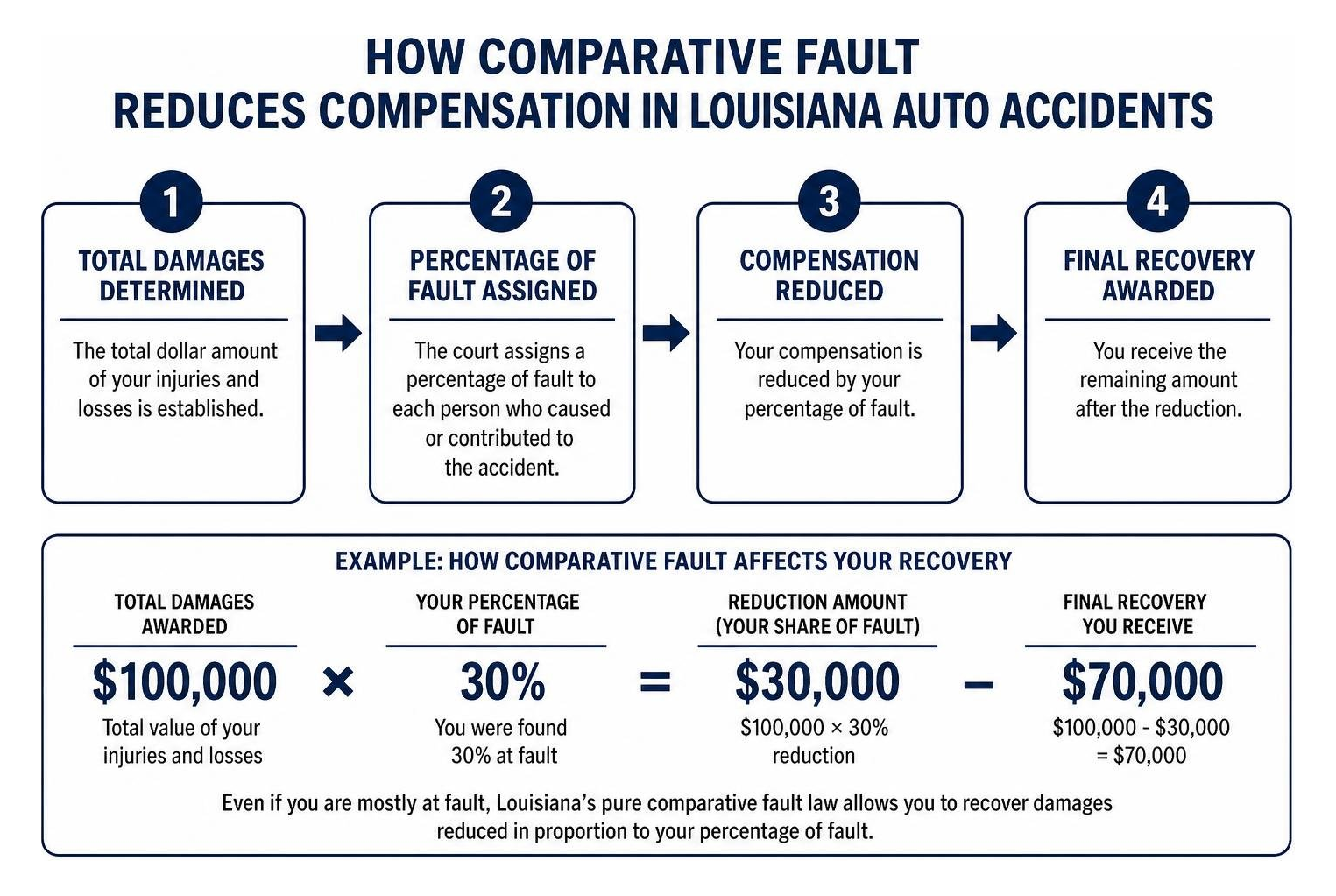
Louisiana operates under a pure comparative fault legal doctrine, codified in Louisiana Civil Code Article 2323. Under this statute, the degree or percentage of fault of all persons causing or contributing to an injury is determined by the court, and your financial recovery is reduced in direct proportion to your assigned percentage of fault.
How Comparative Negligence Works in Practice
Unlike some states where you are barred from recovering any compensation if you are 50% or 51% at fault, Louisiana allows you to recover damages even if you share partial responsibility for the collision.
Consider this real-world scenario on an Opelousas street:
- An Uber driver makes an illegal left turn across traffic on Bellevue Street without yielding, colliding with your vehicle.
- However, you were traveling 5 mph over the posted speed limit at the time of the impact.
- A court or insurance settlement negotiations determine that your total damages (medical expenses, lost wages, vehicle loss, and pain) equal $100,000.
- If you are assigned 20% of the fault for speeding, your total payout will be reduced by 20% ($20,000). You would still receive $80,000.
Defending Against Insurance Adjuster Blame Tactics
Corporate insurance companies defending Uber claims employ aggressive tactics to artificially inflate your percentage of comparative fault. Adjusters may claim that:
- You were driving too fast for roadway conditions
- You failed to keep a proper lookout
- You could have taken evasive action to avoid the Uber driver’s reckless maneuver
- You were distracted by something inside your own vehicle
At Doran & Cawthorne, we counter these allegations by gathering objective physical evidence, traffic camera footage, and witness testimony. We work diligently to protect your rights and ensure your financial recovery reflects the true extent of your losses under Opelousas car accident compensation laws.
What Evidence Is Essential to Prove Fault in an Opelousas Uber Crash?

Building a winning liability case against an Uber driver and their commercial insurer requires comprehensive, indisputable evidence. Because rideshare crashes involve corporate platforms and multiple insurance carriers, securing evidence early is vital.
Here is the essential checklist of evidence needed to prove fault:
- Official police crash report: The formal accident report from the Opelousas Police Department or Louisiana State Police establishing officer observations, citations issued, and initial fault assessments.
- Scene and vehicle photography: High-resolution photographs capturing all vehicle damage points, final resting positions, skid marks, road conditions, and sightline obstructions.
- App timestamp metadata: In-app logging data showing whether the Uber driver was logged on, waiting for a ride, or transporting a passenger at the time of impact.
- Driver telematics: GPS tracking data, vehicle velocity logs, acceleration metrics, and braking records maintained on Uber’s servers.
- Driver mobile phone records: Call logs, text histories, and data usage records proving active device distraction at the time of the crash.
- Third-party video footage: Video from dash cameras, business security cameras along local Opelousas commercial corridors, or residential doorbell cameras.
- Eyewitness statements: Neutral, third-party testimony from other motorists or pedestrians who witnessed the driving behavior leading up to the collision.
- Medical records and billing statements: Comprehensive emergency room charts, imaging scans, and therapy notes connecting your physical injuries directly to the impact.
Critical On-Scene Evidence
The moments immediately following a collision are critical for collecting perishable evidence. Skid marks wash away with rain, vehicles are towed and repaired, and eyewitnesses leave the area.
If your physical condition allows, take photographs of:
- Every vehicle involved from multiple angles, including license plates and rideshare decals.
- The wider accident scene, capturing traffic lights, stop signs, lane markings, and any construction hazards.
- Interior damage to your vehicle, deployed airbags, and visible physical injuries like cuts, bruises, or burns.
Make sure the investigating officer from the Opelousas Police Department or Louisiana State Police notes on the official report that the other motorist was driving for Uber. Request the officer’s name, badge number, and the incident report number before leaving the scene.
Digital and Rideshare-Specific Evidence
The most critical evidence in an Uber accident claim is digital data held exclusively by Uber. Rideshare platforms continuously collect telematics data from their drivers’ smartphones and vehicles.
This digital footprint includes:
- The precise second a driver accepted a ride
- The exact route the GPS ordered the driver to take
- The vehicle’s speed leading up to the impact
- Whether the driver interacted with the smartphone screen while the car was moving
Because this data is stored on remote corporate servers, it is not accessible through a casual phone call to an insurance adjuster. Our legal team acts promptly by sending formal spoliation letters to Uber and the driver. These legal notices command the preservation of all electronic records, telematics, app activity logs, and dashcam recordings connected to the collision, preventing the company from deleting or overwriting vital proof.
What Steps Should You Take Immediately After Being Struck by an Uber Driver?
If you are involved in a collision with an Uber driver on an Opelousas road—whether along the I-49 service roads, US-190, or a local residential street—taking the right steps protects your health, preserves evidence, and strengthens your legal claim.
Follow this step-by-step procedure:
- Check for injuries and call 911: Prioritize the safety of yourself and your passengers. Call emergency services immediately and request both police and emergency medical personnel.
- Obtain an official police report: Always ensure law enforcement investigates the scene. A formal police report from the Opelousas Police Department provides an unbiased record of the crash scene, citations, and driver information.
- Exchange information with the driver: Collect the driver’s full name, address, telephone number, personal insurance details (carrier and policy number), driver’s license number, and vehicle registration. Ask the driver to show you their active Uber app screen to confirm their current status.
- Collect witness contact details: If any bystanders, nearby business employees, or other motorists stopped to help, write down their names, phone numbers, and addresses.
- Seek immediate medical care: Visit the emergency room at Opelousas General Health System (located on East Prudhomme Street) or a local urgent care facility, even if you believe your injuries are minor. Adrenaline can mask severe soft-tissue damage, concussions, internal bleeding, and spinal injuries. Immediate medical documentation creates a direct link between the crash and your physical condition.
- Report the crash through the Uber app: If you were a passenger in the Uber or another driver involved in the wreck, report the incident through the Uber app safety center. Keep your description factual and concise: state that a collision occurred, provide the time and location, and give your contact information.
- Do not give recorded statements to insurance adjusters: Shortly after the wreck, adjusters from Uber’s insurance provider (such as Progressive, Allstate, or Sedgwick) will likely contact you. Do not provide recorded statements, do not sign medical releases, and do not discuss fault until you have consulted legal counsel.
- Consult an attorney: Speak with an experienced Uber injury lawyer in Opelousas who understands rideshare insurance law before accepting any settlement offers or signing insurance documents.
Why Should You Hire a Local Opelousas Rideshare Collision Attorney?
Rideshare accident claims are far more complex than standard two-vehicle collisions. Pursuing compensation requires managing multiple insurance companies—the driver’s personal insurer, Uber’s commercial liability carrier, and potentially your own uninsured motorist provider—each attempting to shift liability and deny financial responsibility.
When you work with our team at Doran & Cawthorne, we handle the legal, administrative, and investigative demands of your claim so you can focus entirely on your physical recovery.
Here is how our legal representation helps your case:
- Uncovering all available insurance coverage: We investigate the driver’s app records to determine whether Period 1, 2, or 3 coverage applies, allowing us to pursue the maximum available policy limits.
- Accurate damages calculation: We work with medical providers, economists, and vocational professionals to calculate the full scope of your losses, including:
- Current medical bills and anticipated future surgeries, rehabilitation, and medications
- Lost wages and lost future earning capacity if you cannot return to your prior job
- Physical pain, emotional suffering, mental anguish, and loss of enjoyment of life
- Total vehicle repair costs or fair market value reimbursement for a totaled car
- Managing aggressive insurance adjusters: We take over all communications, negotiations, and paperwork with corporate insurance adjusters, preventing them from using pressure tactics or misrepresenting your statements.
- Navigating Louisiana’s strict prescriptive period: In Louisiana, personal injury claims are subject to a strict one-year prescriptive period (statute of limitations) under Civil Code Article 3492. You generally have just one calendar year from the date of the crash to file a formal lawsuit in civil court. Missing this deadline permanently forfeits your right to financial recovery.
Our firm maintains dedicated offices in Opelousas, Lafayette, and Baton Rouge, providing local representation backed by extensive courtroom litigation experience across Louisiana. If you or a family member was injured in a crash, connecting with a seasoned rideshare accident attorney in Opelousas ensures your case is handled with the personal attention and legal diligence it deserves.
Frequently Asked Questions About Uber Accidents in Opelousas
What if the Uber driver was off-duty or driving for personal reasons?
If the Uber driver was off-duty and had the Uber partner app turned off at the time of the crash (Period 0), Uber’s corporate commercial liability policy will not apply.
In this situation, you must seek compensation through the driver’s personal automobile insurance policy. If their personal insurer attempts to deny coverage due to commercial exclusions, or if their policy limits are insufficient to cover your medical expenses and property damage, we can help you file a claim through your own uninsured/underinsured motorist (UM/UIM) coverage.
Can I still recover damages if I was partially at fault for the crash?
Yes. Under Louisiana’s pure comparative fault system (La. C.C. Art. 2323), you can recover damages even if you were partially responsible for the accident.
Your total financial compensation will simply be reduced by your percentage of fault. For example, if you sustained $50,000 in total damages but were determined to be 10% at fault for the collision, you remain legally entitled to recover 90% of your award ($45,000).
How long do I have to file a lawsuit after an Uber accident in Louisiana?
In Louisiana, the prescriptive period (statute of limitations) for personal injury and property damage claims resulting from an auto accident is one year from the date the accident occurred.
If you fail to file a lawsuit in the proper court before the one-year anniversary of the crash, the court will dismiss your case, and you will lose your legal right to seek financial compensation from the at-fault driver and Uber.
Protect Your Legal Rights After an Opelousas Rideshare Crash
Determining fault after an Uber collision requires understanding Louisiana traffic statutes, pure comparative negligence rules, and the multi-tiered insurance policies that govern rideshare companies. When you are dealing with painful injuries, mounting medical bills, and a damaged vehicle, you should not have to fight multi-billion-dollar corporate insurers on your own.
At Doran & Cawthorne, we are committed to standing up for injured motorists throughout St. Landry Parish. We investigate every detail of your crash, secure essential digital telematics from the rideshare platform, and pursue the full compensation you need to rebuild your life.
If an Uber driver hit your vehicle in Opelousas, do not wait until critical evidence disappears or statutory deadlines expire. Visit our online contact page to schedule a free, no-obligation consultation. Let our dedicated legal team review your case, explain your options, and fight for the recovery you deserve.
Share this Blog

When You Need Real Talk & Results™
Louisiana Personal Injury Attorneys Committed to Advocating on Your Behalf


