 Skip to content
What to do after getting hurt on someone else’s property in Baton Rouge

If you’re looking for a premises liability attorney in Baton Rouge, here’s what you need to know right away:
Quick answers for injury victims in Baton Rouge:
- You have 2 years to file — Louisiana law (effective July 1, 2024) gives you two years from the date of your injury to file a premises liability claim.
- Property owners can be held liable if they knew (or should have known) about a dangerous condition and failed to fix it or warn you.
- You can still recover compensation even if you were partly at fault — as long as you were 50% or less responsible.
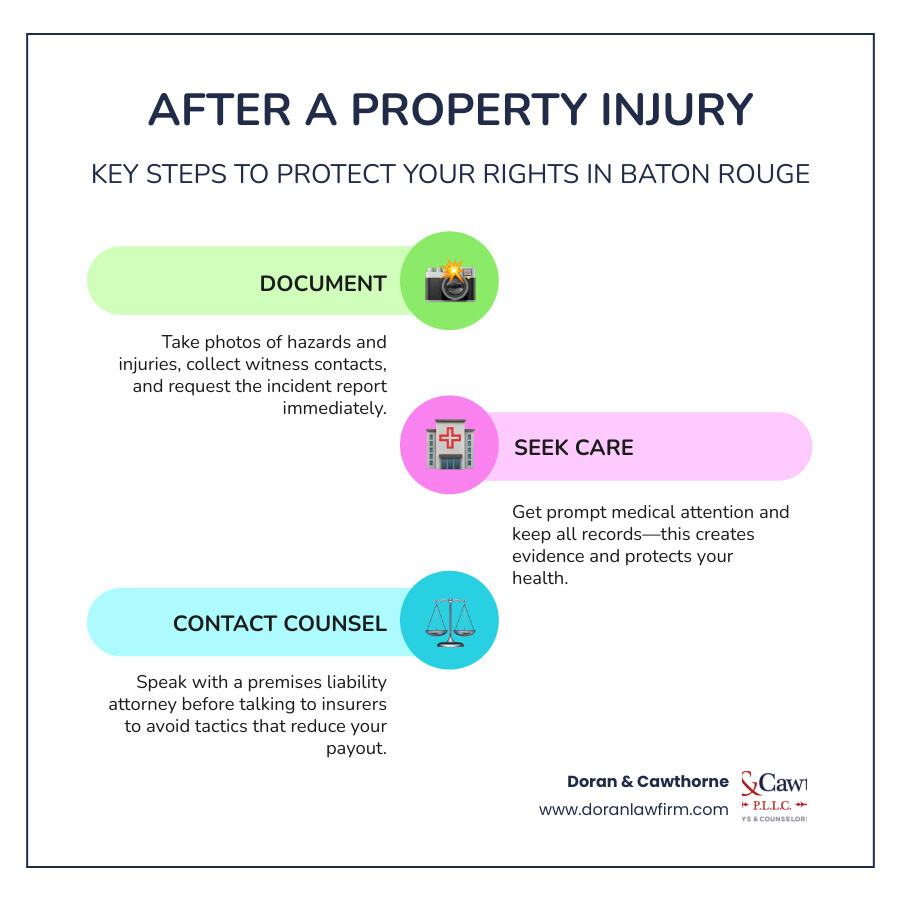
- Document everything now — photos, witness contacts, and incident reports are critical and can disappear fast.
- Don’t talk to the insurance company alone — adjusters work to minimize your payout, not protect your interests.
Every year, people across Baton Rouge are seriously hurt on property that someone else was responsible for maintaining — a wet grocery store floor, a poorly lit parking lot, a broken staircase with no warning. These aren’t just accidents. In many cases, they’re the direct result of a property owner’s failure to do their job.
Louisiana law is clear: property owners must keep their premises reasonably safe. When they don’t, and you get hurt, you have the right to pursue compensation — for your medical bills, lost income, and the pain you’ve had to live with.
But getting fair compensation isn’t always straightforward. Insurance companies have attorneys and resources working against you from day one.
I’m Pride Doran, a trial lawyer with over twenty years of experience handling premises liability litigation across Louisiana, including right here in Baton Rouge. As a premises liability attorney in Baton Rouge, I’ve represented thousands of injury victims — many of them facing the same overwhelming situation you’re in now — and I know how to build the kind of case that gets results.
Premises liability attorney in baton rouge terms at a glance:
Understanding Louisiana property owner obligations and visitor classes
When you step onto someone else’s property in Baton Rouge—whether it is a local grocery store, a neighbor’s home, or a public office building—you have a reasonable expectation of safety. Under Louisiana Civil Code Article 2317 and 2322, property owners and custodians are legally obligated to maintain their premises in a condition that does not present an unreasonable risk of harm.
However, a property owner’s specific “duty of care” is not a one-size-fits-all concept. To understand if you have a viable claim, we must look at how the law defines the relationship between the property owner and the person who was injured. Louisiana courts look closely at whether the property custodian met basic safety standards and performed regular maintenance to prevent foreseeable hazards. If you have been hurt, consulting a Baton Rouge premises liability injury attorney is the first step toward determining how these legal duties apply to your specific situation.
How a premises liability attorney in Baton Rouge evaluates your visitor status
In Louisiana premises liability law, visitors are traditionally categorized into three distinct classes. Each class carries a different level of responsibility for the property owner:
- Invitees: These are individuals who enter the property for business or commercial reasons that benefit the owner. Think of a shopper at a grocery store on Bluebonnet Boulevard or a diner at a restaurant downtown. Property owners owe the highest duty of care to invitees. They must regularly inspect the premises, actively look for hazards, fix any problems immediately, and warn visitors of any dangers that cannot be instantly repaired.
- Licensees: These are social guests who enter the property with the owner’s express or implied permission, such as a friend invited over for a backyard barbecue. The property owner must warn licensees of any hidden dangers they know about that are not open and obvious. However, the owner generally does not have an active duty to constantly inspect the property for unknown hazards on behalf of a licensee.
- Trespassers: These are individuals who enter a property without any legal right or permission. Generally, property owners owe no duty of care to adult trespassers, other than refraining from intentionally injuring them or setting traps. However, there are critical exceptions to this rule, particularly when children are involved.
When we review your case, our team at Baton Rouge premises liability attorneys will carefully evaluate your visitor status. Insurance companies often try to claim that an injured victim was in an unauthorized area to lower their liability, which is why establishing your legal status is so crucial.
The attractive nuisance doctrine and child trespassers
Children are naturally curious, and they do not perceive danger the way adults do. Because of this, Louisiana recognizes a legal concept known as the “attractive nuisance doctrine.”
Under this doctrine, a property owner can be held liable for injuries to child trespassers if the property contains an artificial, dangerous condition that is highly likely to attract children. Common examples of attractive nuisances in East Baton Rouge Parish include:
- Unsecured residential swimming pools
- Active construction sites with heavy machinery or open trenches
- Trampolines without safety netting or fences
- Abandoned appliances or old vehicles
If a property owner leaves a dangerous hazard unsecured when it would have been simple and reasonable to put up a fence or lock a gate, they can be held responsible for a child’s injuries. If your child was hurt because a property owner failed to secure an attractive hazard, we can help you hold them accountable. You can read more about how these principles apply across regional offices, including our Lafayette premises liability services, to see how we protect families throughout South Louisiana.
Why you need a premises liability attorney in Baton Rouge after an injury
It is a common mistake to assume that because you were hurt on someone else’s property, their insurance company will simply write a check to cover your medical bills. In reality, premises liability cases are notoriously difficult to win on your own.
Insurance adjusters are trained to protect their company’s bottom line. They will use a variety of tactics to deny your claim or pay you as little as possible. They might claim that the liquid on the floor was “open and obvious” and that you should have seen it, or they might argue that your injuries are related to a pre-existing condition.
By securing experienced representation, you level the playing field. We handle all communication, investigate the property’s history, and gather the evidence needed to maximize your settlement. If you want to understand your legal rights better, reviewing our detailed guide on Baton Rouge premise liability will help clarify your path forward.
Comparative fault and the 50% bar rule in Louisiana
One of the most important aspects of any Louisiana personal injury claim is how fault is distributed. Under Louisiana’s modified comparative fault law (which applies to claims arising on or after January 1, 2026), your financial recovery depends directly on your percentage of responsibility.
Here is how the modified comparative fault system works:
- The 50% bar rule: You can only recover damages if you are found to be 50% or less at fault for the accident. If a court decides you were 51% or more responsible for your own fall—perhaps because you were running through a restricted area while looking at your phone—you will receive nothing.
- Proportional reduction: If you are partially at fault but remain under the 50% threshold, your compensation is reduced by your percentage of fault. For example, if your total damages are $100,000, but you are found to be 20% at fault because you ignored a warning sign, your final recovery will be $80,000.
Because of these rules, insurance companies will do everything they can to shift the blame onto you. Having a skilled legal team to defend your actions is vital. For a deeper dive into how victim fault is handled in local courts, check out our resource on slip fall and call finding the best premises liability lawyer in Baton Rouge LA.
What you must prove to win a Louisiana property negligence claim
To win a premises liability lawsuit in Louisiana, you cannot simply show that you fell and got hurt. You must establish a clear chain of negligence. Specifically, you must prove the following four elements:
- The property owner owed you a duty of care: You were lawfully on the property, or the owner had a duty to protect you from a known hazard.
- A hazardous condition existed: The property had a defect or hazard that created an unreasonable risk of harm (e.g., a broken step, a hidden hole, or a slick surface).
- The owner had actual or constructive notice: The owner knew about the hazard, or they should have known about it if they had been exercising reasonable care.
- Causation and damages: The hazardous condition directly caused your injuries, resulting in real financial or physical damages.
Proving that a condition posed an “unreasonable risk of harm” requires looking at the social utility of the object, the likelihood and severity of potential injuries, and the cost of fixing the hazard. For commercial properties, proving these elements can be particularly complex. We invite you to read our guide on proving hazardous conditions on Opelousas commercial property to see how we analyze and establish business negligence.
Proving constructive notice and merchant liability
If your accident occurred at a commercial business, such as a grocery store, department store, or restaurant, your claim falls under the Louisiana Merchant Liability Act (La. R.S. 9:2800.6). This statute places a heavy burden of proof on the injured plaintiff.
To win a merchant liability claim, you must prove that:
- The condition presented an unreasonable risk of harm, and that risk was reasonably foreseeable.
- The merchant either created the condition or had actual or constructive notice of it prior to your injury.
- The merchant failed to exercise reasonable care to correct the hazard.
“Constructive notice” means that the dangerous condition existed for such a period of time that the merchant should have discovered it through regular, reasonable inspections. This is known as the temporal element. You cannot simply say, “There was water on the floor, so they are guilty.” You must show that the water had been there long enough that an employee exercising basic care should have spotted it and cleaned it up.
This legal hurdle is high, which is why big-box retailers fight these claims aggressively. To learn more about dealing with major corporate retailers, read our survival guide: don’t let a Walmart wipeout ruin your wallet.
How a premises liability attorney in Baton Rouge gathers crucial evidence
Because the burden of proof is on you, gathering evidence immediately after your injury is the single most important factor in securing a fair settlement.
When we take on your case, our legal team immediately initiates an investigation to preserve and gather the following pieces of evidence:
- Surveillance footage: Most Baton Rouge businesses have security cameras. However, this footage is often recorded over or deleted within 30 to 90 days. We send immediate spoliation letters to legally obligate the property owner to preserve all video recordings of your accident.
- Incident reports: If you reported your fall to a manager, they likely filled out an internal incident report. We demand copies of these reports to see what the store acknowledged at the time of the accident.
- Witness statements: Bystanders and other customers often see the hazard before or during your fall. Getting their contact information and written statements provides unbiased proof of the dangerous condition.
- Medical records: Your medical documentation links your injuries directly to the fall, preventing the insurance company from claiming your pain was caused by something else.
Common types of property accidents and recoverable damages

Premises liability covers a broad spectrum of accidents. While slip and falls are the most frequent, we handle many different types of property negligence claims in Baton Rouge, including:
- Slip, trip, and fall incidents: Wet floors, uneven sidewalks, ripped carpeting, or poorly designed transitions.
- Negligent security: Assaults, robberies, or physical attacks in parking lots, apartment complexes, or shopping centers that lacked proper lighting, working locks, or security patrols despite a history of local crime.
- Dog bites and animal attacks: Louisiana Civil Code Article 2321 holds dog owners strictly liable for damages caused by their animals if the owner could have prevented the attack.
- Elevator and escalator malfunctions: Misaligned elevator cabs, sudden stops, or failing escalator handrails.
- Swimming pool accidents: Drowning or near-drowning incidents due to missing safety equipment or lack of secure fencing.
The financial recovery in these cases varies wildly depending on the severity of your injuries and whether you required surgical intervention.
| Injury category | Typical settlement range in Louisiana | Key factors influencing value |
|---|---|---|
| Slip & fall (no surgery) | $15,000 – $50,000 | Soft tissue injuries, sprains, minor lacerations, short recovery periods. |
| Slip & fall (with surgery) | $50,000 – $250,000+ | Fractures requiring hardware, herniated discs requiring fusion, joint reconstructions. |
| Severe / permanent disability | $500,000 – $1,000,000+ | Traumatic brain injuries, spinal cord damage, paralysis, permanent loss of earning capacity. |
Recovering full compensation for your injuries
If you have been injured due to a property owner’s negligence, you are entitled to pursue both economic and non-economic damages.
- Economic damages: These are tangible, quantifiable financial losses. They include your past and future medical bills, physical therapy costs, prescription medications, lost wages from missed work, and diminished earning capacity if you can no longer work in the same field.
- Non-economic damages: These are subjective losses that do not have a direct price tag. They include your physical pain and suffering, mental anguish, emotional distress, loss of enjoyment of life, and loss of consortium (the impact of your injuries on your relationship with your spouse).
Our goal is to ensure that every expense—both immediate and long-term—is fully calculated so you are not left paying for someone else’s mistake. For more details on how we build these valuations, please visit our overview on personal injury premises liability.
Frequently asked questions about Baton Rouge property injuries
What is the statute of limitations for a premises liability claim in Louisiana?
In Louisiana, the statute of limitations for personal injury claims is known as the prescriptive period. Under Louisiana Civil Code Article 3493.1, for accidents occurring on or after July 1, 2024, you have two years from the date of the injury to file a formal lawsuit in court. For accidents that took place before that date, a one-year limit applies. If you miss this deadline, you will permanently lose your right to seek compensation.
Can I still recover compensation if I was partially at fault for my fall?
Yes. Under Louisiana’s modified comparative fault system, you can still recover compensation as long as your share of the fault is 50% or less. Your final settlement will be reduced by your percentage of responsibility. However, if you are found to be 51% or more at fault, you are barred from recovering any damages.
What should I do immediately after getting hurt on someone else’s property?
First, seek medical attention immediately to document your injuries. Second, report the incident to the property owner or manager and request a copy of the written incident report. Third, take photos of the hazard (such as the spill, broken step, or lack of lighting) before it is cleaned up or repaired. Finally, gather contact info from any witnesses and contact an attorney before speaking with any insurance adjusters.
Protect your rights and secure your recovery today
If you or a loved one has been injured on someone else’s property in Baton Rouge, you do not have to fight the insurance companies alone. Big corporations and property insurers have experienced legal teams ready to minimize your claim. You deserve a team of dedicated advocates who will protect your rights and fight for the maximum compensation you need to heal.
At Doran & Cawthorne, we bring decades of personal injury experience to the table. We understand the local courts, we know the tactics insurance companies use, and we work on a contingency fee basis—meaning you pay us nothing upfront, and we only get paid if we win your case.
Take the first step toward securing your recovery today. Contact us to schedule a free, no-obligation consultation with a dedicated trial attorney. Let us handle the legal burden while you focus on getting better. To learn more about our local team and how we represent injury victims in the Capital Area, visit our page on Baton Rouge premises liability representation.
Share this Blog

When You Need Real Talk & Results™
Louisiana Personal Injury Attorneys Committed to Advocating on Your Behalf


