 Skip to content
Why Finding the Right Baton Rouge Premises Liability Attorney Can Make or Break Your Case
Every year, over 800,000 people are hospitalized in the U.S. after falls on unsafe property. Many of those injuries happen at places people visit every day — grocery stores, apartment complexes, parking lots, restaurants.
When a property owner fails to keep their space reasonably safe, you pay the price. Medical bills pile up. You miss work. And then the insurance company’s attorneys start working against you.
That’s a hard position to be in alone.
Louisiana premises liability law gives you the right to hold negligent property owners accountable. But the rules are specific — visitor classifications, notice requirements, and strict filing deadlines all affect whether your claim succeeds.
Choosing the right attorney matters more than most people realize.
I’m Pride Doran, a trial lawyer and Tulane Law School graduate with over 20 years of experience handling premises liability cases across Louisiana — making me a trusted Baton Rouge premises liability attorney for injured individuals fighting back against powerful insurers. In this guide, I’ll walk you through what separates strong claims from weak ones, and how our team at Doran & Cawthorne is equipped to help.
Understanding Louisiana Premises Liability Law vs. General Personal Injury
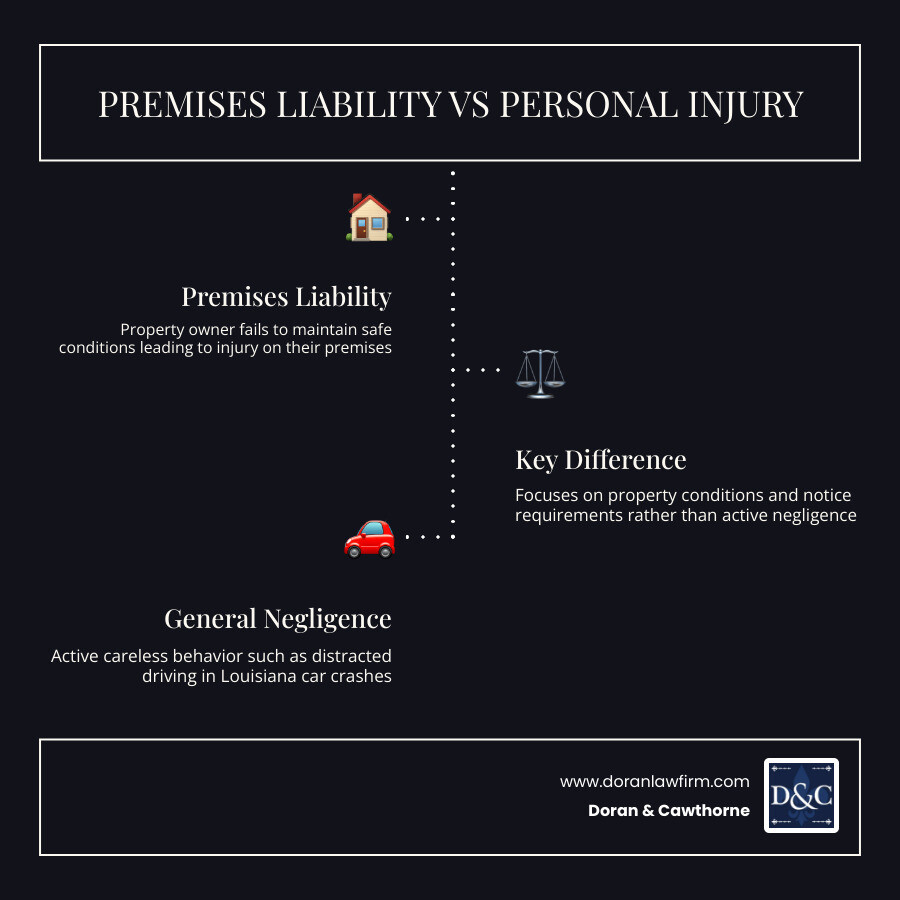
When you get hurt because of someone else’s carelessness, you might assume all personal injury claims are handled the same way. However, Louisiana law draws a distinct line between general negligence and premises liability.
General personal injury claims typically stem from active negligent behavior. For example, if a distracted driver runs a red light and hits your car, that falls under general negligence. We see this daily in our work handling Louisiana car crashes. The focus of the legal battle is on the driver’s immediate actions behind the wheel.
In contrast, personal injury premises liability focuses on the physical condition of a property. If you step into a grocery store and slip on a puddle of liquid that was left uncleaned for hours, your claim centers on the property owner’s or merchant’s failure to maintain a safe environment. The core question is not whether the owner actively pushed you, but whether they allowed a hazardous condition to exist on their premises without fixing it or warning you.
Whether you are seeking a Lafayette premises liability lawyer or local representation in Baton Rouge, understanding this distinction is crucial. In a premises liability case, we must prove that a specific property defect or hazard existed, that the owner knew or should have known about it, and that they failed to act.
Visitor Classifications and the Duty Owed by a Baton Rouge Premises Liability Attorney
Under Louisiana premises liability law, the legal duty a property owner owes to you depends heavily on why you were on the property in the first place. Historically, Louisiana courts categorized visitors into three distinct groups. While modern cases focus on a general standard of “reasonable safety under the circumstances,” these classifications still strongly influence how a judge or jury views your case:
- Invitees: These are individuals who enter a property for the financial benefit of the owner, such as shoppers in a retail store, diners in a restaurant, or guests in a hotel. Property owners owe the highest duty of care to invitees. They must regularly inspect the property for hidden dangers, perform timely maintenance, and clearly warn visitors of any known risks.
- Licensees: These are social guests who enter a property for their own convenience or pleasure with the owner’s permission. A classic example is a friend invited over for a backyard barbecue. The property owner must fix known hazards promptly and warn licensees of any non-obvious dangers on the property.
- Trespassers: These are individuals who enter a property without any legal right or permission. Generally, property owners owe no duty of care to adult trespassers, other than a basic obligation to refrain from setting intentional traps or causing willful harm.
When we evaluate a claim at our Baton Rouge premises liability practice, we look closely at your visitor status to establish the exact level of care the property owner should have provided.
The Attractive Nuisance Doctrine and Protecting Children
While adult trespassers are rarely protected under Louisiana law, the legal landscape changes dramatically when children are involved. This is due to a legal concept known as the attractive nuisance doctrine.
Children do not perceive danger the same way adults do. A water-filled hole, an unsecured construction site, or an open swimming pool can look like an exciting playground to a curious child rather than a life-threatening hazard.
Under the attractive nuisance doctrine, a property owner can be held liable for injuries to trespassing children if the following elements are met:
- The owner knew or should have known that children were likely to trespass on the property.
- The property contained a dangerous condition that was highly likely to attract children.
- The child, because of their youth, did not understand the risk involved.
- The utility of maintaining the condition and the burden of eliminating the danger were slight compared to the risk to children.
- The owner failed to take reasonable safety precautions to secure the hazard (such as putting up a fence, locking a gate, or covering a pool).
If your child was injured because a property owner left a hazardous area unsecured, we can help you hold them accountable for failing to protect the most vulnerable members of our community.
What You Must Prove to Win a Baton Rouge Premises Liability Attorney Claim
Filing a lawsuit is one thing; winning it is another. To secure compensation in a premises liability case, the burden of proof rests on you, the plaintiff. You must establish the four core elements of negligence:
- Duty of care: You must show that the defendant owned, occupied, or managed the property and owed you a legal duty to keep the premises safe.
- Breach of duty: You must prove that the property owner breached that duty by allowing a dangerous condition to exist.
- Causation: You must directly link the property hazard to your injuries. It is not enough to show that the floor was wet; you must prove that the wet floor is what caused you to fall and get hurt.
- Damages: You must show that you suffered actual, measurable losses as a result of your injuries, such as medical bills, lost wages, and physical pain.
A major hurdle in these cases is proving notice. You must show that the property owner had either actual notice (they knew about the hazard because they saw it or someone reported it) or constructive notice (the hazard existed for such a length of time that they reasonably should have discovered and fixed it).
If you are dealing with a Baton Rouge slip and fall or need to consult a specialist in premises liability Baton Rouge, gathering evidence of notice immediately is critical to your success.
Proving Notice and Merchant Liability Standards
If your injury occurred at a commercial business, such as a grocery store, supermarket, or retail outlet, your case is governed by a specific Louisiana law: La. R.S. 9:2800.6 (the Merchant Liability Act). This statute places a heavy burden of proof on the injured shopper.
To win a case against a merchant, you must prove three strict elements:
- The condition on the property presented an unreasonable and foreseeable risk of harm, and that risk of harm was reasonably foreseeable.
- The merchant either created the condition or had actual or constructive notice of the condition prior to the occurrence.
- The merchant failed to exercise reasonable care to prevent the injury (such as failing to clean up a spill or block off a wet aisle).
To prove constructive notice under this act, you must show that the hazard existed for a certain period of time before your accident. This is where professional evidence collection comes into play. We work to obtain store surveillance footage, sweep logs, employee shift records, and witness statements to establish exactly how long a hazard was left unaddressed.
Common Types of Property Accidents and Key Evidence
Premises liability claims are not limited to wet grocery store floors. Dangerous conditions can manifest in many different ways across commercial, residential, and public properties in Baton Rouge.
Some of the most common cases we handle include:
- Slip, trip, and falls: Caused by spilled liquids, freshly mopped floors, torn carpeting, uneven sidewalks, or unexpected potholes in parking lots.
- Dog bites and animal attacks: Property owners and harborers can be held liable if their dog attacks a visitor, especially if the owner knew the animal had dangerous tendencies.
- Negligent security: If a business or apartment complex is located in a high-crime area but fails to provide adequate lighting, working locks, or security guards, they may be held liable if a visitor is assaulted on their property.
- Swimming pool accidents: Unfenced pools, missing depth markers, or slippery pool decks can lead to devastating near-drowning or drowning incidents.
No matter where your injury occurred—whether you need a Baton Rouge lawyer or are seeking a Lafayette premises liability specialist—having the right evidence is what turns a denied claim into a successful recovery.
How a Baton Rouge Premises Liability Attorney Evaluates Back Injuries and Car Crashes
When a person slips, trips, or falls from an elevated surface, the physical impact can be incredibly violent. The sudden, jarring motion of a fall frequently causes severe spinal trauma, herniated discs, and soft tissue damage.
At our firm, we evaluate these injuries with the same clinical precision we use when handling complex spinal cases. If you require Opelousas back injury legal services or have suffered spinal damage from a fall, we understand that your long-term recovery depends on securing comprehensive medical documentation.
Just like victims of high-speed Louisiana car crashes, premises liability victims often need MRIs, physical therapy, and sometimes invasive spinal surgeries to regain their quality of life. We work closely with medical experts to project your future care costs so that we can demand a settlement that covers your lifetime medical needs.
How Comparative Negligence and Statutes of Limitations Impact Your Case
Two major legal concepts can drastically affect the outcome of your Baton Rouge premises liability claim: comparative negligence and the statute of limitations.
First, Louisiana operates under a pure comparative negligence system. This means that if you are partially at fault for your own accident (for example, if you were distracted by your phone when you tripped over an obvious hazard), you can still recover damages. However, your financial recovery will be reduced by your percentage of fault. If a jury determines your total damages are $100,000 but finds you 30% at fault, your final recovery will be $70,000.
Second, you must act quickly. In Louisiana, the statute of limitations—known legally as the prescriptive period—for personal injury and premises liability claims is generally one year from the date of the injury. If you fail to file a formal lawsuit within this one-year window, you will lose your right to seek compensation forever.
| Scenario | Plaintiff’s Fault % | Defendant’s Fault % | Impact on $100,000 Claim |
|---|---|---|---|
| No plaintiff fault | 0% | 100% | Plaintiff receives full $100,000 |
| Distracted walking | 25% | 75% | Plaintiff receives $75,000 |
| Ignoring warning signs | 50% | 50% | Plaintiff receives $50,000 |
| High degree of recklessness | 80% | 20% | Plaintiff receives $20,000 |
Frequently Asked Questions about Louisiana Property Injuries
What is the statute of limitations for a premises liability claim in Louisiana?
Under Louisiana Civil Code Article 3492, you generally have exactly one year from the date of the accident to file a lawsuit. Because this prescriptive period is one of the shortest in the country, it is critical to contact an attorney immediately to protect your rights.
Can I recover damages if I was partially at fault for my slip and fall?
Yes. Thanks to Louisiana’s pure comparative negligence rules, you can recover compensation even if you were partially responsible for your fall. Your final payout will simply be reduced by the percentage of fault assigned to you by the court or insurance adjusters.
What damages are recoverable in a Baton Rouge property injury case?
Victims can recover both economic and non-economic damages. These include:
- Special damages: Quantifiable financial losses like past and future medical bills, rehabilitation costs, and lost wages.
- General damages: Subjective, non-monetary losses such as physical pain and suffering, mental anguish, loss of enjoyment of life, and permanent scarring or disability.
Choosing the Best Legal Representation
Recovering from a serious injury on someone else’s property can turn your life upside down. Between medical appointments, lost income, and physical pain, the last thing you need is the stress of fighting an aggressive insurance company that wants to pay you as little as possible.
At Doran & Cawthorne, we believe in providing compassionate, aggressive legal advocacy to level the playing field. We know how insurance companies operate, and we know the tactics they use to delay, devalue, or deny valid premises liability claims.
Whether you were hurt in Baton Rouge, Lafayette, or Opelousas, our experienced legal team is ready to stand by your side. contact us today for a free, no-obligation consultation, or visit our Baton Rouge premises liability page to learn more about how we can help you secure the maximum recovery you deserve.
Share this Blog
When You Need Real Talk & Results™
Louisiana Personal Injury Attorneys Committed to Advocating on Your Behalf


