 Skip to content
What You Need to Know About Premises Liability Baton Rouge
Premises Liability Baton Rouge is an area of law that holds property owners responsible when their negligence causes someone to get hurt on their property. If you’ve been injured on someone else’s property in Baton Rouge, here’s what matters most:
Quick answers at a glancein Baton Rouge is an area of law that holds property owners responsible when their negligence causes someone to be injured
- What it is: A legal claim against a property owner whose negligence caused your injury
- Who can claim: Anyone lawfully on a property — customers, tenants, guests, and sometimes others
- Common injuries: Slip and falls, dog bites, inadequate security incidents, falling objects, and more
- What you can recover: Medical bills, lost wages, pain and suffering, and other damages
- Time limit: You generally have one year (some sources cite two years under Louisiana Civil Code) to file — act quickly
- First step: Contact a premises liability attorney for a free consultation as soon as possible
When a property owner fails to maintain safe conditions — whether that’s a wet floor in a grocery store, a broken railing, or a poorly lit parking lot — and you get hurt as a result, you may have a legal right to compensation. You should not have to absorb the financial consequences of someone else’s negligence.
I’m Pride Doran, a trial attorney with over twenty years of experience handling Premises Liability Baton Rouge cases and other personal injury matters across Louisiana. A graduate of Tulane Law School, I’ve represented thousands of injured individuals — many through trial — and I understand exactly how to fight for fair outcomes when powerful property owners and insurers push back.
Understanding Premises Liability Baton Rouge Laws
At its core, Louisiana law requires property owners to keep their premises in a “reasonably safe condition.” This doesn’t mean every property must be perfect, but it does mean that if a hazard exists, the owner has a duty to fix it or warn you about it. When they fail to do this, and that failure leads directly to your injury, they are considered “negligent.”
In Baton Rouge, we see these cases everywhere from the busy shops at Towne Center to private apartment complexes near LSU. Whether it is a commercial business or a private residence, the owner’s responsibility is to ensure that visitors aren’t walking into a trap.
Visitor Classifications and Duty of Care
One of the quirks of Personal Injury Premises Liability is that the level of “care” an owner owes you often depends on why you were on the property in the first place. Louisiana law generally looks at three types of visitors:
- Invitees: These are people on the property for the owner’s benefit—think of a customer in a grocery store or a diner in a restaurant. Owners owe these folks the highest duty of care, including a duty to inspect the property for hidden dangers.
- Licensees: These are people on the property with permission but for their own purposes, such as a social guest or a mail carrier. The owner must warn them of known dangers that aren’t easily spotted.
- Trespassers: Generally, owners don’t owe much to people who aren’t supposed to be there. However, they can’t intentionally set traps, and as we’ll see below, there are big exceptions when children are involved.
Regardless of your status, if there was a hazard that the owner knew about (or should have known about) and they didn’t put up a warning sign or mop it up, you may have a case.
The Attractive Nuisance Doctrine in Premises Liability Baton Rouge
We all know that kids are naturally curious. If there is a sparkling swimming pool or a big pile of dirt at a construction site, a child might wander in even if they haven’t been invited. This is where the “Attractive Nuisance Doctrine” comes into play.
Under this rule, a Baton Rouge Premises Liability Lawyer can argue that a property owner is liable for injuries to trespassing children if the property contained a dangerous condition that was likely to attract them. Because children often lack the judgment to understand the risk of a deep pool or heavy machinery, the law puts the burden on the owner to secure these hazards with fences or locks. If a child gets hurt because a construction site was left wide open, the owner can’t simply say, “Well, the kid shouldn’t have been there.”
Common Hazards and Proving Negligence
What does a premises liability accident actually look like? It’s rarely a dramatic movie scene; usually, it’s a split-second moment that changes your life. Common examples we handle in Baton Rouge include:
- Slip and Falls: The classic Baton Rouge Slip and Fall often involves spilled liquids, leaked refrigeration units, or freshly mopped floors without signs.
- Trip and Falls: These are frequently caused by uneven sidewalks, bunched-up floor mats, or poorly lit stairwells.
- Dog Bites: If a dog owner in Baton Rouge knows their pet has a “vicious propensity” and fails to restrain them, they can be held liable for the resulting trauma.
- Inadequate Security: This is a big one for apartment complexes and parking garages. If an area has a history of crime and the owner fails to provide proper lighting or locks, they may be responsible if a visitor is assaulted.
- Falling Merchandise: In “big box” stores, improperly stacked items can fall from high shelves, causing serious head or shoulder injuries.
If you’ve experienced something similar in nearby areas, our Lafayette Slip Fall Accidents team also sees these patterns frequently in local retail hubs.
Proving Negligence in a Premises Liability Baton Rouge Claim
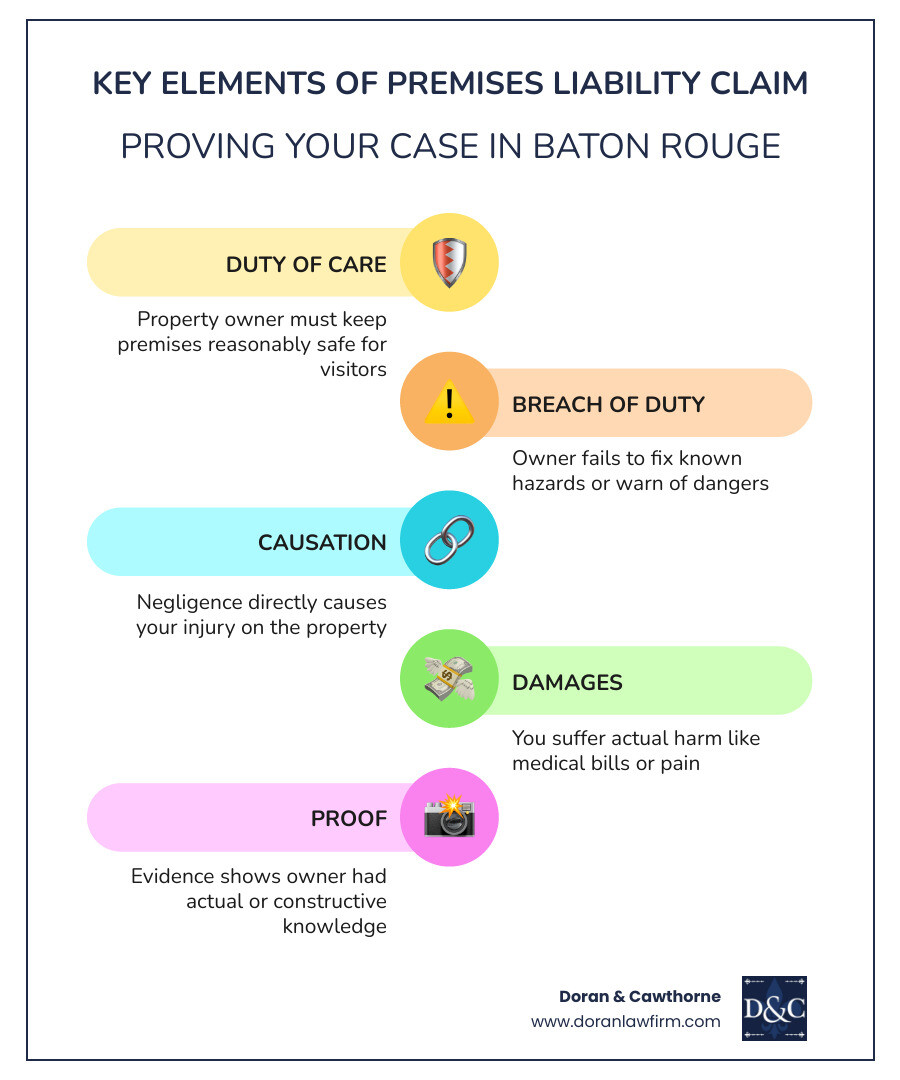
Proving a case isn’t just about showing you were hurt; it’s about proving the owner messed up. To win, a Baton Rouge Premises Liability Lawyer must typically demonstrate:
- The condition presented an unreasonable risk of harm.
- The owner knew or should have known about the condition (this is called “constructive knowledge”).
- The owner failed to exercise reasonable care (they didn’t fix it or warn you).
- The condition caused your injury.
Evidence is the fuel for your claim. This is why we look for surveillance footage, witness testimony, and maintenance logs to see how long that spill sat on the floor before you walked by.
Immediate Steps to Take After an Injury
The moments following an injury are chaotic, but what you do next can make or break your Baton Rouge claim:
- Seek Medical Attention: Your health is #1, and medical records are the best proof of your injuries.
- Report the Incident: Tell the manager or owner. Ensure they create an incident report and ask for a copy.
- Take Photos: Use your phone to capture the hazard (the spill, the broken step, the lack of lighting) before they “fix” it five minutes later.
- Get Witness Info: If anyone saw you fall, get their name and phone number.
- Keep Everything: Save your torn clothes, your medical bills, and any notes about missed work.
Compensation and the Statute of Limitations
When we file a claim, we are looking to make you “whole” again. This involves calculating both the money you’ve lost and the physical/emotional toll the accident took on you.
| Type of Damage | Examples |
|---|---|
| Economic Damages | Medical bills, physical therapy, lost wages, future loss of earnings |
| Non-Economic Damages | Pain and suffering, emotional distress, loss of enjoyment of life |
| Wrongful Death | Funeral expenses, loss of consortium (for surviving family) |
In any Personal Injury case, the goal is to ensure the insurance company doesn’t just pay for your first ER visit, but also for the months of rehab or the permanent limp you might now have to live with.
The Two-Year Statute of Limitations in Louisiana
Timing is everything. In the legal world, we call this the “prescriptive period.” For a long time, Louisiana had a very strict one-year limit for personal injury claims. However, as of April 2026, it is vital to consult with a Baton Rouge Personal Injury Attorney to confirm the current deadlines applicable to your specific case.
While the Louisiana Civil Code (specifically Art. 3492 and Art. 2315.2) has historically leaned toward a one-year limit for many torts, recent legislative updates and specific case types (like wrongful death) can sometimes extend to two years. Regardless of the exact day, waiting is your enemy. Evidence disappears, witnesses move away, and surveillance tapes get recorded over. The sooner we start, the stronger your case will be.
Defenses and Legal Challenges
Property owners and their insurance companies don’t usually just hand over a check. They have a playbook of defenses to try and lower your settlement:
- Open and Obvious: They might argue that the hazard was so big and visible that any reasonable person would have seen it and walked around it.
- Comparative Fault: Louisiana follows a “comparative negligence” rule. If a jury finds you were 20% responsible (maybe you were looking at your phone), your total compensation is reduced by 20%.
- Assumption of Risk: They may claim you knew the area was dangerous but chose to enter anyway.
- Liability Shifting: Sometimes a store owner will blame a third-party cleaning crew or a maintenance contractor. This is why our Premises Liability Lawyers investigate every contract involved to find out who is actually holding the bag.
Frequently Asked Questions about Baton Rouge Property Injuries
What is the difference between personal liability and premises liability?
Personal liability usually involves a person’s specific actions (like accidentally hitting someone with a golf club). Premises liability is specifically about the condition of a property (like a rotten floorboard).
Can I sue if I was injured while visiting a friend’s apartment?
Yes. If the injury was caused by a hazard the landlord should have fixed (like a broken stair), you can file a claim against the landlord’s insurance. If your friend caused the hazard, it might fall under their renter’s insurance.
How does comparative negligence affect my settlement?
If you are found partially at fault, you can still recover money! For example, if your damages are $100,000 but you are 30% at fault, you would still receive $70,000. We work hard to minimize the “fault” the insurance company tries to pin on you.
Get Legal Help with Doran & Cawthorne
At Doran & Cawthorne, we believe that when you enter a business or a neighbor’s property, you have a right to return home in the same condition you arrived. If a property owner’s laziness or greed led to your injury, they should be the ones to pay for the recovery—not you.
We are a veteran-owned firm that knows how to go toe-to-toe with massive insurance corporations. Whether you are in Opelousas, Lafayette, or right here in Baton Rouge, we provide the aggressive advocacy you need to secure the maximum recovery possible.
Don’t let the clock run out on your rights. Contact Us today for a free, no-obligation consultation. Let’s discuss your Baton Rouge Premises Liability case and get you the justice you deserve.
Share this Blog

When You Need Real Talk & Results™
Louisiana Personal Injury Attorneys Committed to Advocating on Your Behalf


