Skip to content

What you need to prove in a Lafayette vehicle defect lawsuit
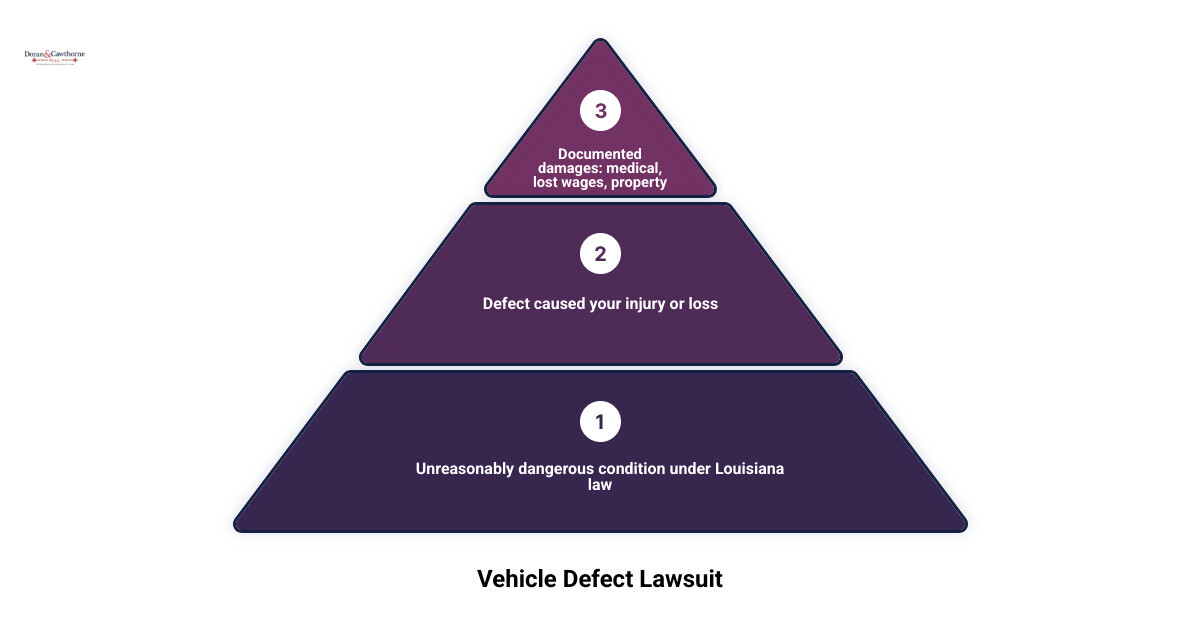
When preparing a vehicle defect lawsuit in Lafayette, you need to show that the vehicle was unreasonably dangerous under Louisiana law, that the defect caused your injury, and that you suffered losses. Preserve the vehicle, photos, repair records, and medical records. Avoid repairs or disposal that could erase evidence before the vehicle can be examined.
I’m Pride Doran, and when handling complex auto and trucking defect claims across Acadiana, I bring more than 20 years of trial experience. Here’s a quick view of what the claim must establish.
Key resources for injured drivers:
- Auto injury settlement lawyer
- Lafayette maximum settlement lawyer
- Louisiana car accident settlement
Core elements of a vehicle defect lawsuit Lafayette

When an unexpected vehicle failure turns a regular drive along Interstate 10 or Johnston Street into a catastrophic collision, initiating a vehicle defect lawsuit in Lafayette requires navigating Louisiana’s complex statutory system to hold manufacturers accountable. Product liability law does not operate like standard negligence. Under the Louisiana Products Liability Act (LPLA), found in La. R.S. § 9:2800.51, auto manufacturers are held strictly accountable when their products fail to protect vehicle occupants.
To understand how to hold manufacturers accountable in Louisiana, you must satisfy specific statutory elements. You cannot simply point to a damaged car and ask for compensation. Under the LPLA, an auto owner or injured victim must establish four distinct points:
- Manufacturer status: The defendant actually designed, manufactured, produced, or placed the vehicle into commerce.
- Unreasonably dangerous condition: The vehicle was unreasonably dangerous in construction, design, inadequate warning, or nonconformity with express warranty.
- Reasonably anticipated use: The damage arose from a reasonably anticipated use of the vehicle by an ordinary consumer.
- Proximate causation: The defective characteristic directly caused the collision, injury, or catastrophic damage.
Proving unreasonably dangerous design in a vehicle defect lawsuit Lafayette
A design defect claim asserts that an entire line of vehicles is inherently unsafe due to engineering decisions made before the car ever reached an assembly line. To succeed in an unreasonably dangerous design claim, a plaintiff must prove two things: first, that an alternative design existed capable of preventing the harm, and second, that the risk of harm outweighed the burden on the manufacturer to adopt that alternative design.
This risk-utility balancing test was highlighted in the Louisiana appellate ruling in Gordon v. Ford Motor Co., where the court evaluated whether a seat-belt D-ring design with an exposed metal edge posed an unreasonable danger to vehicle occupants during a crash. To satisfy the court, the injured party must demonstrate that a safer, economically feasible alternative design was available and would have prevented or mitigated the injury without destroying the vehicle’s utility.
Failure to warn and express warranty breaches
A vehicle may be built flawlessly according to its blueprint, yet still be legally defective if the automaker fails to provide adequate warnings regarding dangerous characteristics that an ordinary driver would not appreciate. Automakers possess advanced testing data and know precisely how vehicle components behave under extreme conditions. If they discover a hidden hazard and fail to warn the public, they face liability.
Similarly, an automaker can be held responsible when a vehicle fails to conform to an express warranty that induced the customer to purchase or use the vehicle. Disputes often arise regarding warranty coverage versus verbal promises. In cases such as L T Garrett v. Nissan of Lafayette, LLC, courts examined consumer reliance on dealer representations when documentation was incomplete or contradictory. Showing justifiable reliance and explicit breach remains a crucial legal hurdle for injured motorists.
The four legal grounds under Louisiana law
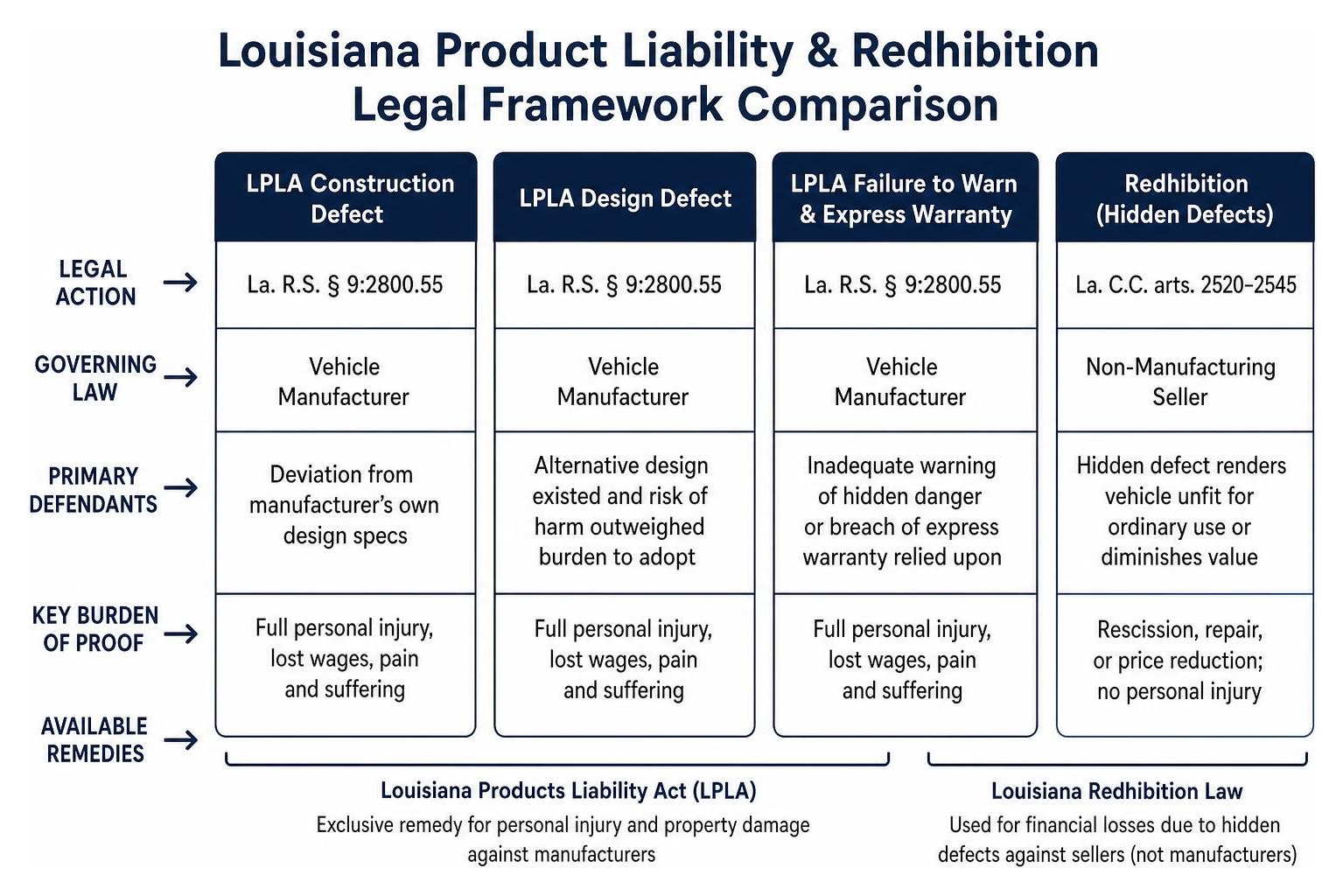
Louisiana law establishes clear boundaries for vehicle defect litigation. The LPLA provides the exclusive legal avenue against vehicle manufacturers for personal injury and property damage, while traditional Louisiana redhibition claims handle pure financial losses caused by hidden mechanical defects against non-manufacturing sellers.
| Legal Action | Governing Law | Primary Defendants | Key Burden of Proof | Available Remedies |
|---|---|---|---|---|
| LPLA Construction Defect | La. R.S. § 9:2800.55 | Vehicle Manufacturer | Deviation from manufacturer’s own design specs | Full personal injury, lost wages, pain and suffering |
| LPLA Design Defect | La. R.S. § 9:2800.56 | Vehicle Manufacturer | Feasible alternative design + risk-utility balance | Full tort damages, medical recovery, disability |
| LPLA Inadequate Warning | La. R.S. § 9:2800.57 | Vehicle Manufacturer | Failure to provide adequate notice of hidden danger | Full tort damages, wrongful death damages |
| LPLA Express Warranty | La. R.S. § 9:2800.58 | Vehicle Manufacturer | Failure to conform to explicit performance claims | Full tort damages, economic loss |
| Redhibition Claim | La. Civ. Code art. 2520 | Dealership / Seller | Non-apparent defect existing at the time of sale | Rescission of sale, purchase price reduction, attorney fees |
When a catastrophic mechanical failure causes an accident on Lafayette roadways, consulting a Lafayette car accident lawyer ensures your claim is correctly filed under either the LPLA or redhibition rules.
Manufacturing and construction defects
A manufacturing or construction defect occurs when a specific vehicle rolls off the assembly line with a dangerous flaw that deviates from the automaker’s own specifications or identical production units. Unlike design defects, you do not need to show that the entire vehicle model line was poorly engineered. You only need to demonstrate that this specific car had a flaw—such as an improperly torqued suspension bolt, contaminated brake fluid, or flawed metal casting—that existed when it left the manufacturing plant.
Redhibition claims vs. LPLA actions against dealerships
Dealerships often try to shield themselves by claiming they are merely retail sellers, not manufacturers. However, under Louisiana redhibition law (La. Civ. Code art. 2520), buyers are protected against non-apparent defects that existed at the time of purchase. If a defect makes the vehicle useless or so inconvenient that the buyer would not have purchased it, the buyer can demand a complete rescission of the sale or a price reduction.
In Barbara W. Flake v. P & P Automotive Interests, Inc., Toyota Motor Corporation, and Toyota Motor Sales, U.S.A., Inc, the Louisiana Court of Appeal evaluated claims where a parking brake failed on an incline. The court affirmed that for a redhibition claim to succeed, the plaintiff must provide substantive proof that a hidden defect existed at the time of sale, rather than relying solely on visual multi-point dealership inspections that failed to detect internal mechanical wear.
Essential evidence and forensic testimony required to win
Proving a vehicle defect claim requires meticulous evidence collection immediately after the collision. Automakers have teams of corporate defense lawyers ready to argue that driver error caused the crash rather than mechanical failure. To overcome these defenses, plaintiffs must compile comprehensive technical proof, including:
- Electronic Control Module (ECM) black box crash data
- Internal vehicle diagnostic error logs
- National Highway Traffic Safety Administration (NHTSA) recall bulletins
- Automaker Technical Service Bulletins (TSBs)
- Dealership repair invoices and maintenance logs
- High-resolution photographic documentation of component fractures
Reviewing what Lafayette drivers must know about winning a Louisiana car accident settlement shows that preserving this physical evidence is often the single most critical factor in achieving a favorable outcome.
Mechanical and biomechanical witness qualifications under Daubert
To get technical evidence admitted into a Louisiana courtroom, your engineering and medical professionals must meet strict admissibility standards under the Daubert doctrine. Automakers routinely file motions to strike witness testimony by challenging their qualifications.
In the Gordon v. Ford Motor Co. appeal, the defense contested whether an accident reconstruction engineer could provide opinions on biomechanical head-strike kinematics. Under Louisiana civil procedure, courts require that every technical professional demonstrates reliable scientific methodology, peer-reviewed analysis, and relevant qualifications before presenting causation opinions to a jury.
Preservation of physical components and diagnostic records
The vehicle itself is the primary piece of evidence. If an insurance company tows the wrecked car to a salvage yard and crushes it, critical evidence vanishes, severely compromising your case under spoliation-of-evidence rules.
The importance of preserving physical components was clearly demonstrated in Carlsen v. Mehaffey & Daigle, Inc., where a brake line fracture caused a serious rear-end crash. Forensic metallurgists analyzed the brake tubing and improper bracketing to prove that mechanical vibration caused metal fatigue and catastrophic hydraulic failure, leading to a substantial judgment for the injured plaintiff.
Overcoming automaker defenses and procedural hurdles
Automakers and corporate insurers rely on procedural tactics to dismiss claims before they reach trial. They may argue comparative fault, claiming driver inattention or speeding caused the crash, or serve tactical discovery requests to corner an unrepresented plaintiff. In serious commercial collisions, working with a semi-trailer crash attorney in Lafayette helps level the playing field against large corporate entities.
Component part manufacturers vs. final automakers
Modern vehicles are assembled using parts from hundreds of third-party suppliers, from airbag sensors to chassis components. When an accident occurs due to a missing safety feature or defective sub-assembly, courts must analyze whether liability rests on the final automaker, the component supplier, or both.
This issue was addressed in Che v. Daimler Trucks North America, LLC, where a chassis was supplied without optional Electronic Stability Control (ESC) systems. The court analyzed whether a component manufacturer is protected when it actively offers standard safety features that the final vehicle builder chooses to decline. Determining which corporate entity owed a legal duty requires an in-depth examination of supply chain contracts and design purchase orders.
Procedural deadlines and standing in a vehicle defect lawsuit Lafayette
Filing deadlines and legal standing represent major hurdles in Louisiana product liability litigation. Under Louisiana law, tort claims generally face a strict one-year prescriptive period from the date of the injury or the date the defect was discovered.
Furthermore, if a vehicle defect causes a fatal fire or severe home damage, questions arise about who has the legal authority to sue. In Ruffino v. General Motors LLC, the Louisiana First Circuit Court of Appeal clarified that universal successors and heirs acquire ownership rights immediately upon a decedent’s passing under the doctrine of le mort saisit le vif. Heirs have legal capacity to bring property damage and defect claims without waiting for formal probate administration, ensuring their claims are not dismissed on procedural exceptions.
Damages recoverable in Louisiana auto defect claims
When a vehicle defect causes serious injury or death, the financial and emotional toll on a family can be overwhelming. Under the LPLA and general Louisiana tort principles, injured plaintiffs are entitled to seek comprehensive compensatory damages to restore their financial security:
- Past and future medical expenses: Hospitalization, emergency surgeries, physical therapy, prescription medications, and long-term in-home care.
- Lost income and earning capacity: Wages lost during recovery, as well as the long-term reduction in your ability to earn a living.
- Physical pain and suffering: Compensation for bodily pain, enduring physical impairment, and emotional trauma resulting from the collision.
- Loss of enjoyment of life: Compensation for the inability to participate in hobbies, family activities, and daily routines.
- Property damage: Repair or replacement costs for damaged vehicles and surrounding real property damaged in collisions or vehicle fires.
- Wrongful death and survival damages: Burial costs, lost financial support, and compensation for the loss of love and companionship suffered by surviving family members.
Frequently asked questions about vehicle defect litigation
What is the time limit to file an auto defect claim in Louisiana?
In Louisiana, the prescriptive period for filing a personal injury claim under the LPLA is generally one year from the date of the accident or injury. For redhibition claims regarding financial loss from an undisclosed defect, the prescriptive period is one year from the date of sale if the seller was in good faith, or one year from the date the buyer discovered the defect if the seller acted in bad faith. Because these timelines are strictly enforced, prompt legal action is essential.
Can heirs sue an automaker if a defective vehicle caused property damage or death?
Yes. Under Louisiana Civil Code articles 934 and 935, universal successors acquire ownership of an estate immediately upon the decedent’s death. As established in Louisiana appellate jurisprudence, heirs do not need to wait for a probate court to conclude succession proceedings before instituting legal actions to recover property damages or pursuing survival actions against an auto manufacturer.
How do dealership claims differ from manufacturer lawsuits in Louisiana?
Under the LPLA, only the actual manufacturer of the vehicle or component part can be sued for personal injury damages under product liability theories. Dealerships that merely retail or service vehicles are generally sued under Louisiana redhibition laws for financial rescission of the sale, or under general negligence theories (such as negligent repair or failure to disclose known hazards) under Louisiana Civil Code article 2315.
Protecting your legal rights after an auto defect collision
Proving that a vehicle defect caused your injuries requires decisive action, thorough forensic analysis, and deep familiarity with Louisiana product liability laws. Automakers and their corporate legal teams fight aggressively to protect their brand reputations and minimize financial exposure.
At Doran & Cawthorne, P.L.L.C., we help injured drivers throughout Acadiana challenge powerful corporate entities and insurance carriers. If you or a loved one suffered injuries due to a vehicle mechanical failure, faulty safety component, or automaker oversight, our team is ready to evaluate your claim and preserve essential evidence. Explore how our dedicated product liability attorneys can advocate for your rights and help you seek maximum financial recovery.
Share this Blog

When You Need Real Talk & Results™
Louisiana Personal Injury Attorneys Committed to Advocating on Your Behalf