 Skip to content
Legal Foundations of a Lafayette Bike Fault Claim
Recovering compensation after a collision requires understanding how Louisiana tort law and product safety statutes work together. When a motorist hits a cyclist on Johnston Street or near the University of Louisiana at Lafayette, standard negligence principles apply under Louisiana Civil Code Article 2315. To succeed, you must demonstrate that the driver owed you a duty of reasonable care, breached that duty through reckless or inattentive actions, and directly caused your physical injuries and economic losses.
However, liability is not always confined to careless drivers. Some crashes occur—or worsen—because a bicycle component fails catastrophically during normal riding. In those scenarios, the Louisiana Products Liability Act (LPLA) governs claims against bicycle manufacturers. Under the LPLA, an injured cyclist must establish that the product was unreasonably dangerous in construction, design, or warning at the time it left the manufacturer’s control.
Louisiana applies a pure comparative fault system under Civil Code Article 2323. This means that even if a defense attorney argues you share partial responsibility for an incident, your recovery is simply reduced by your percentage of fault rather than eliminated entirely. When complex liability overlaps between reckless motorists and failing machinery, consulting a Lafayette personal injury attorney who represents injured cyclists across Acadiana can clarify your legal avenues. The landmark appellate decision in Delahoussaye v. Boelter demonstrates how strictly Louisiana courts analyze equipment changes, safety mechanisms, and the burden of proof when a bicycle fails mid-ride.
Analyzing Driver Duty of Care vs. Product Failure
Motorists must share the road responsibly with cyclists, maintaining a safe passing distance and yielding the right-of-way at intersections. Violations such as dooring, making an unsafe left turn across a bike lane, or following too closely represent clear breaches of this legal duty. A major contributor to local crashes is inattention behind the wheel; our guide to suing a distracted driver details how phone records and traffic camera logs can prove a motorist was not watching the road.
At the same time, we must distinguish between driver negligence and sudden mechanical breakdown. If a motorist strikes a cyclist because a wheel detached or handlebars snapped without warning, the driver’s insurer may claim the collision was unavoidable due to equipment failure. Conversely, if a cyclist crashes independently because a structural component collapses, the legal focus shifts from traffic negligence to manufacturing standards and product integrity.
Lessons from Delahoussaye v. Boelter on Bike Defects
The case of Delahoussaye v. Boelter, 290 So.3d 669 (La. App. 2019), provides vital lessons for bike crash claims in Louisiana. The plaintiff suffered severe injuries when his front wheel detached during a minor maneuver known as a “bunny hop.” He filed suit against the bicycle manufacturer under the LPLA, alleging that the bike possessed a defective quick-release mechanism and lacked necessary warning labels regarding wheel retention.
The Louisiana appellate court affirmed summary judgment in favor of the manufacturer. Crucially, the evidence revealed that the bicycle—originally sold to a prior owner before being resold on eBay—had its secondary retention devices (often called “lawyer lips” or safety tabs) removed or altered by a third party. The court determined that:
- The quick-release mechanism was not inherently dangerous when used with its original secondary retention device.
- The manufacturer provided appropriate warnings and safety hardware when the bike was first sold.
- Alterations made by a previous owner or reseller broke the chain of causation, preventing the manufacturer from being held liable under the LPLA.
This decision shows that when safety hardware is removed or altered by prior owners, product liability claims against the original maker will struggle in court, shifting responsibility toward previous owners, retailers, or the user’s own assembly choices.
Investigating Mechanical Defects vs. Driver Negligence
Disentangling driver fault from mechanical defect requires immediate, disciplined investigation. When we review an accident, our team examines physical evidence, gathers electronic data, and works with engineering professionals to reconstruct the event. A trusted Lafayette negligence attorney from our firm can help uncover whether a driver failed to yield or if a component defect triggered a chain reaction.
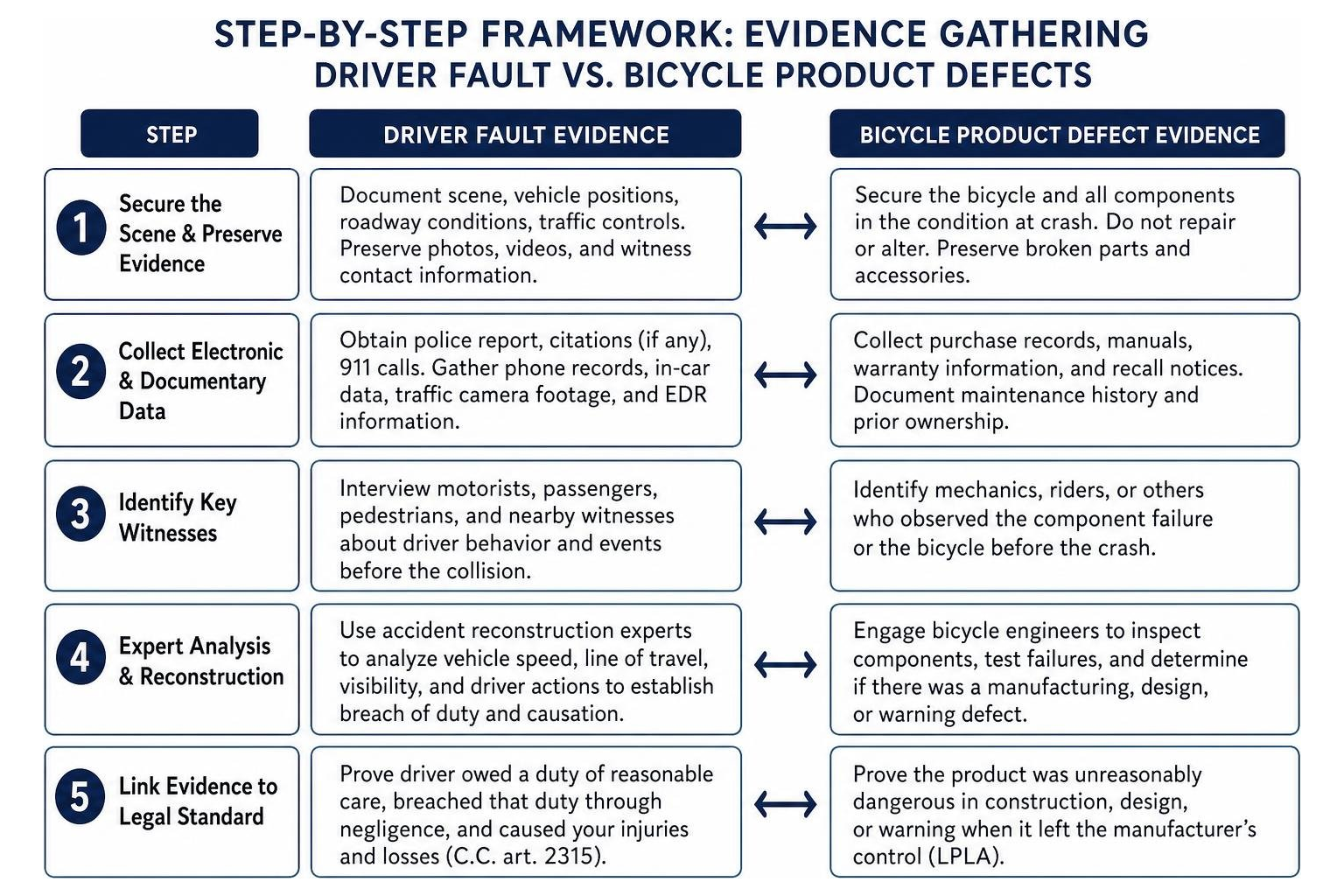
Under the LPLA, establishing a manufacturing defect requires proving that the specific bicycle component deviated from the manufacturer’s own design specifications or performance standards. In contrast, proving a design defect requires demonstrating that an alternative, safer design existed that would have prevented the injury without substantially destroying the product’s utility. Warning defect claims require proof that the manufacturer failed to provide adequate notices about non-obvious hazards.
Filing a Lafayette Bike Fault Claim After a Mechanical Failure
When a carbon fiber fork snaps or a disc brake caliper seizes, filing a claim requires securing the bike exactly as it was at the moment of the crash. Do not attempt to repair the bicycle, discard broken pieces, or return parts to a local shop. The hardware must remain preserved in an unaltered state to maintain the chain of custody required for court admissibility.

Navigating component failure involves understanding product specifications and factory standards. For instance, manufacturers such as Lauf Cycles maintain specific guidelines regarding component design, torque tolerances, and structural integrity, as seen in their warranty guidelines. While warranty policies provide replacements for broken parts, they do not provide compensation for hospital bills, surgical expenses, or lost earnings. Pursuing those damages requires a formal legal claim under Louisiana tort or product liability law.
Manufacturer Warranties vs. Legal Tort Liability
Many cyclists mistakenly believe that submitting a manufacturer warranty claim is an adequate legal remedy after an accident. Warranties are private contractual promises meant to repair or replace broken equipment; they consistently disclaim liability for personal injury, pain and suffering, or third-party damage.
Furthermore, bicycle brands enforce strict exclusions. Normal wear, improper modifications, non-approved third-party parts, and crash impacts are almost universally excluded from standard warranty coverage. Some brands provide crash replacement programs offering discounted parts, such as the Lauf crash replacement terms, but accepting these offers does not compensate you for physical injuries.
Retailers and manufacturers outline distinct claim pathways:
- Retail platforms outline documentation requirements in their LafoBikes warranty claim process.
- E-bike brands enforce strict limits on batteries and motors under the Magicycle warranty policy.
- Specialty brands specify return fees and collision disclaimers within their FattE-Bikes warranty conditions.
The table below outlines how manufacturer warranties and crash programs compare to legal liability claims under Louisiana law:
| Program / Remedy | Primary Coverage Scope | Personal Injury Compensation? | Handling of Crash Damage | Second-Hand Owner Transferability |
|---|---|---|---|---|
| Lauf Cycles Warranty | Material & factory defects (7 yrs original / 2 yrs second-hand) | No | Excluded entirely | Yes (2-year limit from original purchase) |
| Lauf Crash Replacement | 50% discount on Lauf-made frames, forks, and bars | No | Covered (5-year eligibility window) | No (Original owner only) |
| Magicycle Warranty | 2-year limited coverage on frames, components, and motor | No | Excluded; 7-day shipping claim window | Yes (Requires original order number) |
| FattE-Bikes Warranty | 1-2 year limited coverage; $99 motor/battery return fee | No | Excluded (Accidents, stunts, collisions void terms) | No (Original purchaser only) |
| Louisiana Tort / LPLA Claim | Full financial recovery (medical care, wages, pain & suffering) | Yes | Core focus when caused by driver or defect | Actionable regardless of bicycle ownership history |
Step-by-Step Process for Proving Fault in Louisiana Courts
Successfully resolving an injury case requires establishing concrete evidence from the first moments following a collision. If you are struck by a vehicle while cycling in Acadiana, an experienced Lafayette car accident lawyer can assist you in protecting your rights.
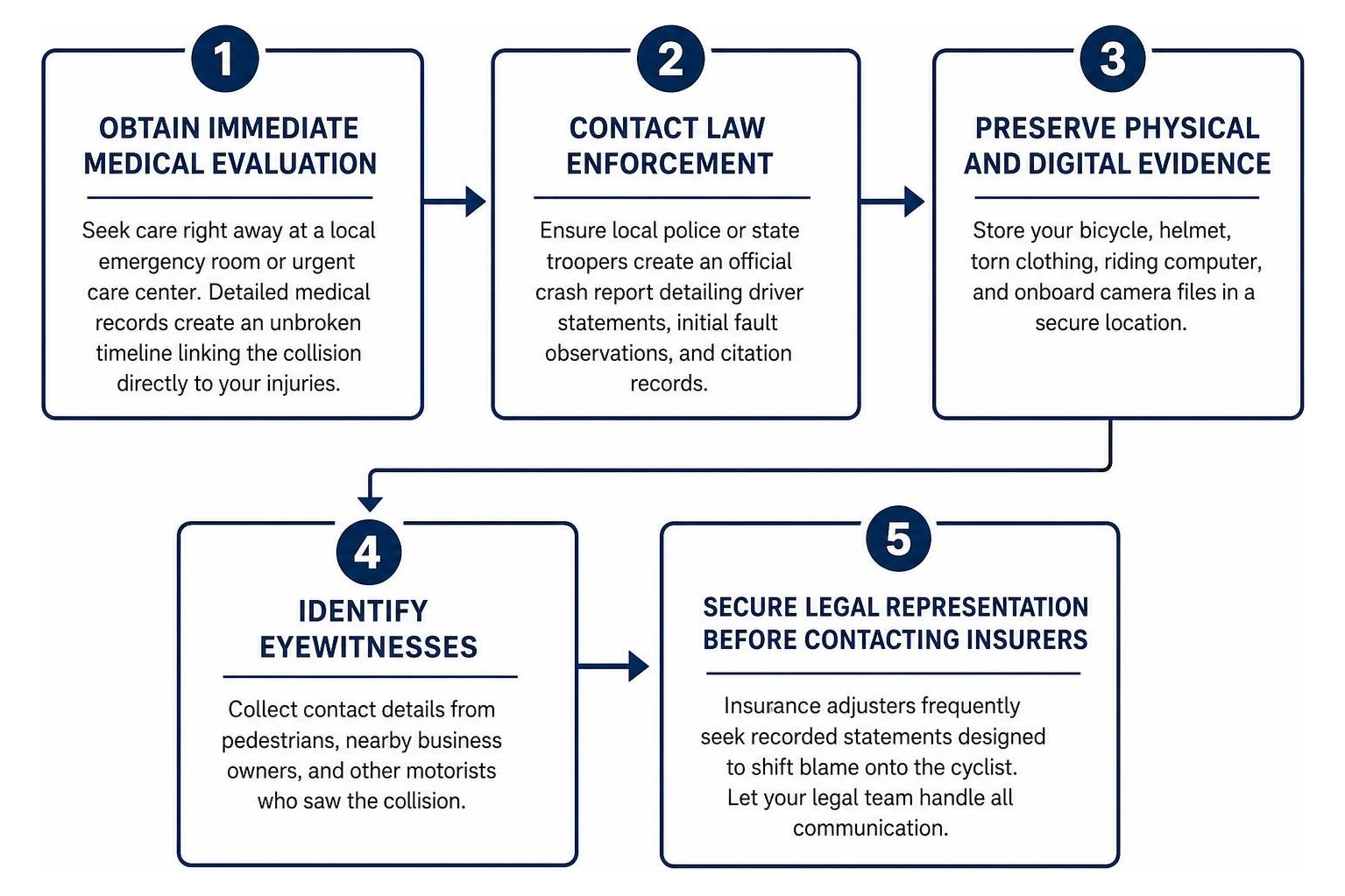
- Obtain Immediate Medical Evaluation: Seek care right away at a local emergency room or urgent care center. Detailed medical records create an unbroken timeline linking the collision directly to your injuries.
- Contact Law Enforcement: Ensure local police or state troopers create an official crash report detailing driver statements, initial fault observations, and citation records.
- Preserve Physical and Digital Evidence: Store your bicycle, helmet, torn clothing, riding computer, and onboard camera files in a secure location.
- Identify Eyewitnesses: Collect contact details from pedestrians, nearby business owners, and other motorists who saw the collision.
- Secure Legal Representation Before Contacting Insurers: Insurance adjusters frequently seek recorded statements designed to shift blame onto the cyclist. Let your legal team handle all communication.
Essential Evidence to Prove a Lafayette Bike Fault Claim
Compiling robust evidence makes the difference between an undervalued settlement and complete financial recovery. When establishing a Lafayette bike fault claim, specific documentation proves critical:
- Helmet and Gear Damage: Cracks and scrapes on safety equipment help accident reconstructionists calculate impact angles and force severity.
- GPS and Cycling App Metrics: Speed, cadence, and location data from devices like Garmin or Strava provide precise timestamps proving your position and road positioning.
- Maintenance Records: Routine service logs from a local bike shop prove that your bicycle was in sound operating condition prior to the crash, defeating claims of improper maintenance.
- Scene Photography: Comprehensive pictures of tire marks, vehicle bumper heights, debris fields, and sightline obstructions document the environment before conditions change.
Cyclists can also review practical road safety strategies in our Lafayette bicycle accident safety guide to better understand riding rights and common traffic hazards across south Louisiana.
Overcoming Defenses and Comparative Fault Arguments
Insurance companies routinely attempt to minimize payouts by blaming cyclists for their own injuries. Common defense tactics include claiming the rider:
- Failed to use an active headlight or taillight during dawn, dusk, or nighttime riding.
- Executed an unpredictable turn or sudden lane merge.
- Failed to wear a helmet (though Louisiana law does not require adult cyclists to wear helmets, adjusters still attempt to use this to dispute head injury damages).
- Made unauthorized mechanical changes or failed to maintain proper tire and brake pressure.
Overcoming these defenses demands systematic counter-evidence. By comparing scene photos, camera footage, and vehicle damage profiles, we counter false comparative fault allegations. Cyclists can learn more about overcoming insurance settlement tactics in our breakdown of strategies for a Louisiana car accident settlement.
Frequently Asked Questions About Bike Fault Claims in Louisiana
How does Delahoussaye v. Boelter impact used bicycle defect claims?
The Delahoussaye decision establishes that bicycle manufacturers are not liable under the LPLA when a previous owner or reseller removes, alters, or fails to properly maintain critical safety components like wheel retention tabs. If you purchased a used bicycle that was modified or assembled improperly by a private seller or bike shop, your legal claim targets that specific seller’s negligence rather than the original manufacturer.
Does a manufacturer’s warranty cover crash injuries?
No. Commercial bike warranties cover only the repair or replacement of broken frames and components caused by factory material or manufacturing defects. They explicitly disclaim liability for medical expenses, lost wages, and pain and suffering. To recover compensation for your physical injuries and financial losses, you must pursue a personal injury or product liability claim.
How does comparative negligence affect compensation in a bike crash?
Louisiana follows a pure comparative fault rule (La. C.C. Art. 2323). If a court determines you were 15% responsible for a collision (for example, due to improper lighting) and the negligent driver was 85% at fault, your total awarded compensation is reduced by exactly 15%. You are still entitled to recover the remaining 85% from the liable driver.
Take Action to Protect Your Bike Accident Claim
A bicycle collision can result in significant medical bills, missed work, and complicated legal disputes involving drivers and equipment manufacturers. Navigating Louisiana’s strict product liability and comparative negligence standards requires dedicated legal advocacy.
At Doran & Cawthorne, we have decades of courtroom experience standing up to aggressive insurance companies on behalf of injured people. If you or a loved one suffered injuries in a bicycle crash, our team is ready to evaluate your case, preserve vital evidence, and pursue the compensation you deserve. We maintain convenient office locations across southern Louisiana, including Lafayette, Baton Rouge, and Opelousas.
Contact our office today to schedule a consultation with our product liability attorneys and let us help you pursue full financial recovery.
Share this Blog

When You Need Real Talk & Results™
Louisiana Personal Injury Attorneys Committed to Advocating on Your Behalf

