 Skip to content
Rideshare insurance coverage dispute in Baton Rouge
A rideshare insurance coverage dispute can leave injured drivers and victims facing a wall of confusing policy language, denied claims, and insurance companies that seem to change their story mid-lawsuit. Here is what you need to know right away:
Quick answers to the most common rideshare coverage questions:
| Situation | Are You Covered? |
|---|---|
| Driver has a passenger in the vehicle | Yes — active transportation coverage applies |
| Driver is en route to pick up a passenger | Yes — most commercial policies cover this phase |
| Driver just dropped off a passenger, no new request | Likely no — coverage often ends at drop-off |
| Driver is logged in but waiting for a request | Depends on policy tier (Phase 1 / “200 Policy”) |
| Driver is logged off entirely | No commercial coverage — personal policy only |
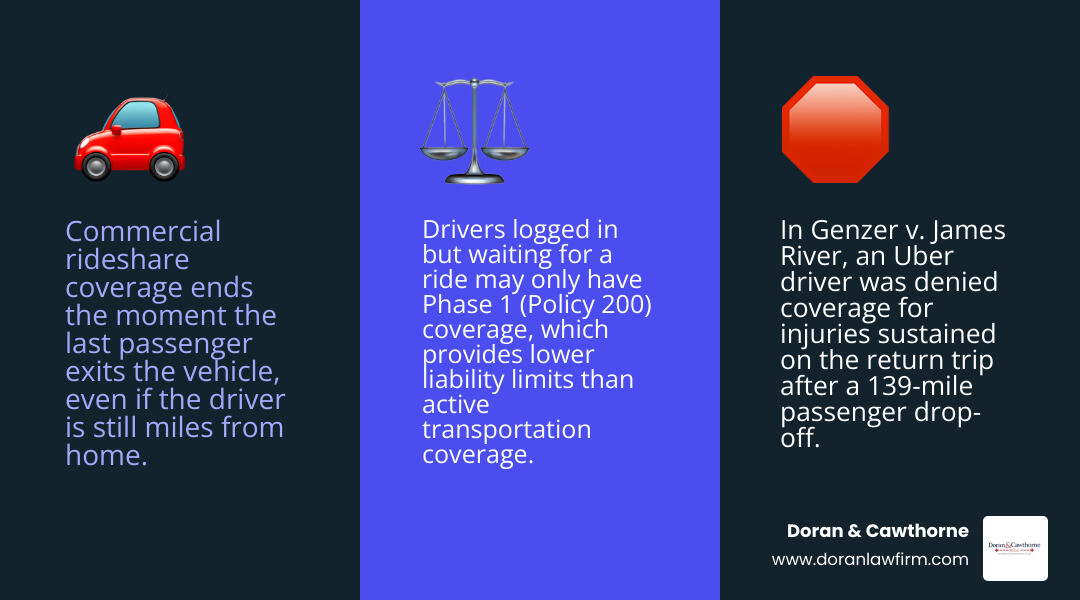
The gap between dropping off a passenger and accepting the next ride is one of the most dangerous blind spots in rideshare insurance. Courts have ruled repeatedly that commercial coverage ends the moment the last passenger exits the vehicle — even if the driver is still miles from home.
Consider what happened in Genzer v. James River Insurance Co.: an Uber driver completed a 139-mile trip from Oklahoma City to Woodward, Oklahoma, then suffered serious facial injuries on the return drive when a metal object was ejected through her windshield by an unidentified semi-truck. The court ruled she was no longer covered under the commercial policy — because her passenger had already been dropped off.
That ruling is a warning for every rideshare driver in Baton Rouge.
I’m Pride Doran, a trial attorney with over twenty years of experience representing individuals against powerful insurance companies in automobile and personal injury claims across Louisiana — including rideshare insurance coverage disputes. If you’ve been injured and are getting the runaround from an insurer, you need to understand exactly where your coverage ends and what your legal options are.
Key legal lessons from Genzer v. James River in a rideshare insurance coverage dispute
To understand why rideshare insurers deny claims so aggressively, we have to look closely at landmark court rulings that shaped commercial transportation insurance. A key decision is explored in the Synopsis background: Genzer v. James River Insurance Company.
In that case, an Uber driver accepted a ride taking a passenger 139 miles. After safely dropping the passenger off at their final destination, the driver began heading back home. While driving on the highway, an oncoming unidentified semi-truck ejected a heavy metallic object straight through her windshield, causing severe facial injuries.

When she filed an uninsured motorist (UM) claim under the commercial policy provided by James River Insurance Company, the insurer denied the claim. The case eventually went to federal court, establishing several pivotal rules about commercial policy boundaries and prelitigation communications.
If you find yourself in a similar situation along I-10 or Florida Boulevard, working with a dedicated Baton Rouge Lyft injury attorney is critical to navigating these technical hurdles.
Mend the hold doctrine in a rideshare insurance coverage dispute
When James River originally denied the driver’s claim before litigation began, its denial letter pointed out that she was not logged into the Uber app at the exact time of the accident. However, after the driver filed a lawsuit alleging she was in fact logged in, the insurer raised a different defense in court: even if she was logged into the app, commercial coverage under the passenger-transport policy ended the moment her rider stepped out of the car.
The driver’s legal team argued that the insurer was barred from changing its reason for denial under a common-law legal rule known as the “mend the hold” doctrine. This doctrine prevents a party to a contract from changing its legal stance after litigation starts.
However, as affirmed in Genzer v. James River Insurance Company, No. 18-6105 (10th Cir. 2019), the court ruled that the mend the hold doctrine did not prevent James River from updating its rationale. The court explained that an insurer is not locked forever into its prelitigation denial letter, especially when the policyholder changes their own factual narrative after filing suit. Holding an insurance company strictly to its initial statement when the claimant shifts their story would be unreasonable.
Impact of shifting factual claims on your insurance lawsuit
In any rideshare insurance coverage dispute, consistency is everything. In the Genzer case, the driver’s position evolved during the dispute:
- Initial claim phase: The driver reported she was simply logged into the app and “available” for new fares.
- Lawsuit phase: To attempt to trigger higher policy limits under the active-fare policy, her claim shifted to arguing she was still actively engaged in “providing transportation services” during her long return trip home.
This shift in factual claims backfired. Because the driver changed her legal strategy, the court allowed the insurance company to assert all relevant policy exclusions and endorsements.
For Baton Rouge commuters and rideshare drivers, this highlights a vital lesson: your initial statements to app support, police officers, and insurance adjusters create a permanent paper trail. Changing your account later can weaken your case and give the insurer leeway to introduce new coverage defenses.
How policy endorsements and trip phases impact Baton Rouge drivers
Rideshare insurance does not operate like standard personal auto insurance. Commercial policies rely on strict “covered auto” endorsements tied directly to app activity. Statistics reveal the scale of this problem across the nation:
- Rideshare drivers are involved in accidents at a rate of 1.1 per million miles driven, compared to 0.6 per million miles for personal drivers.
- Approximately 20% of rideshare drivers report being involved in a collision while driving for a rideshare company.
- Over 40% of rideshare drivers are completely unaware that their personal auto policy may exclude coverage while they are logged into a rideshare app.
- Only 25% of rideshare drivers carry adequate insurance coverage across every phase of rideshare activity.
To understand where you stand after a collision in East Baton Rouge Parish, review the ultimate Uber accident attorney Baton Rouge roadmap and the structural differences between policy tiers:
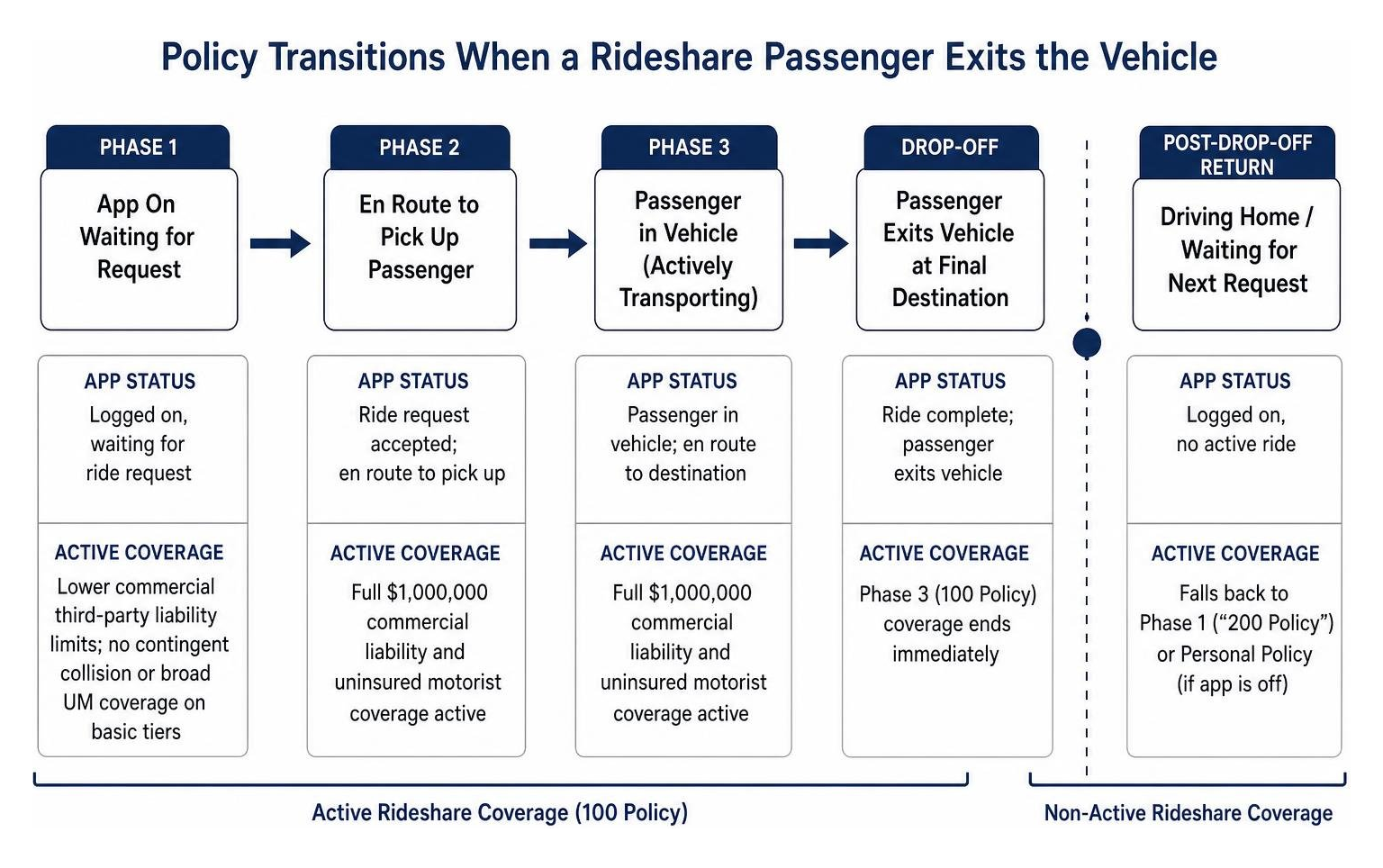
| Policy tier / phase | App status | Active coverage scope |
|---|---|---|
| Phase 1 (“200 Policy”) | App logged on, waiting for a ride request | Lower commercial third-party liability limits; no contingent collision or broad UM coverage on basic tiers |
| Phase 2 (“100 Policy”) | Ride request accepted, en route to pick up | Full $1,000,000 commercial liability and uninsured motorist coverage active |
| Phase 3 (“100 Policy”) | Passenger in vehicle, actively transporting | Full $1,000,000 commercial liability and uninsured motorist coverage active |
| Post-drop-off return | Passenger dropped off, driving home/waiting | Commercial Phase 3 coverage terminates immediately; drops back to Phase 1 or Personal Policy |
Defining final destination under active transportation coverage
Under commercial passenger-transport policy endorsements (frequently referred to as the “100 Policy”), coverage applies while traveling to pick up a rider or while carrying a rider to their final destination.
The legal debate often centers on what constitutes the “final destination.” Courts give this phrase its plain, ordinary meaning: the physical location where the passenger requests to be dropped off and exits the vehicle.
Once the passenger opens the door, steps out, and closes the door at their intended destination, the transportation service is complete. The driver’s journey back home or to a busier area of Baton Rouge—such as driving from downtown back toward College Drive—is not legally considered part of traveling to the passenger’s final destination.
Why policy 100 and policy 200 distinctions matter for coverage
Rideshare platforms maintain separate policy levels to manage liability:
- Policy 100 (Phases 2 & 3): Applies when a ride is accepted or underway. It carries maximum policy limits (typically $1,000,000 in liability and uninsured motorist coverage).
- Policy 200 (Phase 1): Applies when a driver is online and available, but has not accepted a request. It provides much lower primary liability coverage (such as $50,000 per person / $100,000 per accident) and generally excludes contingent physical damage or comprehensive UM benefits unless state law mandates otherwise.
In the Genzer litigation, the driver attempted to cite provisions from the 200 Policy to support her claim. However, the court found the 200 Policy irrelevant because her claim was filed specifically under the 100 Policy’s uninsured motorist endorsement. If you are facing a denial due to these subtle policy tier shifts, consulting an insurance claim denial lawyer Baton Rouge can help clarify which endorsement actually governs your accident.
Policy ambiguity and return trip coverage gaps in Baton Rouge
When policy language feels unfair, drivers often argue that the contract is ambiguous and should be interpreted in their favor. Under established contract law, if an insurance clause can reasonably be interpreted in two different ways, courts construe the ambiguity against the insurer.
However, in rideshare cases, courts routinely reject ambiguity arguments regarding return trips. In Genzer, the driver argued that “providing transportation services” should include the necessary return leg of a long-distance trip. The court disagreed, holding that the policy text is clear-cut: coverage starts when a trip request is accepted and ends when the service is complete upon drop-off.
A similar outcome occurred in MBO v. Old Republic Insurance Company (trial court document), District Court, E.D. New York, 2025. In that case, an Uber driver was struck just 5 to 10 seconds after a passenger exited the vehicle. The court granted summary judgment for the insurer, ruling that “transporting passengers” strictly ends when the passenger exits—temporal proximity of just a few seconds does not extend active transportation coverage.
If you are navigating complex claims involving secondary insurers, speaking with a Lyft liability lawyer Baton Rouge can help you identify all available avenues of recovery.
Return leg coverage risks in a rideshare insurance coverage dispute
The “return leg” gap is a major hazard for drivers. Consider a driver who drops a passenger off in suburban Baton Rouge and drives back toward downtown without an active ride request. During this return leg:
- Commercial Phase 3 coverage has ended: The $1,000,000 policy is no longer active.
- Phase 1 applies (if app is on): If the app remains on, only low-limit third-party liability applies. Contingent collision coverage for damage to the driver’s own vehicle is generally unavailable during Phase 1.
- Personal auto exclusion triggered: Most standard personal auto insurance policies include a public or livery conveyance exclusion. This clause denies coverage if an accident occurs while logged into a commercial app.
This exact situation was analyzed in Robey Neeley v. Lyft, Inc., where a driver rear-ended another vehicle while logged into the app awaiting a request. Because no fare had been accepted, the commercial policy provided no collision coverage for the driver’s $30,000 vehicle repair bill, and the personal policy denied the claim due to the app exclusion.
Frequently asked questions about rideshare insurance claims
When does commercial rideshare insurance stop covering a driver after a ride?
Commercial Phase 3 coverage terminates immediately when the passenger reaches their destination and completely exits the vehicle. Unless the driver immediately accepts a new ride request, coverage transitions back to Phase 1 (if the app remains logged on) or the driver’s personal policy (if the app is turned off).
Can an insurance company change its reason for denying a rideshare claim?
Yes. While the mend the hold doctrine restricts contract parties from switching positions in bad faith, federal and state courts generally allow insurers to adjust their legal defenses during litigation—especially if the claimant introduces new factual theories or claims after filing suit.
What happens if I get into an accident on the drive back after dropping off a fare?
If you are involved in a hit-and-run or struck by an uninsured driver on your return drive home without an active passenger or accepted request, the main commercial Phase 3 uninsured motorist coverage will not apply. You must rely on Phase 1 coverage (if available and applicable) or a personal rideshare policy endorsement. With average uninsured motorist claims costing around $20,000 and general rideshare claims averaging $15,000, having the proper personal rideshare endorsement is vital.
Stand firm against denied rideshare claims in Baton Rouge
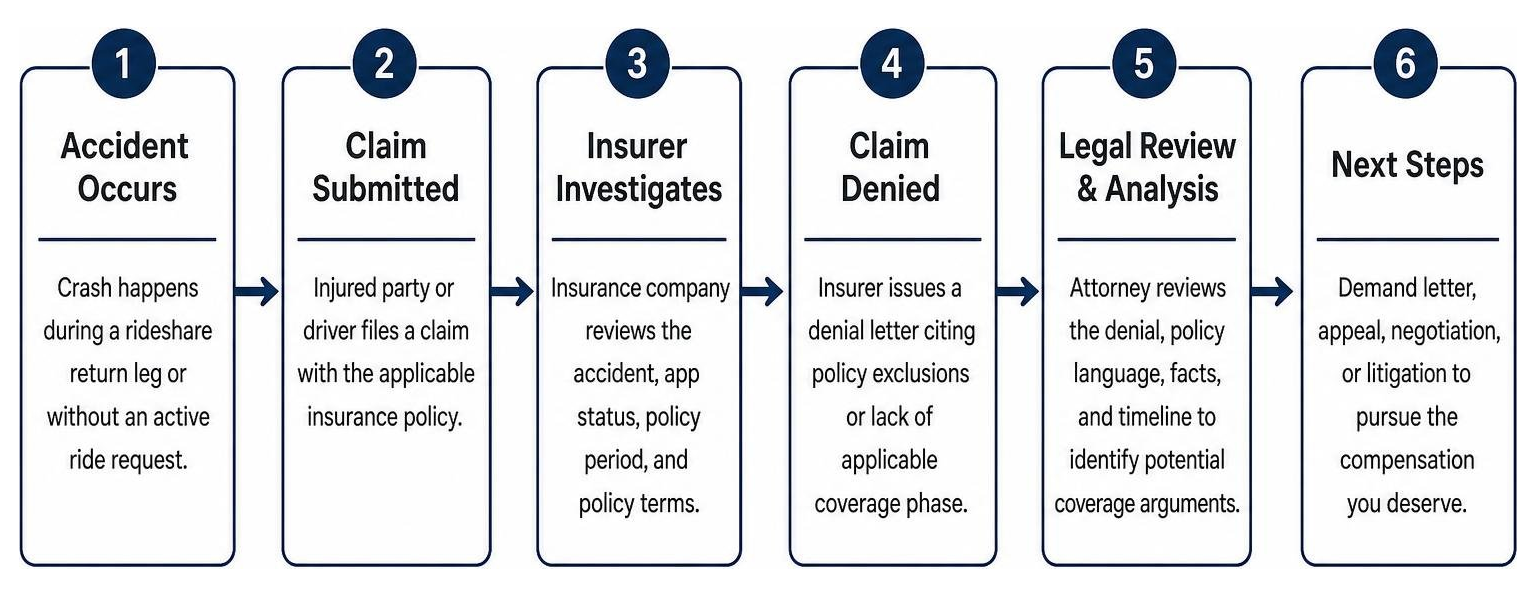
A rideshare insurance coverage dispute can quickly leave you feeling overwhelmed, especially when recovering from painful injuries, missing time from work, and facing mounting medical bills. Insurance carriers count on complex endorsement language and confusing phase definitions to discourage injured claimants from pursuing full compensation.
At our firm, we fight to level the playing field. Whether you were an injured passenger in an Uber, a driver struck during a complex coverage phase, or a third-party motorist hit by a rideshare vehicle, our team works to hold commercial insurance companies accountable to the full extent of the policy language.
If your claim was denied or delayed following a crash, do not try to deal with corporate adjusters on your own. Connect with an experienced Uber Lyft injury attorney Baton Rouge at Doran & Cawthorne today to review your policy details, evaluate your accident timeline, and fight for the recovery you deserve.
Share this Blog

When You Need Real Talk & Results™
Louisiana Personal Injury Attorneys Committed to Advocating on Your Behalf

