 Skip to content
Who May Qualify for Baton Rouge Truck Compensation After a Crash
Baton Rouge truck compensation after a commercial-truck crash may cover your medical bills, lost income, pain and suffering, and other losses when another party’s negligence caused your injuries. Eligibility often depends on proving the crash, identifying who was at fault, documenting your damages, and filing your claim on time.
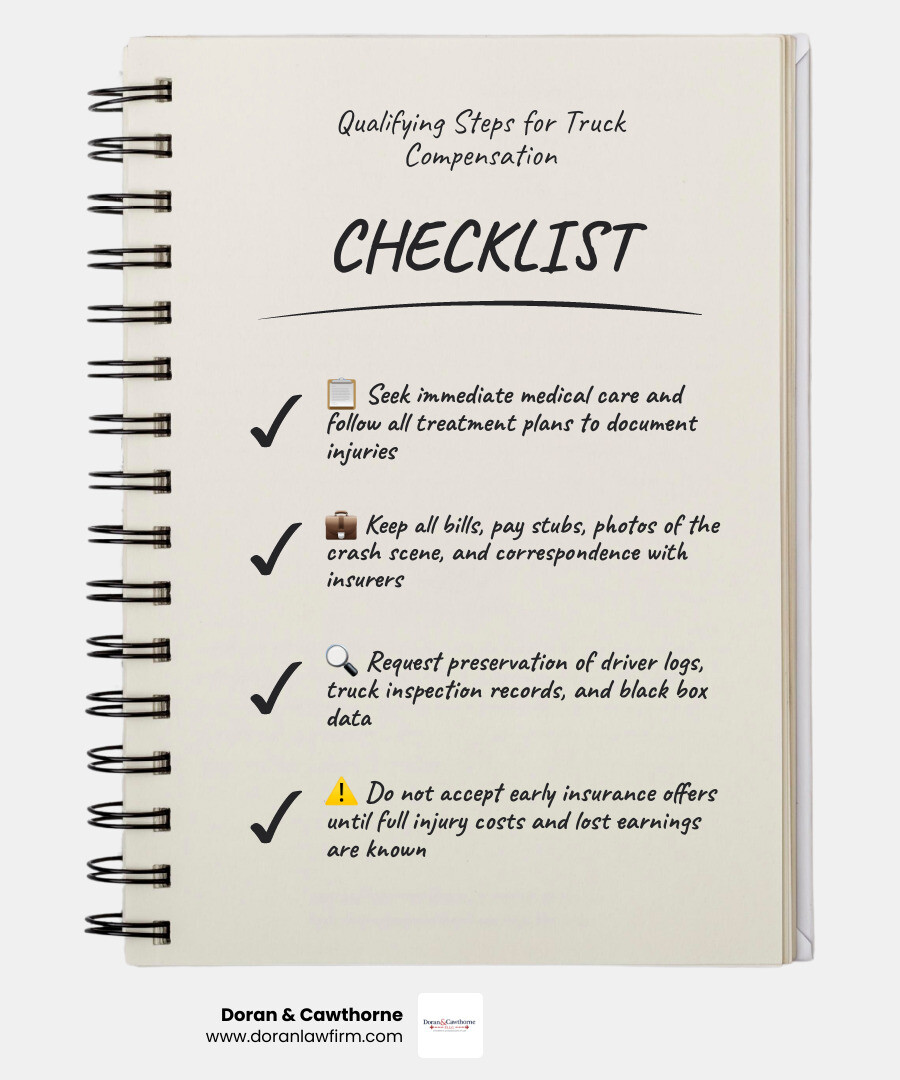
To protect a potential claim:
- Get medical care and follow your treatment plan.
- Keep bills, pay records, photos, and crash-related messages.
- Request that important evidence, such as driver logs and truck inspection records, be preserved.
- Be cautious about accepting an early insurance offer before you know the full cost of your injuries.
Truck collisions can involve the driver, trucking company, maintenance provider, cargo handler, or another party. That matters because commercial insurance policies and the evidence needed to establish fault can be more complex than in a typical car wreck.
I am Pride Doran, a trial lawyer with more than 20 years of experience handling automobile and trucking claims, workplace injuries, and other Louisiana injury cases. This guide explains the key factors that can affect Baton Rouge truck compensation and your path toward a fair recovery.
Know your Baton Rouge truck compensation terms:
Understanding Baton Rouge Truck Compensation After an Accident
When an 80,000-pound commercial vehicle collides with a standard passenger car along Interstate 10, Interstate 12, or Airline Highway, the physical and financial aftermath is rarely minor. Seeking financial recovery requires understanding the categories of damages recognized under Louisiana law.
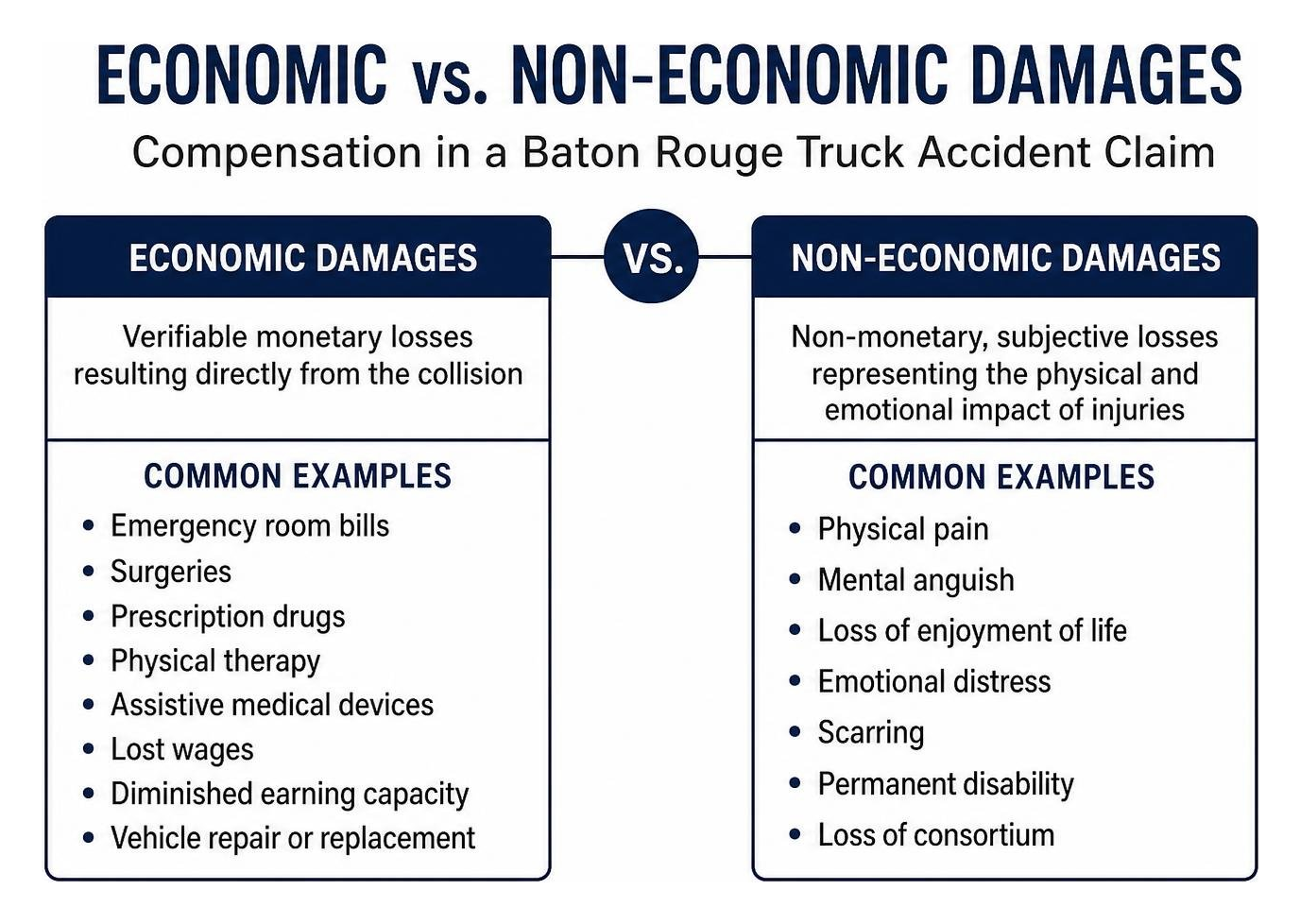
In a commercial vehicle injury claim, damages are broadly split into economic and non-economic losses. Economic damages refer to the concrete, out-of-pocket financial setbacks directly caused by the collision. Non-economic damages address the intangible, human toll of the wreck. An overview of the high cost of truck accidents seeking compensation for your injuries demonstrates how quickly emergency surgery, hospitalization, diagnostic imaging, and long-term physical therapy accumulate into six- or seven-figure financial burdens.

When a crash causes a catastrophic injury, such as traumatic brain injury, spinal damage, or multiple fractures, the financial recovery must account for lifelong medical care, home accessibility modifications, and diminished quality of life.
| Damage Category | Description | Common Examples in Baton Rouge Truck Claims |
|---|---|---|
| Economic Damages | Verifiable monetary losses resulting directly from the collision | Emergency room bills, surgeries, prescription drugs, physical therapy, assistive medical devices, lost wages, diminished earning capacity, and vehicle repair or replacement |
| Non-Economic Damages | Non-monetary, subjective losses representing the physical and emotional impact of injuries | Physical pain, mental anguish, loss of enjoyment of life, emotional distress, scarring, permanent disability, and loss of consortium |
How Lost Earnings and Driver Pay Impact Injury Claims
Accurate calculation of lost earnings is a major component of any commercial vehicle injury claim. Whether the victim is a professional driver hurt on the job or a commuter whose career is sidelined by a negligent trucker, establishing base income requires reviewing real-world earning metrics.
In the Baton Rouge freight and petrochemical transportation market as of September 2026, commercial transport wages vary significantly depending on contract structure, freight classification, and route type. For example, a CDL-A truck driver – 1099 – $130k+/yr – Baton Rouge, LA job demonstrates that independent contractors and lease-purchase operators often handle base pay structures ranging between $1.17 and $2.90 per mile, with gross earnings reaching $130,000 to $150,000 annually.
Meanwhile, specialized roles such as a dedicated HAZMAT & tanker OTR truck driver – Baton Rouge, LA provide company drivers with approximately $0.60 per mile (CPM), averaging weekly gross wages of $1,600 to $1,800 alongside sign-on incentives. Documenting actual historical income, missing safety bonuses, and lost contract miles is vital when proving how an accident destroyed a worker’s financial livelihood.
Calculating Lost Wages and Baton Rouge Truck Compensation
Calculating earnings lost after a crash goes far beyond multiplying an hourly wage by missed days. Reviewing what you need to know after a Baton Rouge tractor trailer wreck highlights how pay structures require careful financial documentation to ensure complete recovery.
When calculating wage-related losses, we evaluate:
- Base Pay and Mileage Rates: Documenting regular pay rates, whether paid hourly, by salary, or calculated via cents-per-mile (CPM) schedules.
- Overtime and Incentive Losses: Demonstrating regular overtime patterns, safety bonuses, quarterly performance bonuses, and sign-on incentives lost during medical recovery.
- Lost Contractual Revenue: For owner-operators and 1099 contractors, calculating net business losses after accounting for fixed operating expenses, fuel surcharges, and maintenance reserve allocations.
- Diminished Future Earning Capacity: When permanent injuries prevent someone from returning to commercial driving, industrial labor, or their previous career path, financial analysts project the lifetime difference between their pre-accident earning potential and their post-injury capabilities.
Legal Factors That Determine Baton Rouge Truck Compensation
Several foundational legal and factual components dictate the ultimate value of a commercial vehicle claim. A successful Baton Rouge truck accident claim requires aligning medical documentation, economic proof, and statutory insurance requirements.
- Commercial Insurance Policy Limits: Federal Motor Carrier Safety Administration (FMCSA) regulations require interstate motor carriers to maintain commercial liability policies ranging from $750,000 for standard freight to $5,000,000 or more for hazardous material transport. These higher limits provide a recovery source capable of covering catastrophic harm.
- Comparative Fault Principles: Louisiana applies pure comparative fault under Civil Code Article 2323. Your recovery is reduced in direct proportion to your share of responsibility. Insurance adjusters frequently try to push undue blame onto injured motorists to reduce payouts.
- Medical Evidence and Causation: Clear medical records linking the collision to immediate trauma and chronic limitations prevent insurers from dismissing your injuries as pre-existing conditions.
Identifying Liable Parties in Louisiana Commercial Truck Wrecks
Commercial transportation operations involve multiple corporate entities. Unlike passenger car accidents where liability is usually confined to the drivers involved, commercial truck crashes often involve widespread institutional liability. An analysis of trucking accidents causes liability breaks down how establishing fault requires investigating every corporate entity connected to the vehicle and its freight.
Potential liable parties include:
- The Commercial Driver: For reckless driving, speeding, distracted driving, driving while impaired, or violating federal rest regulations.
- The Motor Carrier / Trucking Company: Under the legal doctrine of respondeat superior, trucking companies are liable for the negligent acts of their employees. They may also face direct claims for negligent hiring, negligent training, inadequate supervision, or forcing drivers to violate safety rules.
- Freight Shippers and Cargo Loaders: Improperly secured, unbalanced, or overloaded cargo can cause rollovers, jackknife incidents, or catastrophic cargo spills across the highway.
- Third-Party Maintenance Contractors: Freight carriers frequently outsource brake, tire, and mechanical maintenance to third-party vendors. If mechanical failure caused the wreck, maintenance logs reveal whether vendors performed sub-par repairs.
- Equipment Manufacturers: If a defect in the truck’s steering mechanism, braking system, or tires contributed to the wreck, the product manufacturer may be held strictly liable.
Carrier Negligence and Federal Violations
Commercial interstate trucking is strictly governed by Title 49 of the Code of Federal Regulations. Reviewing resources on understanding the common types of truck accidents shows how frequent violations of these safety rules lead directly to catastrophic roadway collisions.
When investigating carrier negligence, we examine:
- Hours of Service (HOS) Violations: Federal rules restrict property-carrying drivers to 11 hours of driving within a 14-hour duty window following 10 consecutive hours off duty. Violating these limits creates extreme driver fatigue.
- Electronic Logging Device (ELD) Falsification: Cross-referencing digital ELD records with highway toll receipts, fuel purchase timestamps, and GPS tracking data often reveals log falsification designed to conceal illegal driving hours.
- Deferred Mechanical Maintenance: Carriers are required to conduct pre-trip and post-trip vehicle inspections. Skipping mandatory brake adjustments, operating on worn tire treads, or ignoring warning lights puts everyone on the road in danger.

Frequently Asked Questions About Baton Rouge Truck Claims
How is pain and suffering calculated in truck collision settlements?
Non-economic damages like physical pain, mental anguish, and loss of enjoyment of life do not come with medical invoices. In Louisiana injury negotiations, pain and suffering damages are evaluated based on the severity of the trauma, the invasiveness of medical treatments (such as spinal injections or orthopedic surgeries), the duration of recovery, and the permanent impact on your daily lifestyle.
Insurance companies often use software formulas or multiplier methods, but strong trial preparation using medical records, treating physician testimonies, and daily life documentation provides the true basis for fair value.
What is the deadline to file a truck injury claim in Louisiana?
In Louisiana, the prescription period (statute of limitations) for personal injury claims resulting from motor vehicle accidents is generally two years from the date of the injury for incidents occurring on or after July 1, 2024. Prior to that statutory update, Louisiana maintained a strict one-year prescriptive period.
Filing your claim within this legal window is essential; missing the deadline permanently bars your right to financial recovery. Furthermore, critical evidence like truck black box (Electronic Control Module) data, dashcam footage, and driver logs can be legally destroyed or overwritten within weeks if a formal spoliation letter is not sent promptly.
Can an injured party recover damages if partially at fault?
Yes. Louisiana operates under a “pure comparative fault” system codified in Louisiana Civil Code Article 2323. Under this rule, an injured person is not barred from recovering compensation even if they share partial responsibility for the collision.
Instead, your total financial recovery is reduced by your exact percentage of fault. For example, if your total damages equal $500,000 but a court finds you 10% responsible for the accident, you remain eligible to collect 90% of the compensation, or $450,000.
Securing Fair Compensation After a Baton Rouge Truck Collision
Recovering from a severe commercial vehicle crash is physically exhausting and financially stressful. Insurance carriers representing commercial trucking fleets deploy teams of adjusters, investigators, and defense counsel immediately following a wreck to minimize their financial exposure. Protecting your legal rights requires rapid evidence preservation, comprehensive documentation of your medical care and lost income, and aggressive claim handling.
At Doran & Cawthorne, our attorneys stand up against corporate trucking entities and their insurers to pursue the maximum recovery you deserve. We maintain office locations in Opelousas, Lafayette, and Baton Rouge to serve injured individuals throughout Louisiana. If you or a loved one has suffered injuries in a crash, review your legal options through our Baton Rouge truck accident representation resources and schedule a free consultation to protect your claim.
Share this Blog

When You Need Real Talk & Results™
Louisiana Personal Injury Attorneys Committed to Advocating on Your Behalf

