 Skip to content
Your Options After a Motorcycle Passenger Injury in Opelousas
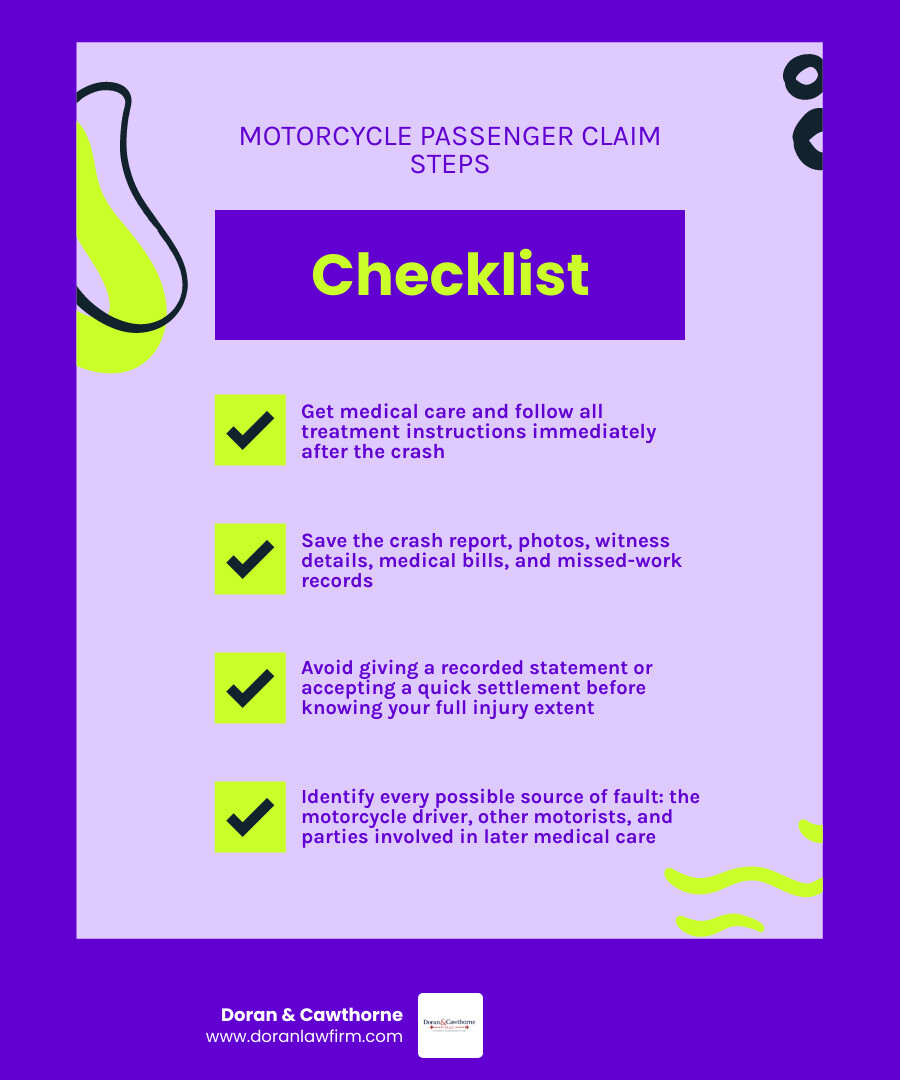
A motorcycle passenger claim Opelousas case may allow you to seek payment for medical care, lost income, pain, and other losses when the motorcycle rider, another driver, or both caused the crash. You do not lose your right to recover simply because you accepted a ride. Take these steps early:
- Get medical care and follow treatment instructions.
- Save the crash report, photos, witness details, bills, and missed-work records.
- Avoid giving a recorded statement or accepting a quick settlement before you know the full extent of your injuries.
- Identify every possible source of fault, including the motorcycle driver, another motorist, and, in limited cases, parties involved in later medical care.
Louisiana uses comparative fault. That means a passenger’s recovery can be reduced by the passenger’s own share of fault, but it is not automatically barred. Under Smith v. Castle, simply riding as an additional motorcycle passenger does not by itself prove that the passenger accepted the risk of a negligent ride. The key question is what the passenger actually knew and chose to do.
Helmet use can also matter, especially if the claimed injuries involve the head or face. Insurers may argue that a failure to wear required safety gear contributed to the severity of an injury, but they still must connect that conduct to the harm at issue.
I am Pride Doran, a trial lawyer with more than 20 years of experience handling Louisiana injury claims involving vehicle collisions, serious injuries, insurance disputes, and settlement negotiations. In a motorcycle passenger claim Opelousas residents bring after a crash, I focus on the evidence needed to pursue fair recovery while preparing for the defenses insurers often raise.
Motorcycle passenger claim Opelousas vocabulary:
Legal Framework for a Motorcycle Passenger Claim Opelousas Residents Pursue
When you ride as a passenger on a motorcycle, you place your physical safety in the hands of the operator and every motorist sharing the road. When a collision occurs along local corridors like Interstate 49 or Highway 190 in St. Landry Parish, injured passengers frequently face complicated legal questions regarding who must pay for their damages.
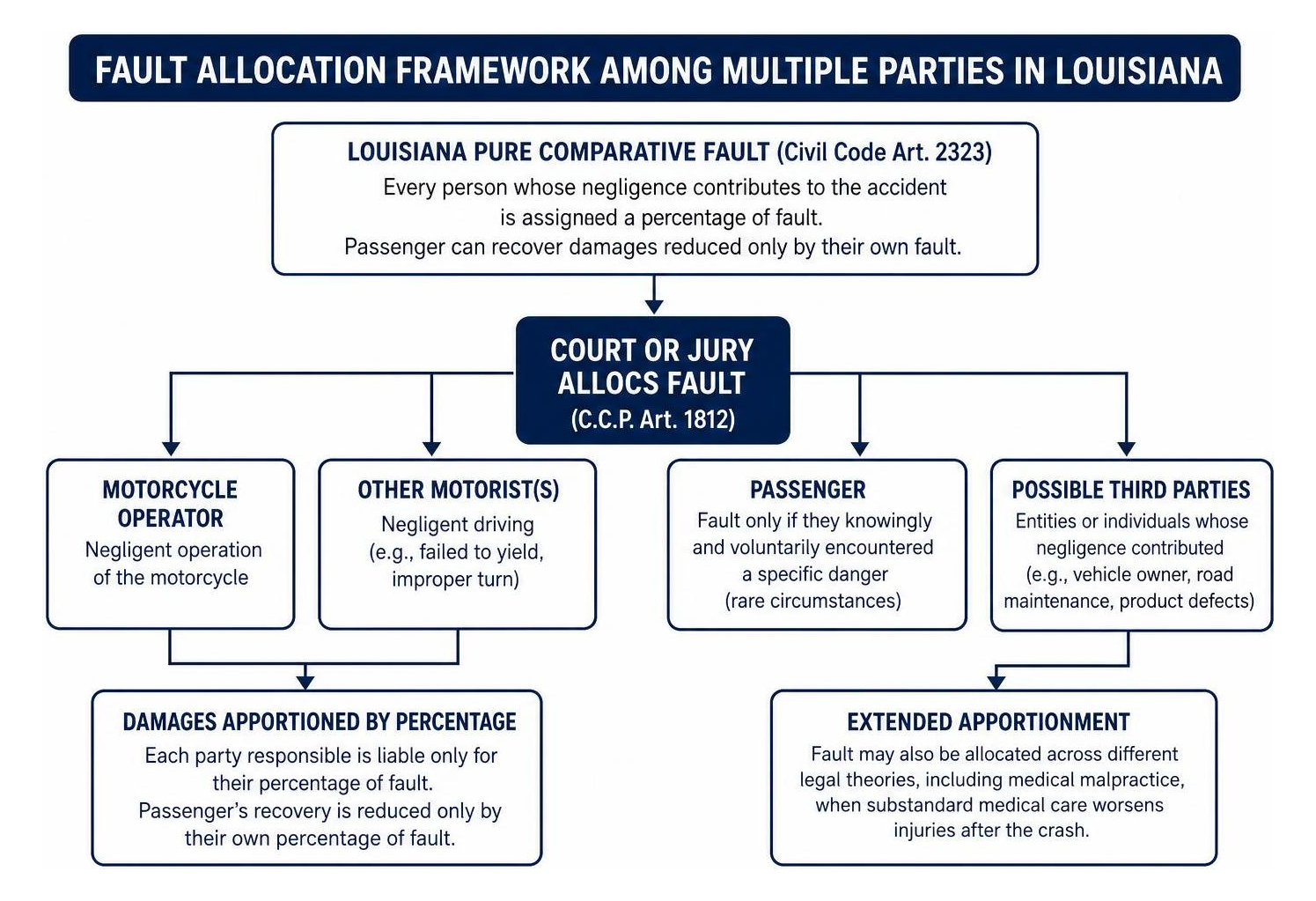
Under Louisiana Civil Code Article 2323, our state follows a pure comparative fault system. This principle dictates that every person whose negligence contributes to an accident is assigned a percentage of fault. For an injured guest passenger, this legal structure is generally favorable. Passengers rarely cause vehicle collisions because they do not control the motorcycle’s throttle, brakes, or steering. Whether a crash results from a driver failing to yield at a rural intersection or another motorist turning left across oncoming traffic, you can pursue compensation against any negligent driver. Learning about motorcycle rights protection in Opelousas and what every rider should know helps riders and passengers alike understand how these liability rules apply in real-world scenarios.
Evaluating Assumption of Risk and Passenger Fault
Insurance companies routinely attempt to shift blame onto motorcycle passengers to reduce payout obligations. One common affirmative defense is the “assumption of risk.” Insurers may claim that by choosing to get on a motorcycle, you knowingly accepted the inherent hazards of the road.
Louisiana courts have firmly rejected the idea that a passenger automatically waives their rights simply by climbing onto a bike. In the landmark decision Smith v. Castle, 361 So. 2d 303 (Louisiana Court of Appeal 1978), the court addressed a scenario where an injured rider was a third passenger on a motorcycle. The appellate court established that simply being a third rider or riding as a passenger does not constitute contributory negligence or assumption of risk unless clear evidence proves that the passenger knowingly and voluntarily encountered a specific danger—such as getting on a bike with an visibly intoxicated or reckless driver. Mere presence on the vehicle does not strip an injured person of their right to recover damages from a negligent driver.
Helmet Requirements and Injury Causation in St. Landry Parish
Louisiana law requires all motorcycle operators and passengers to wear safety helmets that meet specific safety standards. Enforced strictly by local law enforcement, including Louisiana State Police Troop I, this law is designed to mitigate severe head and brain trauma during roadway impacts.
If a passenger is injured in a crash while not wearing a helmet, insurance adjusters often argue that the passenger’s own conduct caused the injuries. Under Louisiana comparative fault rules, failing to wear a helmet does not completely bar your claim. Instead, the defense must prove a direct causal link between the lack of a helmet and the specific injuries suffered. If a passenger suffers a broken leg or fractured pelvis, the failure to wear a helmet has no bearing on those orthopedic damages.
| Factor | Helmet Compliant | Non-Compliant Helmet Use | Impact on Claim Recovery |
|---|---|---|---|
| Orthopedic Injuries (e.g., broken limbs) | Fully recoverable | Fully recoverable | No reduction; helmet use does not affect non-head injuries |
| Head or Brain Injuries | Fully recoverable | Potential comparative fault reduction | Defense must prove lack of helmet worsened specific head trauma |
| General Fault for Crash | 0% passenger liability | 0% passenger liability | Non-compliance does not cause the actual traffic collision |
Multi-Party Liability and Complex Theories of Fault
Many motorcycle collisions in St. Landry Parish involve multiple vehicles and conflicting stories. Under Louisiana Code of Civil Procedure Article 1812, the court or jury must allocate specific percentages of fault to each party involved in causing the harm. Seeking dedicated personal injury representation for motorcycle accidents ensures that every responsible party—and their respective insurance carrier—is brought before the court.
Apportioning Fault Across Negligence and Medical Malpractice
In catastrophic injury cases, the legal issues can extend beyond the initial crash on the roadway. If a passenger suffers severe trauma in a collision and subsequently receives substandard medical care at a hospital, Louisiana law allows for an apportionment of fault among distinct legal theories.
The legal principles established in Brandi Billeaudeau v. Opelousas General Hospital Authority confirm that separate fault percentages can be assigned to different theories of liability, such as initial driver negligence versus institutional hospital negligence. When an injured passenger requires complex emergency room intervention and suffers worsened injuries due to medical errors, our legal strategy accounts for both the initial traffic collision and subsequent healthcare failures.
Louisiana Medical Malpractice Act and Statutory Damage Caps
When a passenger’s injury claim involves subsequent medical errors by qualified health care providers, the Louisiana Medical Malpractice Act (MMA) comes into play. The MMA caps total recovery against qualified healthcare providers at $500,000 (exclusive of future medical expenses), with individual provider liability capped at $100,000 and the remainder covered by the Louisiana Patient’s Compensation Fund.
However, claims that fall outside standard medical malpractice—such as corporate negligence or negligent credentialing by a hospital authority—may not be subject to standard statutory caps in the same manner. Distinguishing between general vehicular negligence, institutional liability, and medical malpractice is vital to maximizing financial recovery.
Evidence and Procedure for Passenger Injury Claims in St. Landry Parish
Succeeding in a personal injury action requires moving quickly to collect physical evidence, interview witnesses, and preserve vehicle telemetry. Following a clear set of steps to take after a motorcycle accident protects your physical recovery and preserves your legal rights. Reviewing how to file an Opelousas accident injury claim in simple steps helps injured victims understand the administrative and legal path forward.
Proving Fault in a Motorcycle Passenger Claim Opelousas Courts Review
Proving liability requires presenting concrete facts to the insurer or the St. Landry Parish District Court. Working with an experienced Opelousas motorcycle negligence attorney allows you to compile the necessary evidence to establish negligence, including:
- Crash Investigation Reports: Official reports compiled by Louisiana State Police Troop I or the Opelousas Police Department documenting points of impact, vehicle rest positions, and traffic citations.
- Witness Statements: Neutral accounts from other motorists or pedestrians confirming traffic signal states, vehicle speeds, and failure-to-yield violations.
- Accident Reconstruction: Engineering calculations, skid mark analyses, and vehicle black box data detailing impact velocity and braking patterns.
- Toxicology and Driver Records: Documentation proving whether either driver was impaired by alcohol, prescription narcotics, or illicit substances.
At Doran & Cawthorne, we investigate these details thoroughly to ensure no insurance company unfairly denies your recovery.
Recoverable Compensation in a Motorcycle Passenger Claim Opelousas Victims Suffer
A passenger injured through no fault of their own is entitled to comprehensive compensation under Louisiana law. Recoverable damages fall into two main categories:
- Special Damages (Economic Losses):
- Past and future medical expenses (hospitalization, surgery, rehabilitation, medications)
- Lost wages and lost earning capacity if you cannot return to your prior occupation
- Out-of-pocket medical supplies and adaptive home modifications
- General Damages (Non-Economic Losses):
- Physical pain and suffering
- Mental anguish, anxiety, and post-traumatic stress
- Loss of enjoyment of life and permanent physical impairment or scarring
Frequently Asked Questions About Motorcycle Passenger Claims in Opelousas
Can a motorcycle passenger recover damages if the motorcycle driver was at fault?
Yes. As a guest passenger, you have the legal right to file an insurance claim or personal injury lawsuit directly against the motorcycle operator’s liability insurance policy if their negligence caused or contributed to the crash. You can also pursue claims against other negligent motorists involved in the collision.
How does not wearing a helmet affect a motorcycle passenger claim in Louisiana?
Not wearing a helmet does not prevent you from recovering compensation. However, the insurance company may argue comparative negligence if you suffered head, neck, or facial injuries. To reduce your compensation, the defense must provide medical proof that wearing a helmet would have eliminated or reduced the severity of that specific injury.
What is the time limit to file a motorcycle passenger injury claim in Opelousas?
In Louisiana, personal injury claims are governed by strict prescriptive periods. You generally have a limited window from the date of the crash to formally file a lawsuit in court. Missing this statutory deadline forever bars your right to financial recovery, making early legal action necessary.
Securing Full Financial Recovery for Injured Motorcycle Passengers
Motorcycle passengers face severe physical vulnerabilities when involved in a roadway collision, and dealing with insurance carriers while trying to heal creates unnecessary strain. At Doran & Cawthorne, our attorneys hold negligent drivers, commercial entities, and healthcare providers accountable to ensure our clients receive the maximum recovery available under Louisiana law. If you or a loved one suffered harm while riding as a passenger in St. Landry Parish, consult an experienced injury attorney in Opelousas to evaluate your claim and protect your future.
Share this Blog

When You Need Real Talk & Results™
Louisiana Personal Injury Attorneys Committed to Advocating on Your Behalf

