 Skip to content
What Is an Opelousas Personal Injury Claim Lawyer and What Cases Do They Handle?
A personal injury claim lawyer is a civil litigator who represents individuals who have been physically or psychologically injured as a result of the negligence or intentional wrongdoing of another party. This area of law is governed by tort law, which is designed to restore an injured victim to the financial position they would have been in had the accident never occurred.
In Louisiana, the foundational rule for these cases is found in Louisiana Civil Code Article 2315, which establishes that anyone whose fault causes damage to another person must repair that damage. To build a successful case under this standard, we must establish four key elements: a legal duty of care was owed to you, that duty was breached through negligent actions, the breach directly caused your injuries, and you suffered actual financial or physical damages as a result. For a deeper look at how these legal pieces fit together, you can read about understanding personal injury claims: the essential elements.
When you are injured, powerful insurance companies and corporate entities deploy teams of adjusters and defense lawyers to protect their bottom lines. Their primary goal is to pay you as little as possible. Retaining an experienced attorney levels the playing field, shielding you from aggressive corporate tactics and ensuring your rights are protected throughout the legal process. To explore our full suite of advocacy services, visit our main page on personal injury.
What Are the Most Common Practice Areas?
Our legal team represents victims across a wide range of accident types, tailoring our strategy to the specific rules of each practice area:
- Car and Truck Accidents: High-impact collisions on Louisiana highways often involve commercial vehicles and heavy 18-wheelers. These cases require an immediate investigation to preserve logbooks, black box data, and maintenance records. If you have been hurt on the road, it is critical to act quickly so you don’t leave money on the table after a car wreck.
- Motorcycle and Pedestrian Accidents: Vulnerable road users have very little physical protection during a crash. As a result, these accidents frequently lead to catastrophic, life-altering injuries that require long-term medical care and extensive rehabilitation.
- Premises Liability and Slip and Falls: Property owners and business operators have a legal responsibility to keep their premises safe for visitors. If you are injured due to a wet floor, poor lighting, uneven walkways, or a lack of proper maintenance, the owner can be held liable for your damages.
- Wrongful Death: When a catastrophic accident results in a fatal injury, the loss is devastating for the surviving family. We help grieving families pursue wrongful death claims to recover funeral costs, lost financial support, and compensation for the loss of companionship and guidance.
How Do You Know If You Need a Personal Injury Claim Lawyer After an Opelousas Accident?
Not every minor accident requires a lawyer, but attempting to handle a serious injury claim on your own is highly risky. Many accident victims underestimate the long-term impact of their injuries. What feels like a minor neck strain or a dull back ache immediately after a crash can easily develop into a chronic, debilitating condition like a herniated disc or nerve damage.
If you attempt to negotiate directly with an insurance company, you lack the leverage required to force a fair settlement. Insurance adjusters are trained to secure quick, low-cost releases before the true physical and financial scope of your injuries is fully known. Once you sign a settlement agreement, your case is closed forever, and you cannot demand more money if your condition worsens. Understanding what are the benefits of hiring a personal injury attorney can help you avoid these costly, irreversible mistakes.
When Is It Critical to Seek Legal Representation?
You should contact an attorney immediately if your situation involves any of the following complicating factors:
- Severe or Permanent Injuries: If your injuries require hospitalization, surgery, physical therapy, or cause you to miss significant time from work, you need professional legal representation to calculate your long-term financial needs.
- Disputed Liability: If the at-fault driver, property owner, or their insurance provider claims that you caused the accident, or if they deny responsibility altogether, we must step in to gather evidence and establish clear fault.
- Multiple Parties Involved: When an accident involves several vehicles, commercial trucking companies, or subcontractors on a job site, determining who is responsible and navigating multiple insurance policies becomes highly complex.
- Lowball Settlement Offers: If an insurance adjuster offers you an immediate cash payment within days of the accident, it is almost certainly a lowball offer designed to make you walk away cheap. Before signing anything, ask yourself: should I accept a settlement from the insurance company?
How Does the Louisiana Personal Injury Claims Process Work?
Resolving a personal injury claim is a structured legal journey. While some cases can be settled relatively quickly through negotiation, others require formal litigation to achieve a fair outcome.
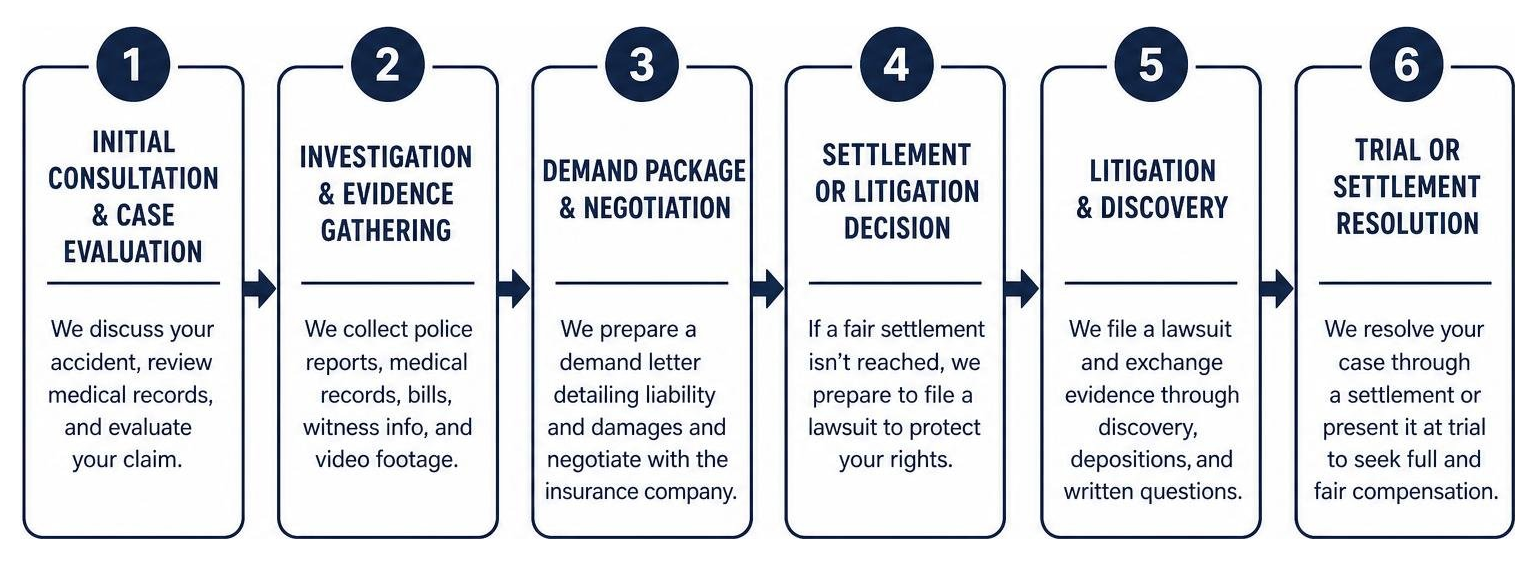
What Are the Key Phases of a Claim?
- Initial Consultation and Case Evaluation: We sit down with you to discuss the details of your accident, review your initial medical treatment, and determine if you have a viable legal claim.
- Investigation and Evidence Gathering: Our team immediately begins collecting police crash reports, medical records, billing statements, eyewitness contact info, and any available video footage of the incident.
- Demand Package and Negotiation: Once your medical treatment is complete or your long-term prognosis is clear, we draft a comprehensive demand letter. This document details the at-fault party’s liability and presents a complete accounting of your financial and physical damages to the insurance carrier.
- Filing a Lawsuit: If the insurance company refuses to negotiate in good faith or offers an inadequate settlement, we transition your case into the formal court system by filing a petition for damages.
- Discovery and Mediation: During the litigation phase, both legal teams exchange evidence, take depositions of witnesses, and often participate in a mediation session to see if the dispute can be resolved under the guidance of a neutral third party.
- Trial: If mediation fails to produce a fair settlement, we present your case in front of a Louisiana judge or jury, using witness testimony and physical evidence to fight for a binding, favorable verdict.
What Types of Compensation Can a Personal Injury Claim Lawyer Help You Recover?
Under Louisiana law, injured victims are entitled to compensatory damages, which are split into two primary categories: economic and non-economic.
| Damage Type | Description | Examples |
|---|---|---|
| Economic Damages | Direct, calculable financial losses with receipts or invoices | Emergency room bills, surgeries, prescriptions, lost wages, future medical care, property repairs |
| Non-Economic Damages | Subjective, non-monetary losses affecting your quality of life | Physical pain and suffering, emotional distress, loss of enjoyment of life, loss of consortium |
To understand what your specific claim might be worth, you can read our detailed guide on what is my personal injury case worth?
What Are Economic and Non-Economic Damages?
- Medical Expenses: This includes the cost of all medical care related to your accident, from the initial ambulance ride and emergency room visit to surgeries, doctor appointments, physical therapy, and medical equipment. If you require ongoing care, we work with medical planners to project your future healthcare costs.
- Lost Wages and Earning Capacity: If your injuries force you to miss work, you are entitled to recover the income you lost during your recovery. If your injuries leave you with a permanent disability that prevents you from returning to your previous job, we pursue compensation for your diminished earning capacity.
- Pain and Suffering: This compensates you for the physical pain and emotional trauma caused by the accident. Because there are no bills or receipts for pain, we use detailed personal journals, medical records, and expert testimony to demonstrate how the injury has impacted your daily life.
- Property Damage: We help you recover the costs necessary to repair or replace your vehicle, clothing, phone, or any other personal property that was damaged or destroyed in the accident.
How Do Personal Injury Lawyers Get Paid and What Are Typical Fee Structures?
One of the greatest barriers to seeking legal help is the fear of high attorney fees. To make the justice system accessible to everyone, our firm operates on a contingency fee basis. This fee structure ensures that any injured person can afford high-quality legal representation, regardless of their current financial situation. To learn more about our firm and how we structure our services, visit personal injury lawyer opelousas | Doran & Cawthorne PLLC.
What Should You Know About Contingency Fees?
- No Upfront Costs: You do not have to pay a retainer or any out-of-pocket fees to hire us. We take on all the financial risk of building and managing your case.
- Percentage-Based Fees: Our fee is calculated as a pre-agreed percentage of the total financial compensation we recover for you. This percentage is clearly outlined in our initial representation agreement.
- No Fee Unless We Win: If we are unsuccessful in recovering compensation for your claim through a settlement or court verdict, you do not owe us any attorney fees.
- Case Expenses: Building a strong personal injury case requires financial resources. Our firm advances all necessary case expenses—such as fees for retrieving medical records, hiring accident reconstruction professionals, and paying court filing fees. These advanced costs are reimbursed from the final settlement only after we win your case.
Why Is the Statute of Limitations Critical for Your Louisiana Claim?
If you have been injured in an accident, you cannot afford to wait to take legal action. Every state establishes strict deadlines for filing civil lawsuits, known as the statute of limitations. In Louisiana, this deadline is called the prescriptive period, and it is one of the shortest in the entire country.
If you miss this legal deadline, the court will almost certainly dismiss your case, and you will be permanently barred from recovering any compensation for your injuries, no matter how severe they are or how clearly the other party was at fault.
What Are the Key Deadlines to Remember?
- One-Year Prescriptive Period: Under Louisiana Civil Code Article 3492, you generally have exactly one year from the date of the accident to file a formal personal injury lawsuit in court.
- Wrongful Death Deadline: If you are filing a wrongful death claim on behalf of a deceased family member, the lawsuit must be filed within one year of the date of their passing, not the date of the accident.
- Government Claims: If your accident involved a government vehicle, a state agency, or a local municipality, you may face much shorter administrative notice requirements—sometimes as short as a few months—before you are permitted to file a lawsuit.
How Can a Personal Injury Claim Lawyer Help When Dealing with Insurance Companies?

Dealing with insurance adjusters can be incredibly stressful, especially when you are trying to focus on recovering from physical injuries. It is important to remember that insurance adjusters are not on your side. They are corporate employees whose job is to minimize the amount of money their company pays out.
They are highly skilled at using friendly conversations to get you to make statements that can later be used to damage your claim. For this reason, you should never agree to give a recorded statement or sign any medical authorization releases without first consulting your attorney.
What Tactics Do Insurance Adjusters Use?
- Shifting Blame: Adjusters will look for any excuse to argue that you were partially or fully responsible for the accident. Under Louisiana’s comparative fault rules, any percentage of fault assigned to you will directly reduce your final compensation.
- Rushing Settlements: An adjuster may offer you a quick cash settlement within days of the accident. These early offers are designed to get you to sign away your legal rights before you have seen a doctor or fully understood the extent of your injuries.
- Delaying the Claim: Insurance companies will sometimes drag out the claims process, ignoring phone calls and delaying paperwork, in hopes that financial pressure from your growing medical bills will force you to accept a lower offer.
- Downplaying Injuries: The insurance company may argue that your medical treatment is excessive, unnecessary, or related to a pre-existing medical condition rather than the accident itself.
What Should You Do Immediately After an Accident to Protect Your Claim?
The actions you take in the minutes, hours, and days following an accident will have a direct impact on your health and the strength of your personal injury claim. By taking systematic steps to protect yourself, you make it much harder for insurance companies to deny or undervalue your case.
What Are the Essential Post-Accident Steps?
- Seek Immediate Medical Attention: Your health is your top priority. Go to an emergency room, urgent care, or your primary doctor as soon as possible, even if you think your injuries are minor. This ensures you receive proper care and establishes an official, timely medical record linking your injuries to the accident.
- Contact Law Enforcement: Call 911 so a police officer is dispatched to the scene. The officer will document the crash, interview witnesses, and write an official accident report that will serve as key evidence in your claim.
- Document the Scene: If it is safe to do so, use your phone to take photos and videos of the accident scene. Capture vehicle damage, skid marks, road conditions, traffic signs, and your physical injuries.
- Gather Witness Information: Speak to anyone who saw the accident occur. Collect their names, phone numbers, and brief statements about what they witnessed.
- Avoid Social Media: Do not post photos, status updates, or comments about your accident or your recovery online. Insurance defense teams actively monitor social media platforms looking for posts they can use to argue that your injuries are not as severe as you claim.
- Consult a Lawyer: Contact an experienced attorney before you speak to any insurance adjusters, give recorded statements, or accept any settlement offers.
Frequently Asked Questions About Personal Injury Claims in Opelousas
How long does it typically take to resolve a personal injury claim?
The timeline for resolving a claim varies depending on the complexity of the accident, the length of your medical treatment, and the willingness of the insurance company to offer a fair settlement. A straightforward claim with clear liability and minor injuries may resolve in a few months, while a complex case involving severe injuries, disputed fault, or formal litigation can take a year or longer to resolve. We do not recommend settling your claim until you have reached maximum medical improvement, ensuring all your medical costs are fully accounted for.
Can I still recover compensation if I was partially at fault for the accident?
Yes. Louisiana follows a system of pure comparative fault under Civil Code Article 2323. This means you can still recover compensation even if you were partially responsible for the accident. However, your final financial recovery will be reduced by your percentage of fault. For example, if your total damages are valued at $100,000, but a court finds that you were 20% at fault for the accident, your final recovery will be reduced to $80,000.
What should I bring to my initial consultation with a personal injury lawyer?
To help us evaluate your case as quickly and accurately as possible, you should bring any documents related to your accident, including:
- The police accident report or exchange of information form
- Photos of the accident scene, vehicle damage, and your injuries
- Contact information for any eyewitnesses
- All medical records, discharge papers, and billing statements
- Any correspondence or settlement offers you have received from insurance companies
- A copy of your own auto insurance policy declaration page
Take Control of Your Recovery and Fight for Your Rights in Opelousas
Suffering a serious injury can turn your life upside down, leaving you to deal with physical pain, emotional stress, and growing financial pressure. You do not have to face this challenging time alone. Having a dedicated legal advocate on your side ensures that your rights are protected and that you pursue the full compensation you need to recover and move forward with your life.
At Doran & Cawthorne PLLC, we are committed to standing up to powerful insurance companies on behalf of injured victims in Opelousas and throughout Louisiana. We understand the tactics insurers use to delay and deny claims, and we use our extensive trial experience to fight for the maximum recovery our clients deserve.
If you or a loved one has been injured due to someone else’s negligence, reach out to us today. Contact our team to schedule a free, no-obligation case evaluation, and let us help you understand your legal options and what your claim is truly worth.
Share this Blog

When You Need Real Talk & Results™
Louisiana Personal Injury Attorneys Committed to Advocating on Your Behalf


