 Skip to content
Why Nighttime Crashes in Opelousas Demand Serious Legal Attention
If you were hurt in an after-dark collision, a nighttime driving collision lawyer can help you prove who was at fault, preserve critical evidence before it disappears, and fight for the full compensation you deserve — including medical bills, lost wages, and pain and suffering.
Here is what you need to know right away:
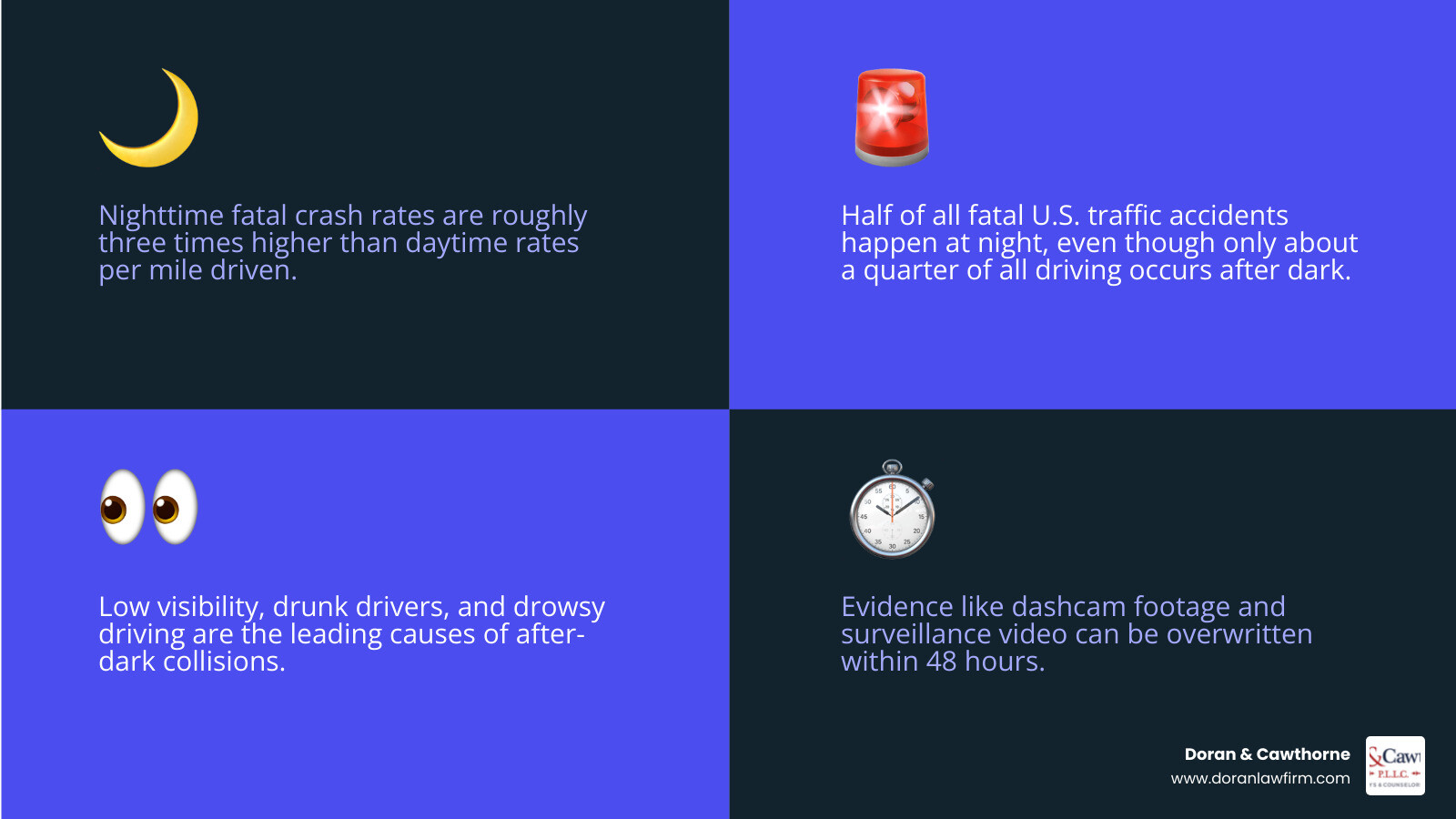
- Nighttime fatal crash rates are roughly three times higher than daytime rates per mile driven
- Half of all fatal U.S. traffic accidents happen at night, even though only about a quarter of all driving occurs after dark
- Low visibility, drunk drivers, and drowsy driving are the leading causes of after-dark collisions
- Louisiana law gives you two years from the date of the crash to file a personal injury lawsuit (for accidents on or after July 1, 2024)
- Evidence like dashcam footage and surveillance video can be overwritten within 48 hours — acting quickly matters
- Insurance companies often make fast settlement offers that do not cover your full losses — do not sign anything without legal advice
The numbers are stark. According to the National Highway Traffic Safety Administration, 54 percent of U.S. traffic fatalities occur at nighttime. In Louisiana, where long stretches of poorly lit rural highway connect communities like Opelousas, the risks are very real. After a nighttime crash, victims often face not just serious injuries, but also a harder fight to prove what happened — because darkness means fewer witnesses, fewer cameras, and evidence that fades fast.
I’m Pride Doran, a trial lawyer with over 20 years of experience handling automobile and personal injury cases across Louisiana, including nighttime driving collision claims in Opelousas and the surrounding area. I’ve represented thousands of individuals and know how quickly evidence disappears and how aggressively insurance companies move to protect their bottom line.
Glossary for Nighttime driving collision lawyer:
Why Nighttime Driving in Opelousas Is So Dangerous

Driving down the I-49 corridor or navigating rural roads in St. Landry Parish after sunset is vastly different from daytime driving. When darkness falls, our eyes struggle to process depth perception, color recognition, and peripheral vision. According to the National Safety Council, vision accounts for roughly 90 percent of a driver’s ability to react behind the wheel. When that vision is compromised by darkness, the window of time a driver has to avoid a hazard shrinks dramatically.
Standard low-beam headlights only illuminate about 160 to 250 feet of the road ahead, while high beams extend that range to roughly 500 feet. At highway speeds, a vehicle can easily outrun its own headlights, meaning a driver cannot stop in time once a hazard becomes visible.
Beyond physical visibility limitations, the nighttime hours bring out specific dangerous driving behaviors. Fatigue and chemical impairment peak after dark, turning otherwise simple drives into life-altering events. Additionally, drivers are highly prone to distractions when they believe the roads are less crowded. Understanding these risks is crucial, which is why we emphasize recognizing the three types of distracted driving to help identify how another motorist’s negligence caused your crash.
How a Nighttime Driving Collision Lawyer Evaluates Low-Visibility Hazards
When we investigate an after-dark wreck, we do not just accept the excuse that “it was too dark to see.” Under Louisiana law, drivers have a strict duty to operate their vehicles at a speed that is safe for current conditions. If visibility is low, a driver must slow down.
A skilled nighttime driving collision lawyer will examine whether the at-fault driver was using low beams when high beams were appropriate, or conversely, if they blinded you by failing to dim their high beams. We also look closely at the roadway itself. Poorly aligned headlights, dirty windshields, and neglected street infrastructure can all contribute to a crash. If you need assistance in St. Landry Parish, consulting with the best Opelousas, LA car accident attorneys ensures that every angle of your low-visibility accident is thoroughly analyzed.
The Role of Driver Fatigue and Impairment After Dark
Fatigue and alcohol are a deadly combination that peaks during nighttime hours. The National Safety Council notes that tired drivers are three times more likely to be involved in a car crash than alert drivers. In fact, driving while sleep-deprived can impair reaction times and judgment just as severely as chemical intoxication.
For commercial truck drivers, long shifts and tight deadlines often lead to drowsy driving on our local highways. Combined with the sheer size of these vehicles, a fatigued trucker who drifts out of their lane can cause catastrophic damage. Furthermore, alcohol-related crashes spike dramatically at night. Of the thousands of alcohol-related traffic fatalities nationwide, a staggering 69% occur during nighttime hours. When a driver chooses to operate a vehicle under the influence or while struggling to keep their eyes open, they must be held accountable. To understand your options for pursuing these drivers, you can read the ultimate guide to suing a distracted driver.
Common Injuries in Nighttime Car Accidents
Because nighttime crashes often involve delayed braking, high-speed impacts, and head-on collisions, the physical toll on victims is frequently severe. Without the benefit of daylight to spot an oncoming hazard, drivers rarely have time to brace or take evasive action before the moment of impact.
Some of the most frequent physical trauma sustained in these wrecks include:
- Traumatic Brain Injuries (TBIs): Concussions, contusions, and permanent cognitive damage caused by the violent whipping motion of a collision.
- Spinal Cord Damage and Paralysis: Fractured vertebrae that can lead to temporary or permanent loss of mobility.
- Broken Bones and Fractures: Impact forces crushing limbs against the dashboard, steering wheel, or vehicle doors.
- Internal Organ Damage: Severe internal bleeding or ruptured organs caused by seatbelt restraint forces or direct cabin intrusion.
To learn more about the physical and financial impact of these conditions, refer to our comprehensive guide on common car accident injuries.
Why Delayed Symptoms Are Common After a Nighttime Crash
Directly following a crash, your body is flooded with adrenaline and endorphins. This natural survival mechanism is designed to mask pain so you can escape immediate danger. Consequently, you might walk away from a nighttime wreck believing you are entirely unharmed, only to wake up the next morning in excruciating pain.
Soft tissue damage, such as whiplash, neck strains, and back injuries, often takes hours or days to manifest. More dangerously, internal bleeding or slow-bleeding head trauma may show no obvious outward signs until the condition becomes life-threatening. This is why we always advise crash victims to seek an immediate medical evaluation, even if they feel fine at the scene. For more information on this phenomenon, explore our detailed resource on whether delayed injuries are common after a car accident.
Proving Liability with a Nighttime Driving Collision Lawyer
Proving who was at fault in a nighttime crash presents unique hurdles. With fewer witnesses on the road and limited visibility, the at-fault driver’s insurance company will likely try to shift the blame onto you. They may claim you were speeding, that your headlights were off, or that the darkness made the accident unavoidable.
To secure compensation, we must establish the four core elements of negligence:
- Duty of Care: The other driver owed you a legal duty to operate their vehicle safely.
- Breach of Duty: They failed in that duty (e.g., by speeding, driving drunk, or failing to yield).
- Causation: Their breach directly caused the collision.
- Damages: You suffered actual physical or financial harm as a result.
Louisiana operates under a comparative fault system. For accidents occurring on or after January 1, 2026, Louisiana law bars recovery if a party is found to be 51% or more at fault for the crash. This makes having an experienced legal advocate on your side even more critical. We know how to counter insurance company tactics that attempt to artificially inflate your percentage of fault. To see how we build successful liability arguments, review our case results: distracted driving accident.
Essential Evidence Your Nighttime Driving Collision Lawyer Will Gather
Because physical evidence at a nighttime scene can degrade or be cleared away by morning, we must act quickly to preserve key details. Our legal team conducts a forensic review of the crash, collecting:
- Official Police Crash Reports: Documenting the responding officer’s initial observations, lighting conditions, and any citations issued.
- Dashcam and Surveillance Footage: Securing video from nearby businesses or residential security cameras before it is overwritten (often within 48 hours).
- Black Box Data: Extracting electronic data from the vehicles to show speed, braking patterns, and steering inputs right before impact.
- Lighting District Maintenance Logs: Investigating whether broken streetlights or poor road markings contributed to the low-visibility conditions.
- Witness Statements: Locating and interviewing other motorists or pedestrians who may have seen the events leading up to the crash.
Recovering Compensation and Dealing with Insurance Companies
A serious nighttime crash can throw your entire life into disarray. Between mounting hospital bills and missed shifts at work, the financial stress can quickly become overwhelming. Through a personal injury claim, we can help you pursue compensation for both your financial losses and the personal toll of the accident.
This compensation generally falls into two categories:
- Economic Damages: Tangible, quantifiable financial losses such as past and future medical bills, rehabilitation costs, lost wages, and property damage to your vehicle.
- Non-Economic Damages: Intangible losses that do not have a direct price tag, including physical pain and suffering, emotional distress, loss of enjoyment of life, and mental anguish.
To get a better understanding of what your potential recovery might look like, read our breakdown on what is my personal injury case worth.
Avoiding the 24-Hour Insurance Settlement Trap
In the hours following a crash, you may receive a call from the other driver’s insurance adjuster offering a quick cash settlement. While this offer can be tempting when bills are piling up, it is almost always a trap.
Insurance companies are profit-driven businesses. Their goal is to settle your claim as cheaply as possible before you realize the true extent of your injuries. Once you sign a release, you waive your right to pursue any additional compensation—even if you later require surgery or cannot return to work. Before agreeing to anything, read our guide on should I accept a settlement from the insurance company to protect your rights.
Frequently Asked Questions About Opelousas Nighttime Crashes
How long do I have to file a lawsuit after a nighttime accident in Louisiana?
For car accidents occurring in Louisiana on or after July 1, 2024, the state has a two-year prescriptive period (statute of limitations) for filing personal injury lawsuits. If you miss this deadline, the court will almost certainly dismiss your case, preventing you from recovering any compensation.
Can I recover damages if the road lighting was inadequate?
Yes. If a parish lighting district, municipal government, or state entity failed to maintain streetlights or ignored reports of outages, and that lack of lighting directly contributed to your crash, they may share liability. However, claims against government entities have much shorter notification deadlines and specialized legal requirements, meaning you must act immediately.
What should I do immediately after a nighttime car accident?
First, prioritize safety. Turn on your hazard lights and, if possible, safely move your vehicle out of the path of oncoming traffic to prevent secondary collisions. Call 911 to get emergency medical services and police to the scene. Document the crash by taking photos of vehicle damage, road markings, and the lighting conditions. For a step-by-step checklist, review our article on 5 steps to take after a car accident.
Secure Your Recovery After a Dark Road Collision
Recovering from a nighttime crash is hard enough without having to fight aggressive insurance adjusters on your own. At Doran & Cawthorne, we are dedicated to standing up to powerful insurance companies to ensure our clients receive the maximum recovery they deserve.
If you or a loved one has been injured in an after-dark collision in Louisiana, do not wait until critical evidence is lost. Contact an experienced Opelousas car accident lawyer at our firm today to schedule your free, no-obligation case evaluation. We will listen to your story, explain your options, and help you take the first step toward rebuilding your life.
Share this Blog
When You Need Real Talk & Results™
Louisiana Personal Injury Attorneys Committed to Advocating on Your Behalf


