 Skip to content
Back Off: When to Call a Tailgating Rear End Attorney in Opelousas
What to Do After a Tailgating Rear-End Crash in St. Landry Parish, Opelousas
If you’ve been hit from behind by a tailgating driver, a tailgating rear end attorney can help you recover compensation for your injuries, lost wages, and pain — even when insurance companies push back.
Here’s what matters most right away:
- Get medical attention — even if you feel fine. Symptoms like whiplash can appear days later.
- Call 911 and get a police report filed at the scene.
- Do not give a recorded statement to the other driver’s insurance company.
- Document everything — photos, witness contacts, dashcam footage.
- Contact a tailgating rear end attorney before accepting any settlement offer.
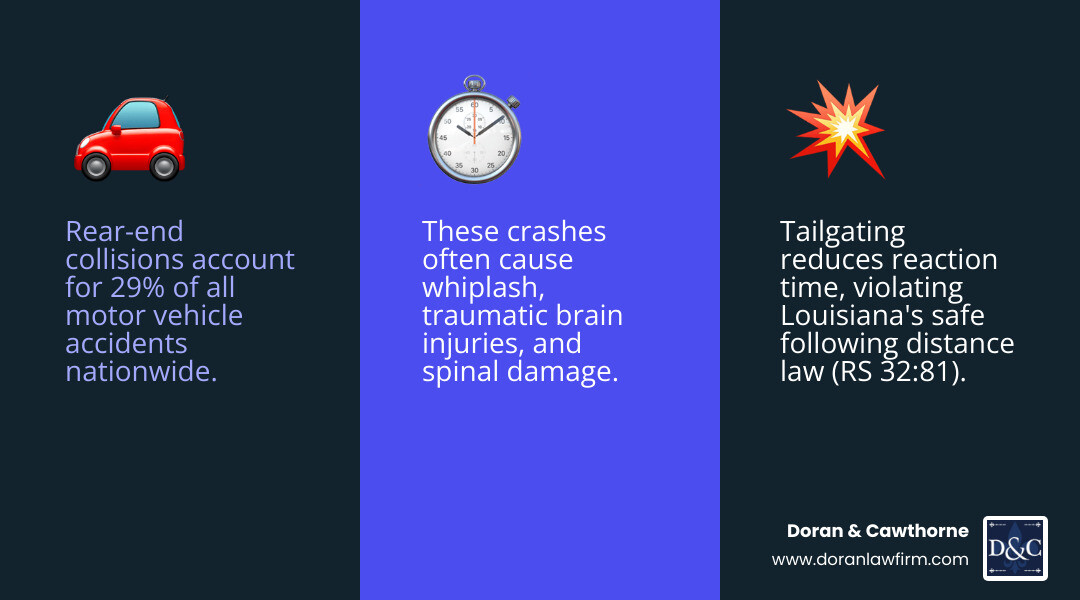
Rear-end collisions are one of the most common crashes on Louisiana roads. Nationally, they make up nearly 29% of all motor vehicle accidents according to NHTSA data, and tailgating is one of the leading causes. These crashes are not minor inconveniences — they can cause serious, life-altering injuries, and the driver who hit you is almost always legally responsible.
Insurance companies know this. That’s exactly why they move fast to offer low settlements before you understand the full value of your claim.
You deserve better than that.
I’m Pride Doran, a trial attorney with over twenty years of experience representing injured people in automobile accidents across Louisiana, including rear-end and tailgating collision claims. As a tailgating rear end attorney, I’ve seen how insurance companies undervalue legitimate claims — and I’ve built my practice on fighting back.
Understanding Liability and the Role of a Tailgating Rear End Attorney in Opelousas
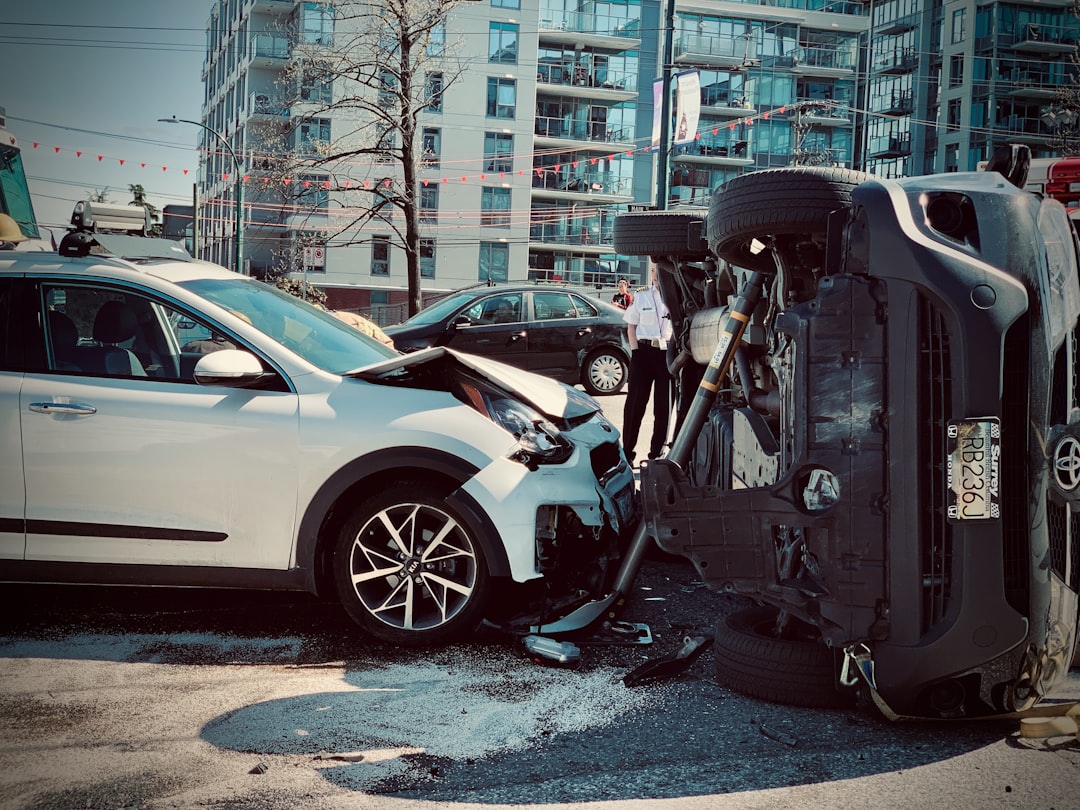
When you are sitting at a red light in Opelousas or slowing down for traffic on I-10 in Lafayette, you have a right to expect the driver behind you to pay attention. Unfortunately, many drivers treat the “two-second rule” as a suggestion rather than a safety requirement. In Louisiana, the law is quite clear about this behavior.
Under Louisiana RS 32:81, the driver of a motor vehicle shall not follow another vehicle more closely than is reasonable and prudent, having due regard for the speed of such vehicle and the traffic upon and the condition of the highway. This is the foundation of the “rear-driver presumption.” In the eyes of the law, if someone hits you from behind, the starting assumption is that they were either following too closely, speeding, or simply not paying attention.
However, a “presumption” isn’t a guaranteed win. To secure the compensation you need, we often have to dig deeper into the facts. Whether it’s a standard Rear-End Collision Case Result or a complex multi-car pileup, proving the exact mechanics of the crash is vital. This is where our expertise on our Car Accidents Personal Injury Page comes into play, helping victims understand that the law is on their side, provided they have the right evidence.
Why You Need a Tailgating Rear End Attorney for Complex Claims
You might think, “The guy hit me from behind; why do I need a lawyer?” The reality is that fault disputes are more common than you’d expect. The other driver might claim you “brake checked” them or that your brake lights weren’t working. Without a tailgating rear end attorney, it becomes your word against theirs.
We help sort out complicated rear-end claims by studying skid marks, damage patterns, and vehicle data to show how the tailgating driver caused the crash. Our serious car accident case results show why severe injury cases often need experienced legal support.
How a Tailgating Rear End Attorney Counters Insurance Tactics
Insurance adjusters have one job: to save their company money. They are experts at “lowballing”—offering a settlement that covers your initial ER visit but ignores the months of physical therapy or lost wages that follow. They might even try to shift the blame to you, suggesting you stopped too abruptly for no reason.
We’ve seen these tactics time and again. In a contested Accident case result, we proved that our client was not at fault despite the insurance company’s aggressive denials. Furthermore, in cases involving a distracted driving accident case result, we often find that the “tailgating” was actually the result of the driver looking at a phone rather than the road. We don’t let insurance companies bully our clients into accepting less than they deserve.
Common Injuries and Recoverable Compensation in St. Landry Parish
The physical toll of a rear-end crash can be devastating. Because the impact often comes as a surprise, your body doesn’t have time to brace, leading to violent “whipping” of the neck and spine.
| Type of Damage | Examples | Purpose |
|---|---|---|
| Economic Damages | Medical bills, Surgery costs, Lost wages, Property damage | To repay actual financial losses |
| Non-Economic Damages | Pain and suffering, Emotional distress, Loss of enjoyment of life | To compensate for physical and mental toll |
| Punitive Damages | Rare; reserved for extreme recklessness (e.g., DUI) | To punish the offender |
Whiplash is the most common injury, but “common” doesn’t mean “minor.” It involves the overextension of ligaments and tendons that can cause chronic pain for years. More severe impacts can lead to traumatic brain injuries (TBIs) or even an aortic dissection—a life-threatening tear in the heart’s main artery caused by the sudden force of the seatbelt or airbag. We’ve handled cases where these injuries required long-term care, as seen in this rear-end collision case result 2.
Exceptions to Rear-Driver Fault
While the rear driver is usually at fault, there are specific scenarios where the front driver might share the blame. These include:
- Broken Brake Lights: If your lights were out, the driver behind you had no warning you were stopping.
- Sudden Reverse: If a driver accidentally shifts into reverse at a stoplight.
- Illegal Merging: Cutting someone off so closely that they have no physical way to stop in time.
Even in these cases, you may still be entitled to significant recovery. In a Rear-End Collision Case Result 3, we navigated the complexities of shared fault to ensure our client was treated fairly.
Calculating Long-Term Damages
How do you put a price on a back that never stops aching? Or the three months of salary you lost while recovering? We work with medical experts and economists to calculate the true cost of your accident. This includes not just the bills on your desk today, but the future surgeries and the “pain and suffering” that impacts your quality of life. Our Car Accident Case Results reflect our commitment to securing maximum recovery for our neighbors in Opelousas and Lafayette.
Proving Fault: Evidence and the Louisiana Legal Process
“He said, she said” is being replaced by hard data. When we take on your case, we act as investigators. We gather:
- Police Reports: The official record of the scene.
- Witness Statements: Neutral accounts of what happened.
- Dashcam & Surveillance: Video doesn’t lie.
- Black Box Data: Most modern cars record speed and braking force in the seconds leading up to a crash.
Using this evidence, we can reconstruct the accident to show exactly how the tailgater failed in their duty to drive safely. You can see how this evidence comes together in this Rear-End Collision Case Result 4.
Pure Comparative Negligence in Louisiana
Louisiana follows a “Pure Comparative Negligence” rule. This is actually good news for victims. It means that even if you were 10% at fault (perhaps for a dim tail light), you can still recover 90% of your damages. Some states bar you from recovery if you are even slightly at fault, but not Louisiana. We use this to our advantage to ensure that even in “messy” accidents, our clients get the help they need. Our Car Accidents Category provides more insight into how this rule applies in real-world scenarios.
The One-Year Prescriptive Period
Time is not on your side in Louisiana. As of April 2026, it remains critical to remember that Louisiana has one of the shortest “statutes of limitations” in the country—known here as a prescriptive period. You generally have only one year from the date of the accident to file a lawsuit. If you miss this window, you lose your right to seek compensation forever.
This is why we urge you to visit our Car Accidents Personal Injury Page and contact us as soon as possible. Building a strong case takes time, and the sooner we start, the better your chances of a successful outcome.
Frequently Asked Questions about Tailgating Accidents
We know you have questions. Here are the most common things our clients ask during their first consultation.
What should I do immediately after being rear-ended?
First, check for injuries and call 911. Even if the damage looks minor, a police report is your best friend in an insurance claim. Take photos of both cars, the road conditions, and any visible injuries. Exchange insurance info, but do not apologize or admit fault—even if you’re just being polite. Finally, call a tailgating rear end attorney.
How does a tailgating rear end attorney prove the other driver was following too closely?
We look at the “point of impact” and the length of any skid marks. If there are no skid marks, it often proves the driver wasn’t looking at the road at all. We also use the “three-second rule” as a benchmark; if the driver couldn’t stop in time, they were by definition too close for the speed they were traveling.
Can I still recover compensation if my brake lights were out?
Yes! Because Louisiana uses pure comparative negligence, you can still recover money even if you were partially at fault. If a jury decides your broken light made you 20% responsible, you would still receive 80% of the total settlement. We fight to keep your percentage of fault as low as possible.
Get Legal Help from Doran & Cawthorne
At Doran & Cawthorne, we believe that no one should have to pay the price for someone else’s impatience. Tailgating is a choice—a negligent one that puts everyone on the road at risk. Whether you are in Opelousas, Lafayette, or Baton Rouge, our experienced attorneys are ready to protect your rights against powerful insurance companies and fight for the maximum recovery you deserve.
Don’t let an insurance adjuster dictate what your recovery is worth. More info about car accident services is just a click away. Contact us today, and let’s get started on holding the negligent driver accountable.
Share this Blog
When You Need Real Talk & Results™
Louisiana Personal Injury Attorneys Committed to Advocating on Your Behalf


