 Skip to content
When an Uber crash in Opelousas turns your life upside down
If you need an Opelousas Uber injury lawyer, here is what you should know right away:
- Rideshare accidents involve multiple insurance policies — not just one
- Uber’s coverage limits change depending on what the driver was doing at the time of the crash
- Louisiana gives you two years to file a personal injury claim (for incidents on or after July 1, 2024)
- You can recover medical bills, lost wages, pain and suffering, and more
- You pay nothing upfront — most rideshare injury lawyers work on a contingency fee basis
Uber and Lyft have made getting around Opelousas and St. Landry Parish more convenient than ever. But when a rideshare vehicle is involved in a crash, what looks like a simple accident quickly becomes a complicated legal battle. You may be dealing with injuries, missed work, and mounting bills — while Uber’s corporate legal team and insurance adjusters work to limit what you receive.
Rideshare accident cases are genuinely more complex than standard car crashes. Multiple insurance policies, shifting liability rules, and Uber’s classification of its drivers as independent contractors all create obstacles that most injured people are not prepared to navigate alone. According to national data, rideshare services have been linked to a 3% increase in car accident fatalities since 2011 — and in the years 2017 and 2018 alone, Uber vehicles were involved in 97 fatal crashes resulting in 107 deaths, with 58% of victims being third parties like pedestrians or people in other vehicles.
I’m Pride Doran, a trial attorney with over twenty years of experience handling automobile accident claims and personal injury litigation across Louisiana, including cases that directly affect people searching for an Opelousas Uber injury lawyer. As a Tulane Law School graduate, I have represented thousands of injured individuals and built a reputation for fighting back against insurance companies that try to minimize fair compensation. In the sections below, I’ll walk you through everything you need to know to protect your rights after a rideshare accident in Opelousas.
Why rideshare accidents in Opelousas are highly complex
When you get into a fender bender on the way to the grocery store, the insurance claim process is relatively straightforward: you exchange insurance cards with the other driver, file a claim, and their liability insurance pays for your vehicle repairs and medical bills.
But if that same driver is logged into the Uber or Lyft app, the legal landscape changes instantly.
The primary reason rideshare accidents are so complex is the legal classification of the drivers. Uber and Lyft drivers are not employees; they are classified as independent contractors. Under traditional Louisiana employment law, an employer is generally held liable for the negligent actions of their employees when those actions occur within the scope of employment. However, because rideshare drivers are independent contractors, Uber and Lyft can legally distance themselves from the driver’s negligence. They will argue that they merely provide the digital platform connecting riders and drivers, meaning they aren’t directly responsible for the driver’s mistakes on the road.
This means you cannot simply sue Uber as a company for hiring a careless driver. Instead, you must navigate a complex web of commercial insurance policies that are layered on top of the driver’s personal auto insurance. To make matters worse, almost all personal auto insurance policies in Louisiana contain a “commercial use exclusion.” If a rideshare driver causes a crash while using their vehicle for profit (like carrying passengers), their personal insurance company will likely deny the claim outright.
Furthermore, determining who is responsible for your injuries depends entirely on whether you were a passenger in the rideshare vehicle, a driver in another car struck by an Uber, or a pedestrian. If you are trying to understand how liability splits when a rideshare driver hits you from behind, you may want to read up on the legal lowdown on st landry rear end collisions to see how local courts evaluate rear-end impacts and driver fault.
Navigating the three insurance coverage periods
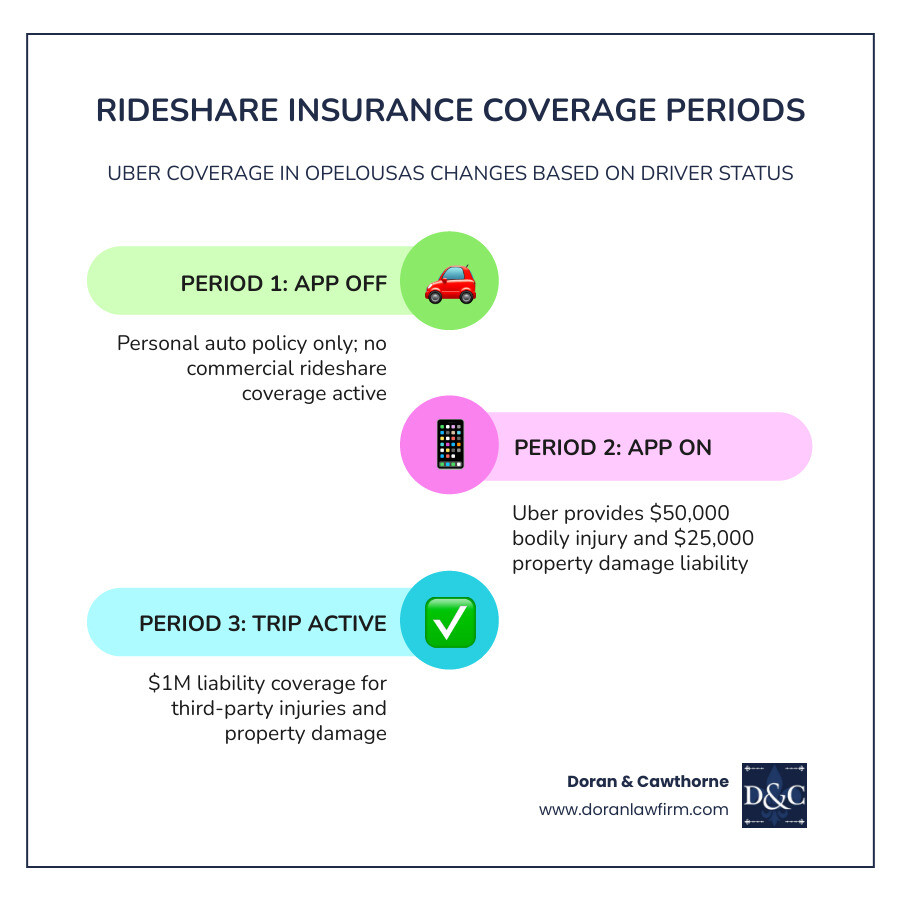
To understand how a rideshare accident claim works, you must understand the “three periods” of rideshare insurance coverage. Uber’s commercial liability coverage is not a static policy; it expands and contracts like an accordion based on the driver’s exact status on the app at the second the collision occurs.
Here is how the coverage breaks down across the three distinct periods:
- Period 1: The app is on, but the driver is waiting for a request. In this phase, the driver has opened the Uber app and is driving around Opelousas waiting for a passenger to request a ride. Because they do not have an active passenger or ride request, Uber provides a lower tier of contingent liability coverage. This coverage only kicks in if the driver’s personal auto insurance denies the claim (which, as mentioned, they usually do). Limits: Up to $50,000 in bodily injury per person, $100,000 in bodily injury per accident, and $25,000 in property damage.
- Period 2: The ride is accepted, and the driver is en route. Once a driver accepts a ride request on their screen and begins navigating toward the pickup spot, Uber’s major commercial insurance policy active. If they crash into you while rushing down Union Street to pick up a passenger, you are covered under this high-limit policy. Limits: Up to $1 million in third-party liability coverage.
- Period 3: The passenger is in the vehicle. This period begins the moment the passenger steps into the rideshare vehicle and ends when they safely exit at their destination. If you are a passenger in an Uber that gets hit, or if an Uber carrying a passenger crashes into your car, this maximum coverage policy is active. Limits: Up to $1 million in third-party liability coverage, plus underinsured/uninsured motorist (UM/UIM) coverage to protect passengers if another driver causes the crash and lacks adequate insurance.
| App status / period | Activity description | Primary insurance applicable | Bodily injury limit (per person) | Bodily injury limit (per accident) | Property damage limit |
|---|---|---|---|---|---|
| Period 1 | App on, waiting for a ride request | Contingent Uber liability | $50,000 | $100,000 | $25,000 |
| Period 2 | Ride accepted, en route to pick up | Full Uber commercial policy | $1,000,000 (combined single limit) | $1,000,000 (combined single limit) | Included in $1M limit |
| Period 3 | Passenger in the vehicle | Full Uber commercial policy | $1,000,000 (combined single limit) | $1,000,000 (combined single limit) | Included in $1M limit |
Because of these shifting periods, an experienced Opelousas Uber injury lawyer must immediately secure the driver’s digital log files and GPS data from the rideshare company. Uber will not simply hand this data over; we must legally demand that they preserve and produce this evidence to prove exactly which period was active at the millisecond of the crash.
High-crash intersections and local traffic risks
Opelousas is the heart of St. Landry Parish, but our historic streets and busy state highways weren’t originally designed for the sheer volume of modern traffic—including rideshare drivers who are constantly glancing down at their phones to check GPS routes and incoming ride alerts.
The City of Opelousas long-range transportation plan has highlighted several high-crash frequency intersections where rideshare vehicles and local commuters frequently collide. Between 2017 and 2021, local traffic studies identified the most dangerous intersections in town:
- LA 31 (Creswell Lane) @ LA 182 (S. Union Street): This is the single most dangerous intersection in Opelousas, recording 126 total crashes over a five-year period, with a crash frequency of 25.2. It is a major commercial hub where drivers are constantly turning in and out of shopping centers.
- US 190 @ LA 182 (S. Union Street): A massive intersection with 122 total crashes and a frequency of 24.4. The transition from high-speed highway traffic to local city streets makes this a prime spot for high-impact collisions.
- US 190 @ LA 182 (Main Street): Recording 121 total crashes and a frequency of 24.2, this intersection sees heavy daily traffic and frequent rear-end collisions.
- US 190 @ LA 749: This intersection experienced 120 total crashes with a crash frequency of 24.0. High speeds on US 190 combined with turning vehicles create a recipe for severe T-bone and angle crashes.
Rideshare drivers often travel these exact corridors while distracted by their app screens, looking for passengers, or trying to navigate unfamiliar side streets. If you or a loved one has been involved in a severe crash at one of these locations, you are not alone in facing the consequences. You can learn more about how families navigate the devastating aftermath of these high-impact collisions by reading our guide on navigating the tragedy of a fatal opelousas wreck.
Seeking an Opelousas Uber injury lawyer for back injuries and severe trauma

Rideshare collisions can happen in the blink of an eye, but the physical consequences can last a lifetime. Among the most common and debilitating injuries we see in Opelousas rideshare crashes are severe back and neck injuries.
When a vehicle is struck from behind or from the side at high speed, the sudden transfer of kinetic energy forces the human body to whip forward and backward violently. This motion frequently results in severe trauma to the spine. Victims may suffer from herniated discs, where the soft cushion between the spinal vertebrae ruptures and presses directly against local nerves, causing excruciating radiating pain, numbness, and muscle weakness.
Even worse, high-impact collisions can cause spinal cord trauma, which can lead to permanent loss of sensation and motor function. If you have suffered a back injury, a brain injury, or broken bones in a collision, you need an attorney who understands the medical realities of these conditions. For a deeper look at how we build cases for victims of severe auto accidents, explore our resources on personal injury car accidents.
Common rideshare collision injuries in St. Landry Parish
While back injuries are incredibly common, rideshare accidents in St. Landry Parish result in a wide array of severe physical trauma. Some of the most common injuries we handle include:
- Whiplash and neck trauma: The sudden acceleration-deceleration force of a crash tears muscles, tendons, and ligaments in the neck, leading to chronic pain and restricted mobility.
- Traumatic brain injuries (TBIs): Ranging from mild concussions to severe cognitive impairment, TBIs occur when a victim’s head strikes the window, steering wheel, or seatback, or from the rapid shaking of the brain within the skull.
- Facial fractures and lacerations: Airbag deployments and flying glass can cause severe cuts, broken noses, and fractured jawbones.
- Internal organ damage: Severe seatbelt restraint pressure or side-impact crushing can cause internal bleeding and damage to vital organs like the spleen, liver, or kidneys.
- Soft tissue damage: Severe bruising, sprains, and muscle tears that may not show up on an X-ray but cause long-term, debilitating pain.
If you want to know more about how to navigate the immediate medical and legal steps after a local collision, you can read our comprehensive opelousas auto collision attorneys guide to find helpful answers.
How an Opelousas Uber injury lawyer proves long-term damages
Insurance companies love to look at your initial emergency room bill and claim that is the maximum value of your injury. But if you have a herniated disc or a traumatic brain injury, that first ER visit is just the tip of the iceberg. You may require years of physical therapy, epidural steroid injections, or even spinal fusion surgery.
To prevent you from being shortchanged, an experienced Opelousas Uber injury lawyer does not just collect your past medical bills—we build a comprehensive model of your future needs. We do this by collaborating with a network of medical and financial experts:
- Life care planners: These are medical professionals who review your medical records, interview your doctors, and draft a highly detailed “life care plan.” This document outlines every single medical expense you will reasonably incur for the rest of your life due to the accident—including future surgeries, prescription medications, physical therapy sessions, assistive devices, and home modifications.
- Vocational experts: If your injuries prevent you from returning to your previous job (for example, if you can no longer perform manual labor or sit at a desk for eight hours due to chronic back pain), a vocational expert will evaluate your physical limitations and determine what kind of work, if any, you can realistically perform in the local job market.
- Economists: Once the life care planner and vocational expert have established your future medical costs and career limitations, an economist calculates the total financial impact. They project your lost earning capacity over your remaining working years, adjusting for inflation and cost-of-living increases, to ensure we demand every dollar you are legally owed.
By presenting these scientifically backed projections to the insurance company or a jury, we make it impossible for them to dismiss your long-term suffering as a minor injury. For a detailed breakdown of how these damages are calculated and what you can expect during the recovery process, check out our guide on rideshare accident compensation opelousas.
Louisiana laws affecting your rideshare accident claim
Every state has its own unique legal quirks, and Louisiana is certainly no exception. If you are injured in an Opelousas rideshare crash, two major legal doctrines will heavily influence your claim: our system of pure comparative fault and our strict statute of limitations.
First, Louisiana operates under a pure comparative fault system. This means that more than one party can be found partially responsible for an accident, and your total financial recovery will be reduced by your percentage of fault. For example, if an Uber driver suddenly cuts you off, but you were speeding slightly at the time, a court might find that the Uber driver was 80% at fault, while you were 20% at fault. If your total damages equal $100,000, your recovery would be reduced by 20%, leaving you with $80,000.
Insurance defense lawyers will use every trick in the book to shift blame onto you to save their company money. We know how to counter these tactics by using accident reconstruction experts, dashcam footage, and black box data to prove the rideshare driver was the primary negligent party.
Second, you must be aware of the timeline for filing a lawsuit. For decades, Louisiana had one of the shortest personal injury deadlines in the country—just one year. However, a major legislative change occurred in 2024.
Important legal update: For all personal injury claims arising from accidents occurring on or after July 1, 2024, Louisiana law has extended the prescriptive period (statute of limitations) from one year to two years.
While this two-year window gives you more breathing room to understand the full scope of your injuries, it is still critical to act quickly. Evidence can disappear, witnesses can forget details, and video footage can be overwritten in a matter of days. To learn more about how Louisiana’s injury laws apply to your specific situation, visit our overview of personal injury law.
Steps to protect your rights after an Opelousas rideshare crash
What you do in the first 48 to 72 hours after an Uber or Lyft accident can make or break your personal injury claim. Insurance companies are already moving to build a narrative that limits their liability; you must act just as quickly to protect yourself.
Here is your step-by-step checklist to preserve crucial evidence immediately after a collision:
- Call 911 immediately: Ensure the Opelousas Police Department or the St. Landry Parish Sheriff’s Office dispatches an officer to the scene. A formal police report is a vital piece of objective evidence that documents the road conditions, driver statements, and citations issued.
- Take screenshots of the rideshare app: This is a step unique to rideshare accidents! Open your Uber or Lyft app immediately and take screenshots of your active ride, the driver’s profile, the route map, and your digital receipt. This prevents the rideshare company from claiming the ride never occurred or trying to alter the timeline of the trip.
- Photograph everything: Use your smartphone to take high-resolution photos and videos of the accident scene. Document the damage to all vehicles (both interior and exterior), license plates, skid marks on the road, traffic signals, and any visible physical injuries you or your passengers suffered.
- Collect witness contact information: If anyone stopped to help or witnessed the crash, ask for their name, phone number, and email address. Independent witness statements are incredibly powerful because they have no financial stake in the outcome of your claim.
- Seek immediate medical attention: Even if you feel “fine” or only have minor soreness, go to an emergency room, urgent care, or your primary care doctor within 24 hours. Adrenaline can mask severe internal injuries, such as herniated discs or internal bleeding. Furthermore, a delay in seeking medical care gives the insurance company an excuse to argue that your injuries were caused by something else after the accident.
- Do not give a recorded statement to insurance adjusters: You will likely receive a call from a polite insurance adjuster representing Uber or the other driver within days of the crash. They may sound like they want to help, but their goal is to get you to say something on the record that damages your case. Consult with an attorney before speaking to them.
By taking these steps, you ensure that vital evidence is locked down before it can be lost or destroyed. If you want to understand how preserving evidence fits into wider property liability or local safety standards, you may also find our opelousas fall injury attorney guide helpful for understanding general evidence collection in St. Landry Parish.
Frequently asked questions about Opelousas rideshare claims
What types of compensation can I recover?
When you file a personal injury claim after a rideshare accident, you are legally entitled to pursue two primary categories of damages: economic damages and non-economic damages.
- Economic damages are the objective, quantifiable financial losses that come with receipts, invoices, and paystubs. These include:
- Past and future medical bills (ER visits, surgeries, physical therapy, prescriptions)
- Lost wages for the time you missed work while recovering
- Loss of earning capacity if your injuries permanently prevent you from earning the same income you did before the crash
- Property damage to repair or replace your vehicle
- Non-economic damages represent the subjective, human costs of an accident that do not have a specific price tag. These include:
- Physical pain and suffering
- Mental anguish and emotional distress (such as PTSD or anxiety after a crash)
- Loss of enjoyment of life (being unable to participate in hobbies, sports, or family activities)
- Permanent scarring or disfigurement
How do law firms structure their fees for rideshare cases?
Most personal injury law firms, including ours, operate on a contingency fee structure. This means you do not have to pay us a single penny out of your own pocket to start working on your case.
We offer a completely free, no-obligation initial consultation to review your accident details. If we take your case, we cover all the upfront costs of investigating the crash, hiring medical experts, securing accident reconstructionists, and filing court paperwork. We only get paid if we successfully recover a settlement or jury verdict for you. Our fee is a set percentage of that final recovery, meaning our interests are completely aligned with yours: we want to maximize your compensation.
Why should I hire an Opelousas Uber injury lawyer instead of handling it myself?
It is technically possible to file an insurance claim on your own, but doing so in a rideshare case is like stepping into a boxing ring with both hands tied behind your back.
Uber is a multi-billion-dollar corporation backed by massive commercial insurance companies and teams of highly experienced corporate defense lawyers. Their entire business model relies on paying out as little as possible on claims. They know that an unrepresented victim is likely under financial pressure from medical bills and missed work, making them prime targets for lowball, early settlement offers that won’t even cover future medical needs.
A local Opelousas Uber injury lawyer knows the local courts, the specific high-crash intersections in St. Landry Parish, and how to navigate the complex layers of rideshare insurance. We handle the paperwork, the aggressive negotiations, and the legal filings so you can focus entirely on your physical recovery.
Get Legal Help from Doran & Cawthorne
A rideshare accident can throw your entire life off course in a single second. Between painful physical therapy sessions, mounting medical bills, and the stress of dealing with aggressive insurance adjusters, you shouldn’t have to carry the heavy legal burden alone.
At Doran & Cawthorne, we believe in providing compassionate, results-driven legal advocacy to injured people in Opelousas, Lafayette, Baton Rouge, and across Louisiana. We have the experience, the resources, and the determination to stand up to major corporations like Uber and Lyft to ensure your rights are protected and you recover the maximum compensation you deserve.
Do not let an insurance company dictate what your recovery is worth. Protect your rights today by visiting our Opelousas resource page to learn more about how we fight for local families, or contact us directly to schedule your free, confidential case evaluation. Let us handle the legal battle so you can focus on healing.
Share this Blog

When You Need Real Talk & Results™
Louisiana Personal Injury Attorneys Committed to Advocating on Your Behalf


