 Skip to content
What to do after a wreck in Opelousas to protect your vehicle wreck injury claim
A vehicle wreck injury claim can feel overwhelming — especially when you’re dealing with pain, missed work, and insurance companies that move fast to protect their own interests.
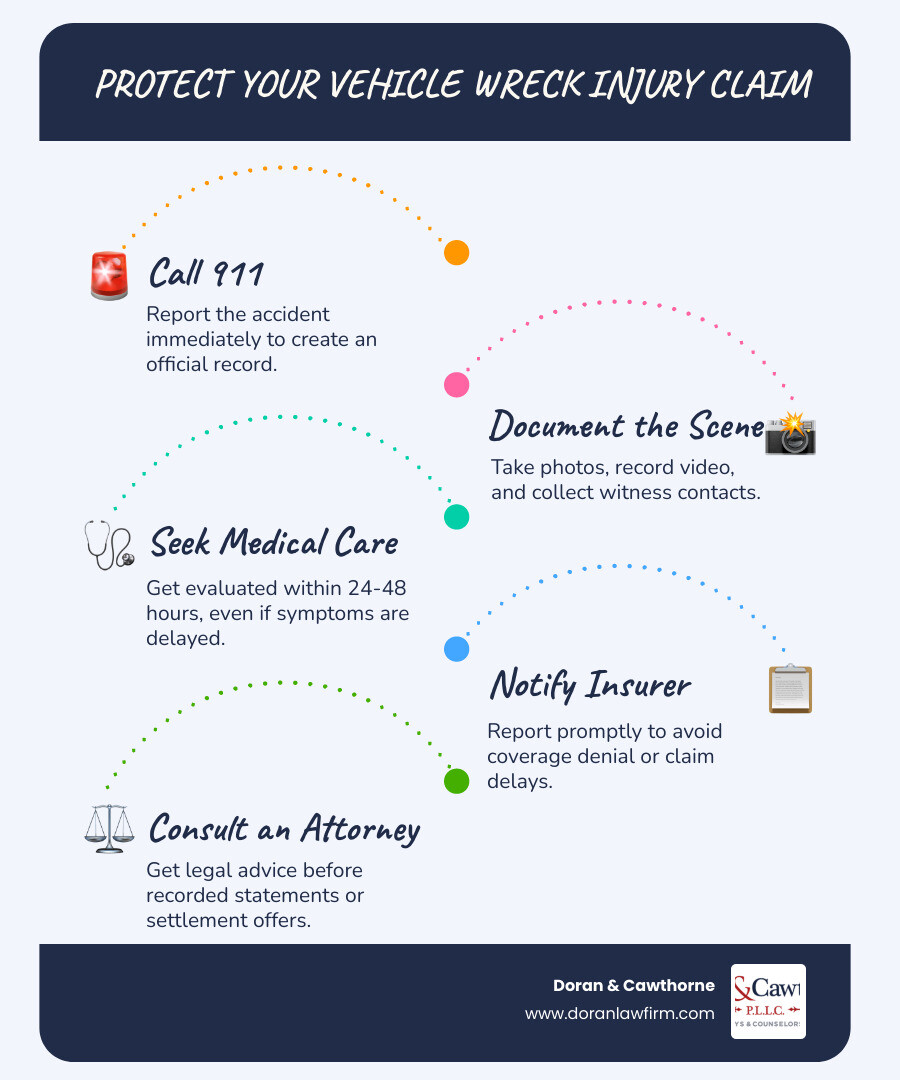
Here’s a quick overview of the key steps to protect your claim:
- Call 911 and report the accident immediately
- Document the scene with photos and witness information
- Seek medical attention within 24–48 hours, even if you feel fine
- Notify your insurance company promptly — delays can cost you coverage
- Avoid recorded statements to the other driver’s insurer without legal advice
- Consult a personal injury attorney before accepting any settlement offer
- File your claim before Louisiana’s one-year deadline (the prescriptive period)
In 2023 alone, there were over 6 million police-reported crashes in the United States, resulting in nearly 2.5 million injuries. Many victims accept far less than they deserve — simply because they didn’t know their rights or acted too late.
The decisions you make in the days and weeks after a wreck can directly impact how much compensation you recover.
I’m Pride Doran, a trial attorney with over twenty years of experience handling vehicle wreck injury claims and Louisiana car crashes, including serious back injuries in Opelousas and across the state. I’ve represented thousands of injured individuals against insurance companies and their attorneys, and I’m here to walk you through exactly what to do next.
Vehicle wreck injury claim terms simplified:
Immediate steps after a Louisiana car crash to protect your rights
When you are involved in a collision on Louisiana roads—whether navigating the busy roundabouts of Lafayette, cruising down I-10 in Baton Rouge, or driving through the historic streets of Opelousas—the immediate aftermath is critical. Your adrenaline will be pumping, making it difficult to think clearly. However, taking structured action is the single best way to protect your physical health and secure your legal rights.
Following a systematic approach ensures you do not inadvertently damage your ability to recover compensation later. By adhering to the 5 steps to take after a car accident, you can build a solid foundation for your potential insurance claim or lawsuit.

First and foremost, establish scene safety. Move your vehicle out of the flow of traffic if possible and safe to do so, but do not leave the scene of the accident. Turn on your hazard lights. Under Louisiana law, you are required to report crashes that result in injury, death, or significant property damage to local law enforcement immediately. Calling 911 brings emergency medical technicians and police officers to the scene. The responding officer will generate an official police report, which serves as a foundational piece of evidence for your vehicle wreck injury claim.
While waiting for the police, exchange basic contact and insurance details with the other driver. However, limit your conversation. Avoid making statements like “I’m sorry,” “I didn’t see you,” or “I feel fine.” Even polite remarks can be twisted by insurance adjusters as admissions of fault. If there are bystanders who witnessed the crash, politely ask for their names and phone numbers. Their independent accounts of the collision can be incredibly valuable if liability is disputed later.
Documenting the scene of the accident
Proving fault in a Louisiana car crash requires clear, objective evidence. Do not rely solely on the police report, as responding officers in busy areas like Baton Rouge or Lafayette may not note every detail. If you are physically able and it is safe to do so, use your smartphone to thoroughly document the scene.
- Take comprehensive photos: Capture images of all vehicles involved from multiple angles. Photograph the close-up damage as well as the wider scene to show the relative positions of the cars.
- Capture the surrounding environment: Photograph skid marks on the pavement, broken glass, scattered debris, and any damaged property like guardrails or signs.
- Note traffic and weather conditions: Document whether the traffic signals were functioning, if road construction was present, and what the weather conditions were (such as wet roads from a sudden Louisiana downpour).
- Look for surveillance cameras: Note if nearby businesses or traffic lights have cameras that may have recorded the collision. Because business surveillance footage is often overwritten within 24 to 72 hours, identifying these cameras immediately allows us to send preservation letters to secure the video files.
Seeking medical attention for a back injury
One of the most common and devastating consequences of Louisiana car crashes is spinal trauma. If you have suffered a back injury, seeking immediate medical evaluation is not just a healthcare priority—it is a legal necessity.
Many serious spinal issues, such as herniated discs, whiplash, and internal soft-tissue damage, do not present symptoms immediately. The body’s natural response to a traumatic event is to flood the system with adrenaline and endorphins, which temporarily masks pain. You might wake up 48 hours later unable to bend over or sit comfortably. Understanding common car accident injuries and why are delayed injuries common after a car accident can help you recognize the warning signs of serious trauma.
If you delay seeking medical care, insurance adjusters will use that gap in treatment to argue that your injuries were not caused by the crash, or that they are not as severe as you claim. They might suggest that you injured your back doing something else in the days following the accident. Going to an emergency room, an urgent care clinic, or your primary care physician in Opelousas within 24 to 48 hours establishes a direct, undeniable link between the collision and your physical injuries.
Insurance claim vs. lawsuit in a Louisiana car crash
Many people confuse filing an insurance claim with filing a personal injury lawsuit. While both are methods of seeking financial recovery, they are distinct legal processes with different rules, timelines, and outcomes.
To help clarify the differences, here is a comparison of how these two paths function in Louisiana:
| Aspect | Insurance claim | Personal injury lawsuit |
|---|---|---|
| What it is | An administrative demand for coverage filed directly with an insurance company. | A formal civil action filed in a Louisiana court against the negligent parties. |
| Who resolves it | An insurance adjuster through negotiation and settlement. | A judge or a jury after hearing evidence (though many settle before trial). |
| Timeline | Typically resolved in weeks or months, provided liability is clear. | Can take several months to several years depending on complexity. |
| Types of recovery | Limited to policy limits; covers property damage, medical bills, and basic lost wages. | Can recover full economic and non-economic damages, including pain and suffering. |
| When it’s used | As the initial step after almost any car wreck. | When negotiations fail, liability is disputed, or damages exceed policy limits. |
Determining the right path depends entirely on the unique details of your accident. Evaluating what is my personal injury case worth requires looking at your medical bills, lost wages, and the long-term impact on your quality of life.
Filing a first-party or third-party vehicle wreck injury claim
In Louisiana, you generally have two avenues for pursuing an insurance claim. A first-party claim is filed with your own auto insurance company. For example, if you have collision coverage, your insurer may pay for your vehicle repairs quickly, minus your deductible, and then seek reimbursement from the at-fault driver’s insurance.
A third-party claim is filed directly with the at-fault driver’s insurance provider. This is where you seek compensation for your bodily injuries, out-of-pocket medical costs, and lost income.
Navigating this process requires a solid understanding of insurance policies. Consulting an insurance claim guide can help you understand the standard timelines and procedures. However, keep in mind that the at-fault driver’s insurance company is not on your side. Their primary goal is to settle your claim for as little money as possible.
Pursuing a personal injury lawsuit for maximum recovery
If the insurance adjuster refuses to offer a fair settlement, denies liability, or if the at-fault driver is uninsured or underinsured, filing a formal personal injury lawsuit in civil court becomes necessary.
Through the litigation process, we can conduct formal discovery, depose the negligent driver and witnesses, and build a compelling case to present to a judge or jury. Litigation is often the only way to force a stubborn insurance company to pay what you are truly owed. When dealing with severe injuries, it is vital that you don’t leave money on the table after a car wreck, as future medical care and long-term disability can cost hundreds of thousands of dollars.
Understanding Louisiana laws and deadlines for your vehicle wreck injury claim
Louisiana has unique civil laws that differ significantly from other states. If you are filing a vehicle wreck injury claim in Opelousas, Lafayette, or Baton Rouge, you must navigate these strict legal frameworks to preserve your right to financial recovery.
The strict Louisiana statute of limitations
In Louisiana, the timeline to take legal action is exceptionally short. The legal deadline for filing a personal injury lawsuit is known as the prescriptive period. Under Louisiana Civil Code Article 3492, you have only one year from the date of the accident to file a lawsuit for personal injuries.
This one-year statute of limitations is one of the shortest in the nation. If you miss this deadline, the court will almost certainly dismiss your case, leaving you with no legal recourse to recover compensation, no matter how severe your injuries are. Understanding the louisiana personal injury statute of limitations is critical to ensuring you do not lose your right to sue.
How comparative fault affects your vehicle wreck injury claim
Louisiana operates under a system of pure comparative fault (Louisiana Civil Code Article 2323). This means that more than one driver can share responsibility for an accident, and your recovery will be reduced by your percentage of fault.
For example, if you are injured in an intersection collision in Lafayette and a court determines that the other driver was 80% at fault for running a red light, but you were 20% at fault for speeding, your total compensation will be reduced by 20%. If your total damages equal $100,000, you would receive $80,000.
Because Louisiana uses a “pure” comparative fault system, you can still recover damages even if you were 99% at fault for the crash—though your recovery would only be 1% of the total damages. Insurance adjusters frequently use this law to shift blame onto injured victims in order to reduce their payouts. Proving the other party’s negligence is essential to protecting your settlement.
How insurance adjusters evaluate a claim
Once you file a claim, the insurance company will assign an adjuster to investigate. Adjusters are trained professionals whose performance is evaluated based on how much money they save the company. They are not neutral investigators; they are looking for reasons to reduce or deny your claim.
When dealing with adjusters, you must decide carefully should I accept a settlement from the insurance company early in the process. Often, their initial offers are “lowball” figures meant to close the case before you understand the full extent of your injuries.
Common tactics used to devalue back injury claims
Back injuries, such as herniated discs or soft-tissue strains, are highly susceptible to insurance company skepticism. Because these injuries often do not show up on basic X-rays and rely heavily on patient reports of pain, adjusters use specific tactics to undermine them:
- Blaming pre-existing conditions: If you have ever complained of back pain or had a minor injury years ago, the adjuster will claim your current pain is a pre-existing condition, not a result of the car crash.
- Exploiting treatment gaps: If you waited a week to see a doctor, or missed a physical therapy appointment, they will argue your injury is minor or unrelated to the accident.
- Requesting broad medical releases: Adjusters will ask you to sign a medical authorization form, claiming they need to verify your injuries. In reality, they will use this to dig through your entire medical history to find unrelated pre-existing issues.
- Pressuring for recorded statements: They will ask to record a conversation with you, hoping you will make casual statements that minimize your pain or confuse the details of the crash.
When to reject a lowball settlement offer
You should never accept a settlement offer until you have reached maximum medical improvement (MMI). MMI is the point at which your treating physician determines that your condition has stabilized and is unlikely to improve further with additional treatment.
If you settle your claim before reaching MMI, you cannot go back and ask for more money if you later discover you need spinal surgery or ongoing chiropractic care. A fair settlement must account for:
- All past and future medical bills.
- Lost wages and any reduction in your future earning capacity.
- Pain, suffering, and loss of enjoyment of life.
Frequently asked questions about Louisiana car crashes
Navigating the legal aftermath of a car accident is complicated. Here are some of the most common questions we hear from clients in Opelousas, Lafayette, and Baton Rouge.
How long do I have to notify my insurance company after a wreck?
While you have one year under Louisiana law to file a lawsuit, your insurance policy is a contract that requires you to report any accident promptly—typically within a few days. Failure to notify your insurer within the timeframe specified in your policy can result in a denial of coverage, leaving you without key protections like uninsured motorist coverage or medical payments (MedPay) benefits.
What should I do if my insurance claim is denied?
If your claim is denied, request a formal, written denial letter stating the exact reasons for the decision. Do not take “no” as the final answer. Insurance companies sometimes deny valid claims hoping the claimant will simply give up. You can file a formal appeal, submit additional evidence, or pursue a bad faith insurance claim if the insurer is acting unfairly. Having legal representation is highly effective in turning a denial into a fair settlement.
When should I consult an Opelousas back injury lawyer?
You should consult a lawyer immediately if you have suffered severe injuries, if liability for the crash is being disputed, or if the insurance company is offering an inadequate settlement. An experienced attorney can handle all communication with the insurance adjusters, gather critical evidence, and protect your rights. At Doran & Cawthorne, we offer a free consultation car accident to help you understand your legal options without any upfront costs.
Conclusion
Recovering from a vehicle wreck is hard enough without having to battle aggressive insurance adjusters who want to minimize your injuries. When you are dealing with a serious back injury or the complex aftermath of a Louisiana car crash, you deserve an advocate who understands the local legal landscape in Opelousas, Lafayette, and Baton Rouge.
At Doran & Cawthorne, our experienced trial attorneys know how to stand up to powerful insurance companies to secure the maximum recovery you deserve for your medical costs, lost income, and pain.
If you or a loved one has been injured, don’t navigate this short one-year window alone. Contact an experienced Opelousas car accident lawyer at Doran & Cawthorne today for a free case evaluation, and let us fight to protect your future.
Share this Blog

When You Need Real Talk & Results™
Louisiana Personal Injury Attorneys Committed to Advocating on Your Behalf


