 Skip to content
When doctors make mistakes: What Baton Rouge patients need to know
If you’re looking for medical malpractice attorneys in Baton Rouge, here’s what matters most:
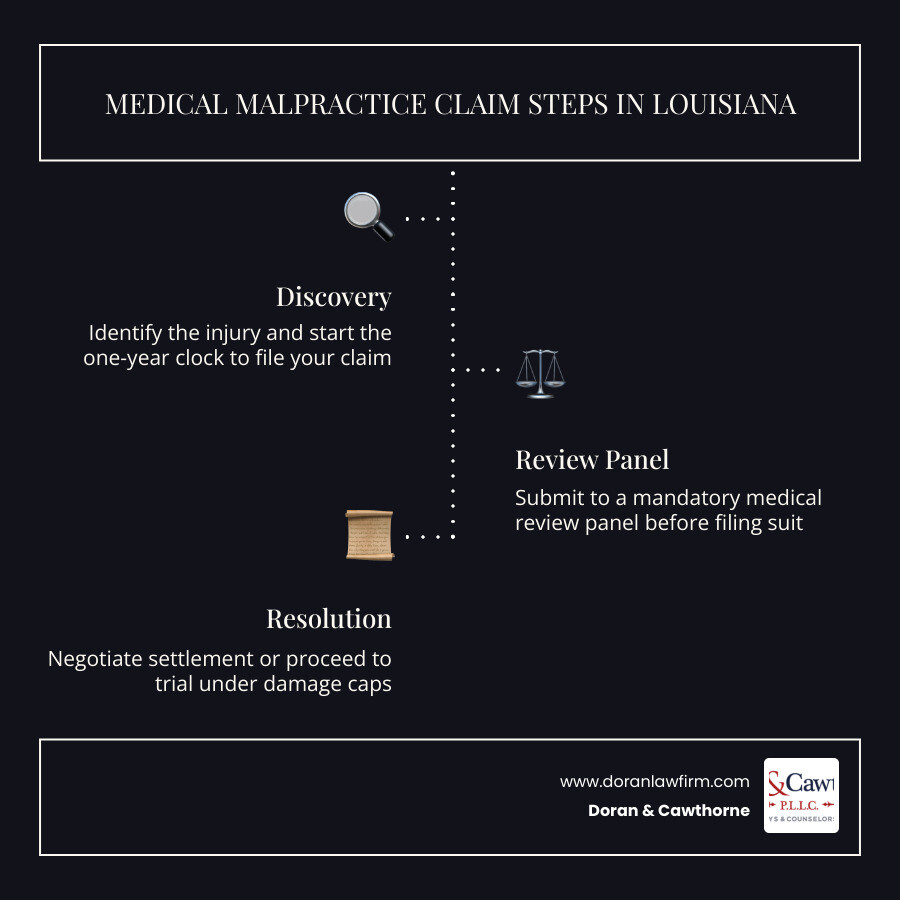
- You have one year from when you discovered the injury to file a claim
- Louisiana caps damages at $500,000 (excluding future medical care) for qualified providers
- A medical review panel must evaluate your case before you can file a lawsuit
- Most attorneys offer free consultations — you pay nothing unless you win
- Common cases include misdiagnosis, surgical errors, birth injuries, and medication mistakes
When you trust a doctor or hospital with your health — and something goes terribly wrong — it can feel like your world has collapsed. Medical bills pile up. You can’t work. And the people responsible have teams of lawyers protecting them.
That’s the reality many Baton Rouge patients face after a medical error. And it’s more common than most people realize.
Louisiana’s medical malpractice laws are among the most complex in the country. There are strict deadlines, mandatory review panels, and damage caps that can significantly limit what you recover. Without the right legal support, navigating this system alone is extremely difficult.
I’m Pride Doran, a trial attorney with over twenty years of experience representing injured individuals across Louisiana, including those harmed by healthcare negligence — the kind of cases where having a skilled medical malpractice attorney in Baton Rouge in your corner can make all the difference. My work has taken me from negotiating tables to courtrooms, always fighting for the people who need it most.
Glossary for medical malpractice attorneys in baton rouge:
Understanding medical malpractice under Louisiana law
To understand whether you have a case, we must first look at how Louisiana law defines medical malpractice. Under the Louisiana Medical Malpractice Act (MMA), malpractice is defined as any unintentional tort or breach of contract based on healthcare or professional services rendered—or which should have been rendered—by a healthcare provider to a patient.
In simpler terms, it means a healthcare professional made a mistake or failed to act when they should have, and that failure directly caused you harm.
However, a bad medical outcome does not automatically mean malpractice occurred. Medicine is not an exact science, and even with the best care, patients sometimes do not recover as hoped. To establish malpractice, we must prove that the provider breached the “standard of care.”
The standard of care is the level of skill, care, and diligence that a reasonably competent healthcare professional in the same specialty would provide under similar circumstances. In Louisiana, this standard can vary:
- General practitioners are typically held to a local or community standard of care (what other general doctors in the Baton Rouge area would do).
- Medical specialists (like cardiologists, neurosurgeons, or obstetricians) are held to a national standard of care, as their specialized training is expected to meet uniform national benchmarks.
Proving a breach of this standard is much more legally and scientifically demanding than proving fault in standard personal injury claims. For instance, if you are involved in one of the many frequent Louisiana car crashes, establishing liability often comes down to police reports, eyewitness statements, and clear traffic laws. Our firm has extensive experience handling these auto accidents, particularly in providing dedicated Opelousas back injury lawyer services for victims suffering from severe spinal trauma, herniated discs, or whiplash after a collision. In those cases, the connection between the crash and the physical damage is often immediate and visible. But in a medical setting, showing that a surgeon’s technique fell below acceptable professional standards requires deep medical knowledge and testimony from independent medical experts.
If a provider’s treatment falls below these standards, they have committed medical negligence. When this negligence results in physical injury, worsened illness, or wrongful death, you have the right to seek compensation. Working with an experienced medical negligence lawyer Baton is crucial because these cases require a deep dive into medical records, hospital protocols, and state statutes.
Common types of medical negligence in Louisiana
Medical errors can happen at any stage of treatment, from the initial emergency room visit to post-operative care. In our practice serving Baton Rouge, Lafayette, and Opelousas, we see several recurring types of medical negligence.
The table below outlines the most common medical errors we handle:
| Error type | Description | Potential consequences |
|---|---|---|
| Birth injury | Negligence during pregnancy, labor, or delivery. | Cerebral palsy, Erb’s palsy, brain damage from oxygen deprivation. |
| Surgical errors | Mistakes made during an operation. | Operating on the wrong site, leaving surgical instruments inside the patient, damaging surrounding organs. |
| Misdiagnosis / late diagnosis | Failing to identify a condition or diagnosing the wrong illness. | Delayed cancer treatment, worsening of preventable conditions, fatal heart attacks or strokes. |
| Medication errors | Prescribing or administering the wrong drug or incorrect dosage. | Severe allergic reactions, internal bleeding, drug interactions, toxicity. |
Let’s look at these common areas of negligence in more detail:
Birth injuries
Few things are more devastating than a preventable injury to a newborn. Birth injuries often occur when medical staff fail to monitor fetal distress signals, delay a necessary emergency C-section, or use birthing tools like forceps or vacuum extractors improperly. These errors can lead to lifelong conditions such as cerebral palsy, shoulder dystocia, or permanent cognitive delays.
Surgical mistakes
While every surgery carries inherent risks, some errors are entirely unacceptable. Often referred to as “never events,” these include performing surgery on the wrong body part, performing the wrong procedure entirely, or leaving gauze, sponges, or medical instruments inside a patient’s body cavity. Anesthesia errors—such as administering too much anesthesia or failing to monitor a patient’s oxygen levels—also fall under this category and can result in permanent brain damage or death.
Misdiagnosis and delayed diagnosis
A timely and accurate diagnosis is often the difference between recovery and terminal illness. If a physician fails to order the correct diagnostic tests, misinterprets laboratory results, or ignores clear symptoms, the patient’s condition can deteriorate rapidly. We frequently see cases where a failure to diagnose cancer, heart disease, or severe infections leads to catastrophic outcomes that could have been prevented with prompt treatment.
If you or a loved one has suffered due to any of these errors, contacting a medical malpractice attorney in Baton Rouge is the first step toward holding the negligent parties accountable. If your treatment occurred closer to Acadiana, consulting a medical malpractice lawyer Lafayette can help ensure your claim is filed in accordance with regional court procedures.
Navigating the Medical Malpractice Act and damage caps
Louisiana has some of the most protective laws for healthcare providers in the United States, primarily governed by the Louisiana Medical Malpractice Act (MMA). If you are seeking compensation, you must navigate a system designed with strict limitations.
The damage cap
The most significant hurdle for victims of medical negligence is Louisiana’s statutory cap on damages. For “qualified healthcare providers” (those who carry a specific amount of malpractice insurance and pay into the state’s Patient’s Compensation Fund), total damages are strictly limited:
- Individual provider liability: A single qualified healthcare provider’s liability is capped at $100,000 plus interest and court costs.
- Total recovery cap: The maximum total recovery for all claims arising from the injury or death of a single patient is capped at $500,000, plus interest and court costs.
- The exception: This $500,000 cap excludes the cost of future medical care and related benefits. If you require ongoing medical treatments, physical therapy, or home care as a direct result of the malpractice, those expenses can be paid out of the Patient’s Compensation Fund (PCF) on an ongoing basis, without being subject to the $500,000 limit.
While this cap is meant to keep malpractice insurance rates stable for doctors, it unfortunately creates severe hardships for patients who suffer catastrophic, life-altering injuries. If a patient is left paralyzed or suffers severe brain damage requiring 24-hour care, $500,000 does not begin to cover their lost earning capacity, pain, and suffering. This is why understanding what is my personal injury case worth? is a vital conversation to have with your attorney early on.
The Patient’s Compensation Fund (PCF)
The PCF acts as a secondary layer of coverage. When a claim is successful, the negligent healthcare provider (or their primary insurer) pays the first $100,000. Any remaining damages up to the $500,000 cap, as well as approved future medical expenses, are paid by the PCF.
Because of these complex financial layers, defending healthcare providers is a highly organized industry. To see how these cases are structured and compare local legal representation, you can review listings of the best medical malpractice lawyers in baton rouge, la on justia.
Why you need medical malpractice attorneys in Baton Rouge
Because the legal deck is heavily stacked in favor of healthcare providers, attempting to handle a medical malpractice claim on your own is highly discouraged. Hospital networks and medical malpractice insurance companies employ aggressive legal teams whose sole job is to minimize payouts or get claims dismissed entirely.
When you work with us, we step in to level the playing field. We protect your rights by:
- Handling all communication: You won’t have to worry about saying the wrong thing to an insurance adjuster who is looking for a reason to deny your claim.
- Navigating complex procedures: We manage the strict filing deadlines and the mandatory medical review panel process so your case isn’t dismissed on a technicality.
- Fighting for maximum recovery: We make sure your future medical needs are fully documented so you can access the Patient’s Compensation Fund for ongoing care costs.
If an insurance company approaches you with an early settlement offer, you should exercise extreme caution. Before signing anything, ask yourself: should I accept a settlement from the insurance company? In almost all cases, early offers are far below what you actually need to cover long-term costs. A dedicated Baton Rouge personal injury attorney can evaluate the offer and negotiate a fair resolution that truly reflects the extent of your injuries.
How medical malpractice attorneys in baton rouge evaluate your case
Building a successful medical malpractice case requires a systematic, detail-oriented approach. We do not guess or make assumptions; we build cases on hard evidence.
When you trust us with your case, our evaluation process involves several critical steps:
- Comprehensive Medical Record Retrieval: We obtain every page of your medical history, treatment charts, surgical logs, lab results, and imaging scans. Even a small notation in a nursing log can be the key to proving negligence.
- Consulting Qualified Expert Witnesses: Under Louisiana law, we must present expert medical testimony to establish what the standard of care was and exactly how the provider breached it. We work with highly respected, board-certified medical specialists to review your records and provide objective opinions.
- Establishing Causation: It is not enough to prove the doctor made a mistake; we must prove that the mistake was the direct cause of your injury. If a patient was already severely ill, the defense will argue the outcome was inevitable. We use medical science to draw a clear line between the provider’s negligence and your physical harm.
Understanding how to handle a medical fail in the red stick means knowing that local courts require meticulous preparation. Whether your case is centered in East Baton Rouge Parish or you need assistance with Lafayette medical malpractice, our approach remains rigorous and focused on trial readiness.
Choosing the right medical malpractice attorneys in baton rouge
Medical malpractice is a highly specialized area of personal injury law. You should not hire a general practice lawyer who only occasionally handles injury claims. You need a firm with a proven track record of taking complex cases to trial.
When researching your options, consider the following:
- Trial Preparation: Some firms prefer to settle quickly to avoid the courtroom. We prepare every case as if it is going to trial. This aggressive preparation often forces insurance companies to offer better settlements because they know we are ready to litigate.
- Experience and Peer Recognition: You want attorneys who are deeply familiar with Louisiana’s unique legal landscape. When you look at directories like Justia, you will find that there are about 74 top rated Louisiana attorneys serving the Baton Rouge area, many with decades of litigation experience. It is important to choose a firm that has the resources to fund these expensive, long-term battles.
- Client-Centered Representation: You deserve direct access to your attorney, clear communication, and compassionate support during what is undoubtedly a stressful time in your life.
By comparing your options and reviewing top rated Louisiana attorneys on Justia, you can make an informed decision about who is best equipped to represent your interests.
Frequently asked questions about medical negligence
Navigating a medical injury claim brings up many questions. Below, we have answered some of the most common questions we receive from patients and their families in Baton Rouge.
What is the statute of limitations for medical malpractice in Louisiana?
In Louisiana, the timeline to file a lawsuit is called the “prescriptive period.” For medical malpractice, this timeline is exceptionally strict:
- The one-year rule: You must file your claim within one year from the date of the alleged malpractice, or within one year from the date you discovered (or should have discovered) the injury.
- The three-year statute of repose: Regardless of when you discovered the injury, Louisiana imposes an absolute limit of three years from the date of the negligent act. If you discover a surgical tool left inside you four years after the surgery, you are unfortunately barred from filing a claim under state law.
Because one year passes incredibly quickly—especially when you are focusing on physical recovery—it is vital to contact an attorney the moment you suspect something went wrong.
How does the medical review panel process work?
Before you can file a formal lawsuit in a Louisiana state court, you must submit your claim to a medical review panel. This is a mandatory step under the Medical Malpractice Act.
- The panel’s composition: The panel consists of three licensed healthcare providers (usually practicing in the same specialty as the defendant) and one non-voting attorney chairperson who facilitates the process.
- The process: Both sides submit written evidence, medical records, and expert briefs. The panel reviews the submissions and issues an opinion on whether the evidence supports the conclusion that the defendant provider failed to act within the appropriate standard of care.
- The impact: The panel’s opinion is non-binding, meaning you can still proceed to court even if the panel rules against you. However, the panel’s written opinion is fully admissible as evidence in court, and the panel members can be called to testify at trial. This process can take several months or even years to complete.
What should I do if I suspect medical malpractice?
If you believe a medical error has caused you or a loved one harm, take these steps immediately to protect your health and your legal rights:
- Seek immediate medical attention: Your health is the priority. See a different, independent physician to evaluate your condition and get the correct treatment.
- Request your medical records: Obtain physical or digital copies of all your records, test results, and discharge summaries from the provider you suspect of negligence. Do this before they realize a claim may be filed.
- Keep a detailed journal: Document your symptoms, pain levels, additional medical appointments, and how the injury has affected your daily life and ability to work.
- Avoid discussing the case: Do not post about your medical issues on social media, and do not speak with the hospital’s risk management team or insurance representatives without consulting a lawyer first.
- Contact an attorney: Schedule a free consultation with an experienced medical malpractice lawyer to discuss your legal options.
Conclusion
Dealing with the aftermath of a medical mistake is physically, emotionally, and financially exhausting. Healthcare providers and their insurers have built a formidable system of damage caps and procedural hurdles designed to discourage you from seeking justice.
At Doran & Cawthorne, we believe you shouldn’t have to carry this burden alone. Our experienced attorneys understand the nuances of the Louisiana Medical Malpractice Act, and we have the resources and determination to stand up to powerful insurance companies on your behalf. We work on a contingency fee basis, meaning you pay nothing out of pocket, and we only get paid if we recover compensation for you.
If you suspect that medical negligence has caused you or a loved one serious harm, do not wait until strict legal deadlines pass. Contact us today to schedule a free, confidential consultation, and let us help you understand your rights under Baton Rouge medical malpractice law.
Share this Blog

When You Need Real Talk & Results™
Louisiana Personal Injury Attorneys Committed to Advocating on Your Behalf


