 Skip to content
What to do after a Lyft accident in Opelousas — and why legal help matters
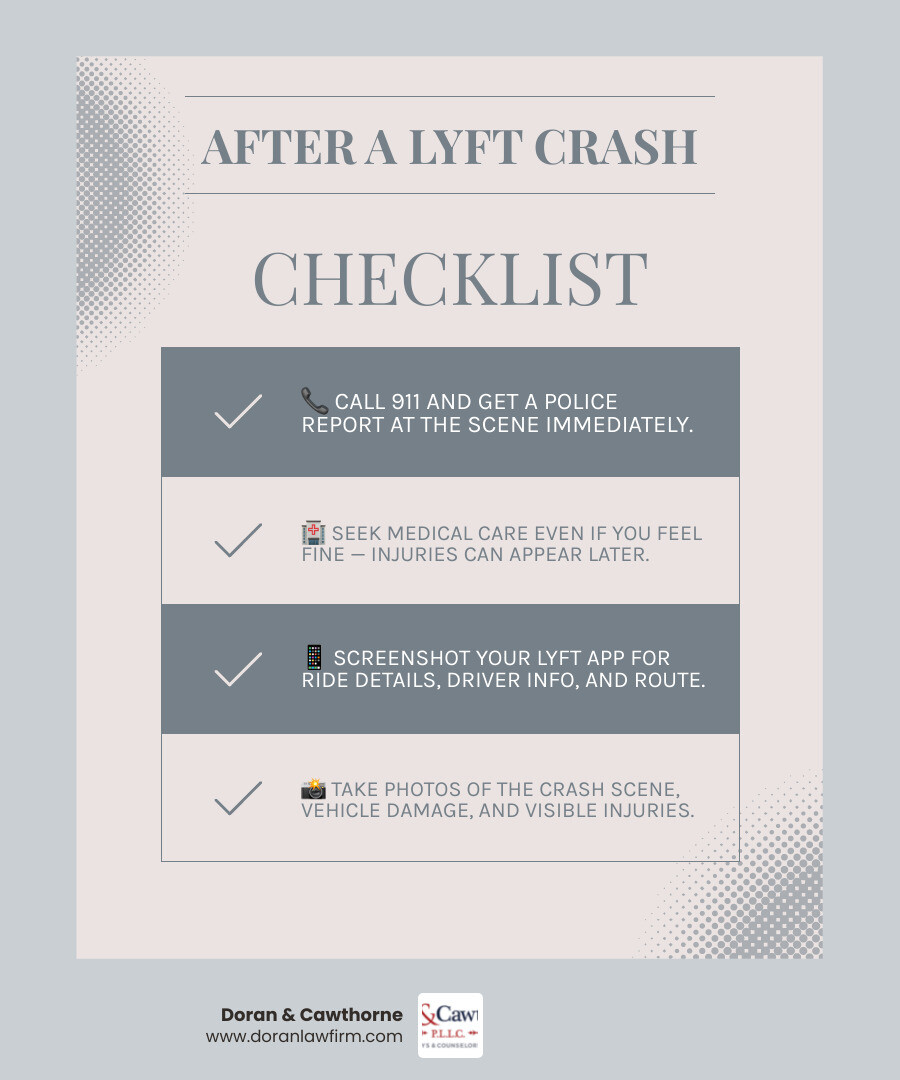
If you need a Lyft accident attorney in Opelousas, here is what you should do right now:
- Call 911 and get a police report at the scene.
- Seek medical care immediately, even if you feel fine.
- Screenshot your Lyft app — save your ride details, driver info, and route.
- Take photos of the crash scene, vehicle damage, and any visible injuries.
- Do not speak to insurance adjusters before talking to an attorney.
- Contact Doran & Cawthorne for a free case review — no upfront fees.
Rideshare services like Lyft have made getting around Opelousas easier than ever. But when a Lyft ride ends in a crash, what follows is anything but simple.
You may be dealing with painful injuries, missed work, and mounting medical bills — all while Lyft’s insurance company works to limit what they pay you. These claims are more complex than standard car accident cases. Multiple insurance policies, corporate liability rules, and strict Louisiana filing deadlines all come into play at once.
And the stakes are real. Louisiana recorded 755 fatal crashes in 2023, and rideshare services have been linked to a 3% increase in car accident fatalities since 2011 nationwide.
I’m Pride Doran, and in over twenty years of personal injury practice — including automobile accident claims across Louisiana — I’ve seen how quickly rideshare victims can be left behind without the right legal support. As a Lyft accident attorney serving Opelousas and the surrounding parishes, I’m here to help you understand your rights and fight for the compensation you deserve.
Lyft accident attorney Opelousas terms made easy:
- Lyft passenger accident lawyer
- Opelousas Uber injury lawyer
- rideshare accident compensation Opelousas
What makes rideshare claims different in St. Landry Parish?
When you get into a collision with an ordinary passenger vehicle, the legal path is relatively straightforward. You determine who was negligent, file a claim against their personal auto insurance, and negotiate a settlement. However, when a rideshare vehicle is involved, the entire dynamic shifts.
The primary difference lies in how rideshare companies structure their business models. Lyft classifies its drivers as independent contractors rather than employees. This classification is a deliberate corporate shield designed to protect the parent company from direct vicarious liability. If a driver makes a reckless mistake on the road, Lyft’s first line of defense is often to point out that the driver does not technically work for them.
Furthermore, a rideshare driver’s personal auto insurance policy almost always contains a “commercial use exclusion.” This means that the moment a driver logs into the Lyft app to make money, their personal insurance policy is no longer active. If they cause an accident while working, their personal insurer will likely deny the claim immediately.
To bridge this gap, Lyft provides corporate commercial insurance, but this coverage is not a static safety net. It is a highly fluid system that scales up or down based on what the driver was doing at the exact millisecond of the impact. Navigating these overlapping layers of personal, corporate, and third-party insurance requires a deep understanding of Louisiana’s insurance statutes. To explore how we approach these complex cases, read our Opelousas rideshare lawyer review top choice guide.
Understanding Lyft insurance coverage and the three driver status periods
To successfully recover compensation after a rideshare accident, you must identify which “period” of driver status was active at the time of the crash. Lyft’s corporate liability coverage is strictly tiered into three distinct phases.

| Driver status period | Description | Lyft insurance coverage limits |
|---|---|---|
| Period 1 | App is open, driver is logged in and waiting for a ride request. | Contingent liability coverage: up to $50,000 per person for bodily injury, $100,000 per accident, and $25,000 for property damage. |
| Period 2 | Driver has accepted a ride request and is actively en route to pick up the passenger. | Third-party liability coverage up to $1 million. |
| Period 3 | The passenger is physically inside the Lyft vehicle. | Third-party liability coverage up to $1 million, plus uninsured/underinsured motorist (UM/UIM) coverage. |
Period 1: App open, waiting for request
If the driver is driving around Opelousas with the app active but has not yet accepted a fare, their personal insurance is the primary target. However, if their personal insurer denies the claim due to the commercial exclusion, Lyft’s contingent liability policy steps in. This policy provides up to $50,000 in bodily injury coverage per person, capped at $100,000 per accident, along with $25,000 for property damage.
Period 2: Ride accepted, en route
The moment a driver accepts a match on their screen and starts driving toward the pickup location, the coverage limits jump dramatically. Lyft provides up to $1 million in third-party liability coverage during this phase. If they rear-end another vehicle or strike a pedestrian on their way to the pickup, this $1 million policy is active.
Period 3: Passenger in vehicle
From the moment you close the door at the start of your trip until you exit at your destination, you are fully covered under Lyft’s $1 million liability and uninsured/underinsured motorist (UM/UIM) policy. If another motorist causes a crash with your Lyft vehicle and that motorist has no insurance, Lyft’s UM/UIM coverage is designed to pay for your injuries. If you were hurt as a passenger, you can learn more about your specific rights by visiting our Lyft passenger accident lawyer page.
Because the policy limits are so different between these periods, insurance adjusters will fight tooth and nail to argue that a driver was in a lower-coverage phase. For example, they might claim the driver had already completed the trip or had not yet accepted the request. This is why preserving digital evidence—such as screenshots of the app, ride receipts, and GPS logs—is absolutely vital.
How to choose the best Lyft accident attorney Opelousas
Finding the right legal representative can make a massive difference in the outcome of your claim. Rideshare litigation is a highly technical subfield of personal injury law. You cannot rely on a general practitioner who occasionally handles standard fender benders; you need someone who understands the digital and corporate complexities of rideshare platforms. To start your search on the right foot, check out our guide on the Opelousas auto accident attorney selection process.
Why you need a local Lyft accident attorney Opelousas
A local attorney brings a deep, practical understanding of the local community, the local courts, and the specific roads where these accidents occur. In Opelousas, crashes frequently happen on high-traffic corridors like U.S. Highway 190 and Interstate 49, as well as busy intersections near the historic district.
A local legal team knows how the St. Landry Parish Sheriff’s Office and the Opelousas Police Department document crashes. We know how to file lawsuits in the 27th Judicial District Court right here in Opelousas, and we are familiar with the local judges and court procedures. This local presence gives your case a distinct advantage. If you want to learn more about our roots in the area, visit our dedicated page for Opelousas.
What to look for in a Lyft accident attorney Opelousas
When evaluating potential law firms, keep these key criteria in mind:
- Rideshare case experience: Ask directly about their history with Uber and Lyft cases. Have they successfully negotiated with major commercial insurers like progressive or Allstate’s rideshare divisions?
- Trial readiness: Many firms prefer to settle quickly for whatever the insurance company offers. You want a firm that is fully prepared to take your case to court if the insurer refuses to offer a fair settlement.
- Resources for experts: Building a strong rideshare case often requires hiring accident reconstructionists, medical professionals, and economists to project your long-term financial needs.
- Clear communication: You should never feel left in the dark. Choose a team that answers your questions clearly and keeps you updated at every step.
- A contingency fee structure: You should not have to pay anything upfront. We work on a contingency fee basis, meaning we only get paid if we successfully recover compensation for you.
To see how we put these principles into action for our clients, read our guide on the Opelousas Uber injury lawyer how we can help you page.
Liability and common causes of rideshare crashes in Opelousas
Determining liability in a rideshare accident can be highly complex. Depending on the circumstances, fault may lie with the Lyft driver, another motorist, a pedestrian, or even a vehicle manufacturer if a mechanical part failed.
Some of the most common causes of rideshare crashes in St. Landry Parish include:
- App-based distractions: Unlike average drivers, rideshare drivers must constantly interact with their phones. They are looking at GPS routes, monitoring incoming ride requests, and trying to find safe drop-off locations. This constant digital distraction is a leading cause of rear-end collisions and lane-departure crashes.
- Driver fatigue: Many rideshare drivers operate their vehicles as a side job to earn extra income after working a full-day primary job. While Lyft has a mandatory rest rule requiring a 6-hour break for every 12 hours spent in driver mode, fatigued driving remains a major hazard late at night and early in the morning.
- Inadequate vehicle maintenance: Traditional taxi companies are subject to strict fleet maintenance schedules. Rideshare companies, however, leave vehicle maintenance entirely up to individual drivers. Worn brake pads, bald tires, and broken headlights frequently contribute to preventable collisions.
- Reckless driving and speeding: Because rideshare drivers are paid per trip, they are under constant financial pressure to complete rides as quickly as possible. This pressure can lead to speeding, tailgating, running red lights, and making unsafe lane changes.
No matter the cause of your crash, identifying all negligent parties is essential to maximizing your recovery. To understand how we calculate the total value of these claims, visit our page on rideshare accident compensation Opelousas.
Louisiana laws affecting your rideshare injury claim
Louisiana has several unique legal statutes that directly impact how personal injury claims are handled. Navigating these rules successfully requires a skilled legal advocate.
- Pure comparative fault (Civil Code Article 2323): Louisiana follows a pure comparative fault system. This means that even if you were partially responsible for the accident, you can still recover compensation. However, your total recovery will be reduced by your percentage of fault. For example, if a court determines you were 20% at fault for a crash and your total damages are $100,000, your final recovery will be $80,000.
- The “no pay, no play” rule: Under Louisiana law, uninsured motorists are barred from recovering the first $15,000 in bodily injury damages and the first $25,000 in property damage, regardless of who caused the crash. Fortunately, this rule generally does not apply to passengers riding inside a Lyft vehicle, as they are not responsible for insuring the car.
- The statute of limitations (prescriptive period): In Louisiana, the timeline for filing a personal injury claim is strictly enforced. Under updated state laws, including ACT No. 423, the prescriptive period for filing a personal injury lawsuit has been extended to two years from the date of the accident for most tort claims. However, you should never delay. Key digital evidence from the Lyft app, police dashcam footage, and witness memories can fade or disappear quickly if not secured early.
To learn more about how these laws apply to your specific situation, read our comprehensive guide on Opelousas car accident compensation.
Frequently asked questions about Opelousas Lyft accidents
Can I sue Lyft directly after an accident?
In most cases, you do not sue the corporate entity of Lyft directly. Because Lyft drivers are classified as independent contractors rather than employees, the law generally shields the parent company from direct liability for a driver’s negligence. Instead, your claim is filed against Lyft’s commercial insurance policy, which provides up to $1 million in liability coverage depending on the driver’s app status at the time of the crash.
How long do I have to file a Lyft accident lawsuit in Louisiana?
Under Louisiana’s updated statutes, you generally have two years from the exact date of the crash to file a personal injury lawsuit. If you miss this deadline, the court will likely dismiss your case, and you will lose your right to seek compensation. We strongly recommend speaking with an attorney as soon as possible to ensure all evidence is preserved and all filing deadlines are met.
What if the Lyft driver was not at fault for the crash?
If another motorist caused the accident while you were a passenger in a Lyft, you will primarily pursue a claim against the at-fault driver’s auto insurance. However, if that driver is uninsured or underinsured, Lyft’s corporate policy includes up to $1 million in uninsured/underinsured motorist (UM/UIM) coverage to protect passengers and ensure their medical bills and lost wages are covered.
Secure your recovery with trusted local legal representation
You do not have to face the complex web of rideshare insurance policies and corporate legal teams alone. At Doran & Cawthorne, we are committed to protecting the rights of injured individuals in Opelousas, Lafayette, Baton Rouge, and across Louisiana.
We will handle all communication with the insurance companies, gather the digital and physical evidence needed to prove your claim, and fight to secure the maximum compensation you deserve for your medical bills, lost income, and pain and suffering.
Take the first step toward your recovery today. Contact our office for a free, confidential case review.
- Call us directly to speak with a member of our team.
- Visit our office in Opelousas or schedule a virtual consultation.
- Reach out online through our contact us page to get started.
Share this Blog

When You Need Real Talk & Results™
Louisiana Personal Injury Attorneys Committed to Advocating on Your Behalf


