 Skip to content
Who Can Be Held Liable for a Highway Work Zone Accident on I-10?
Yes, you can sue if an unsafe work zone caused your collision. Contact Doran & Cawthorne for guidance. Injured drivers can pursue compensation against negligent private contractors, subcontractors, or the state transportation department.
A private contractor, subcontractor, or the Louisiana Department of Transportation and Development (DOTD) may be held legally accountable for your crash. Liability depends on who controlled the work zone and created or ignored the hazardous condition. According to official DOTD traffic reports, I-10 near the Mississippi River Bridge carries over 100,000 vehicles daily, making construction corridors near downtown Baton Rouge especially dangerous for unsuspecting motorists.
To succeed, your claim must prove an unreasonable risk of harm, a breach of legal duty, and a direct link to your injuries. When highway construction companies undertake roadwork on Interstate 10, they must obey state safety regulations. Under La. R.S. 48:35, the state requires construction practices to conform to approved highway safety standards.
Furthermore, public entity liability for roadway defects is governed by La. R.S. 9:2800, which requires proving notice of the hazard. Private contractors often attempt to shield themselves from liability under La. R.S. 9:2771. However, as recognized in Rosato v. Louisiana Department of Transportation and Development, contractor immunity does not protect companies that deviate from safety specifications or knowingly create an unreasonably dangerous condition.
By Pride Doran, Attorney at Law
What Legal Duties Do Road Contractors Owe to Motorists?
Road contractors working on high-speed interstates owe a specific duty of reasonable care to motorists. They must follow an approved, stamped temporary traffic control plan (TTCP). This plan dictates proper lane closures, clear buffer zones, flashing amber warning lights, and advance warning signs.
A contractor breaches this duty when work equipment enters active travel lanes without adequate warnings. For example, leaving equipment or tires encroaching across the white fog line creates a severe hazard. When companies fail to warn oncoming traffic of these obstructions, they can be held liable for resulting collisions.
When Is the Louisiana DOTD Liable for Work Zone Hazards?
The Louisiana DOTD has a legal duty to keep public highways in a reasonably safe condition. This includes managing foreseeable risks caused by lane shifts, narrowing, and resurfacing projects. When DOTD designs an unsafe traffic layout or fails to install temporary barriers, it can share legal fault.
However, holding DOTD liable requires meeting strict statutory standards under Louisiana law. You must prove the department had actual or constructive notice of the defect and failed to correct it within a reasonable time. Our Baton Rouge car accident lawyers can evaluate claims against private contractors and public agencies. An auto accident lawyer Baton Rouge Louisiana can also help identify the responsible parties.
How Does Louisiana Comparative Fault Impact a Work Zone Crash Claim?
Louisiana applies a pure comparative fault system under Louisiana Civil Code Article 2323, meaning your financial recovery is reduced by your percentage of fault rather than completely barred. If a court finds you twenty percent responsible and a contractor eighty percent responsible, you can still recover eighty percent of your total damages from the negligent company.
The Louisiana Supreme Court addressed this issue in Barber Brothers Contracting Company, LLC v. Capitol City Produce Company, LLC. In that case, a contractor’s truck backed up along the I-10 shoulder at one mile per hour while retrieving traffic cones. Its front tire extended twelve to eighteen inches into the active travel lane, where an oncoming delivery truck struck it at highway speed.
The jury initially assigned one hundred percent fault to the contractor. On appeal, the Louisiana Supreme Court modified the fault allocation to eighty percent for the contractor and twenty percent for the driver. The court determined the driver shared partial responsibility because he failed to maintain a proper lookout and reduce speed when approaching active work vehicles.
Insurance companies also raise statutory arguments under Louisiana’s move-over law, La. R.S. 32:125. This statute requires motorists to yield or change lanes when passing stationary emergency or hazard vehicles. In Barber Brothers, the court clarified that La. R.S. 32:125 strictly applies to parked vehicles rather than moving construction equipment backing up along a shoulder.
If you hold a commercial driver’s license (CDL), adjusters may argue you are subject to a professional standard of care. While professional training is considered when evaluating whether a driver kept a proper lookout, it does not bar recovery. Working with a Baton Rouge personal injury attorney helps protect your claim against unfair comparative fault allegations.
What Compensation Can You Recover After an I-10 Construction Crash?
Victims of highway construction crashes can seek financial compensation for economic and non-economic losses. Recoverable damages include past and future medical expenses, lost wages, reduced future earning capacity, physical pain, and emotional distress. Immediate family members may also pursue loss of consortium claims for the disruption of family relationships.
In cases involving traumatic brain injuries or spinal damage, future care costs can reach millions of dollars. However, Louisiana appellate courts closely review large general damage awards for excessiveness. Judges compare jury verdicts against past published decisions to decide whether an award exceeds reasonable legal boundaries.
In the Barber Brothers ruling, the Louisiana Supreme Court evaluated a jury verdict totaling over $13.4 million. While upholding the contractor’s liability, the court reduced the general damages and loss of consortium awards to align with historical state precedents.
| Damage Category | Original Jury Award | Louisiana Supreme Court Adjusted Award |
|---|---|---|
| Plaintiff general damages (TBI & physical injuries) | $10,750,000.00 | $5,000,000.00 |
| Spousal loss of consortium | $2,500,000.00 | $400,000.00 |
| Minor child loss of consortium (per child) | $1,500,000.00 | $100,000.00 |
| Total contractor fault allocation | 100% contractor fault | 80% contractor / 20% driver fault |
These reductions highlight why every component of your injury claim must be backed by documented medical evidence. A dedicated Baton Rouge negligence attorney can present your damages clearly to maximize your financial recovery under Louisiana law.
What Evidence Is Crucial to Prove Negligence in a Baton Rouge Work Zone Crash?
Proving negligence requires concrete evidence showing that a specific work zone hazard caused your crash and that the contractor or state was responsible. Vital evidence includes stamped engineering plans, daily project logs, dashcam video, vehicle data, and eyewitness statements. For state claims, you must also demonstrate actual or constructive notice of the hazard.
To hold public agencies accountable, Louisiana courts apply the standard established in Stobart v. State Through DOTD. Under this precedent, constructive notice can be proven through prior crash reports, commuter complaints, or proof that road crews regularly traveled the corridor and should have seen the danger.

Critical pieces of evidence in an I-10 construction collision include:
- Stamped DOTD temporary traffic control plans and lane closure permits.
- Contractor daily logs, safety inspection reports, and subcontractor agreements.
- Electronic logging device (ELD) records, telematics, and onboard speed data.
- Personal dashcam footage and Louisiana traffic camera recordings.
- Physical measurements of lane widths, buffer zones, and barrier placement.
Highway engineering and accident reconstruction analysis can prove whether advance warning signs were visible and whether safety cones met required distances. Preserving this evidence immediately prevents contractors from altering logs or repairing the roadway before measurements are taken.
What Steps Should You Take Immediately After a Crash on I-10 in Baton Rouge?
Your immediate priorities after an interstate crash are getting medical treatment, reporting the incident, and documenting the work zone safely. Take photos of warning signs, cones, pavement markings, and equipment positions before the contractor changes the setup. Preserve dashcam files, follow your doctor’s treatment plan, and consult legal counsel right away.
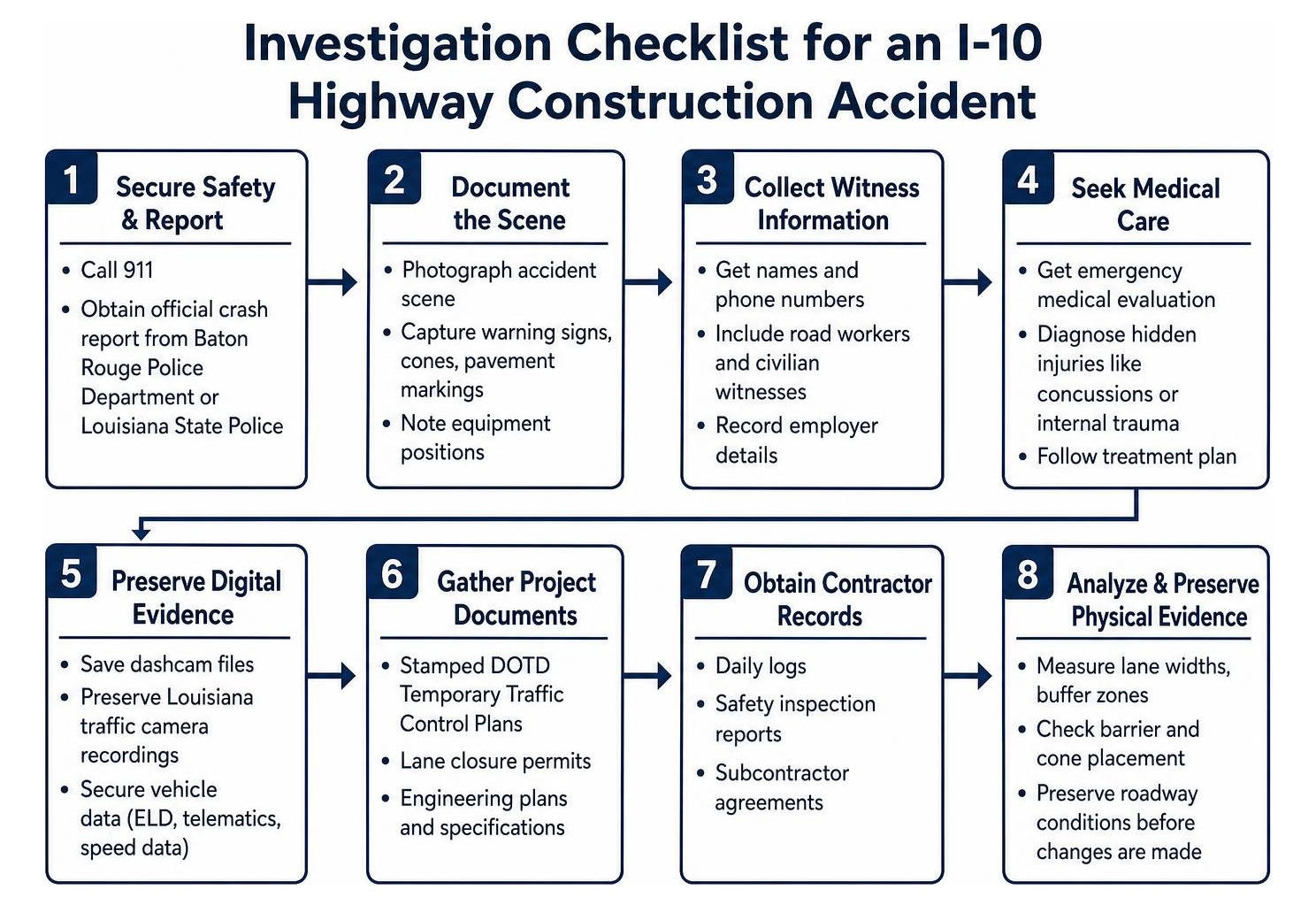
Follow these crucial steps following a work zone collision:
- Call 911 immediately and obtain an official crash report from the Baton Rouge Police Department or Louisiana State Police.
- Photograph the accident scene, including missing signs, cone placement, skid marks, and contractor truck positions.
- Collect names, phone numbers, and employer details from all road workers and civilian witnesses present.
- Seek emergency medical evaluation to diagnose hidden injuries like concussions or internal trauma.
- Save all vehicle camera footage, GPS tracking records, and physical medical documentation.
Work zone configurations change daily as construction progresses along Interstate 10. Contacting an attorney promptly ensures your legal team can issue formal evidence preservation letters to contractors before vital records disappear.
Frequently Asked Questions About I-10 Construction Zone Crashes in Baton Rouge?
Can I still sue if I was driving above the posted speed limit in the work zone?
Yes, you can still bring a claim under Louisiana’s pure comparative fault law. While speeding may result in a percentage of comparative fault assigned to you, it does not bar you from recovering compensation for the contractor’s negligence.
How long do I have to file a personal injury lawsuit after an I-10 construction accident?
Louisiana has strict legal deadlines, known as prescriptive periods, for filing injury lawsuits. Because deadlines vary depending on whether private contractors or government entities are involved, you should seek legal guidance immediately to avoid losing your right to compensation.
What if the construction company blames the state or another subcontractor?
Construction accident cases frequently involve multiple defendants pointing fingers at one another. An attorney can name the general contractor, subcontractors, and public entities in your lawsuit, ensuring all available insurance policies contribute to your recovery.
How does holding a commercial driver’s license affect my injury claim?
Holding a CDL means defense attorneys may scrutinize your speed and lane positioning more closely. However, professional status does not relieve road contractors of their primary legal obligation to keep highway work zones safe for all motorists.
Protect Your Legal Rights with Experienced Baton Rouge Highway Injury Advocates
Proving contractor liability in highway work zone accidents requires a detailed understanding of traffic control regulations, comparative negligence rules, and corporate defenses. Highway contractors have teams of insurance adjusters ready to shift blame onto injured drivers. Our attorneys analyze state traffic plans, obtain black box data, and build strong evidence to counter comparative fault defenses.
At Doran & Cawthorne, we represent injured motorists across our office locations in Baton Rouge, Lafayette, and Opelousas. We are dedicated to holding negligent contractors and government agencies accountable for the harm they cause on our highways.
Contact Pride Doran,
Share this Blog

When You Need Real Talk & Results™
Louisiana Personal Injury Attorneys Committed to Advocating on Your Behalf

