 Skip to content
How Can You Report Nursing Home Neglect in Opelousas Without Calling the Police?
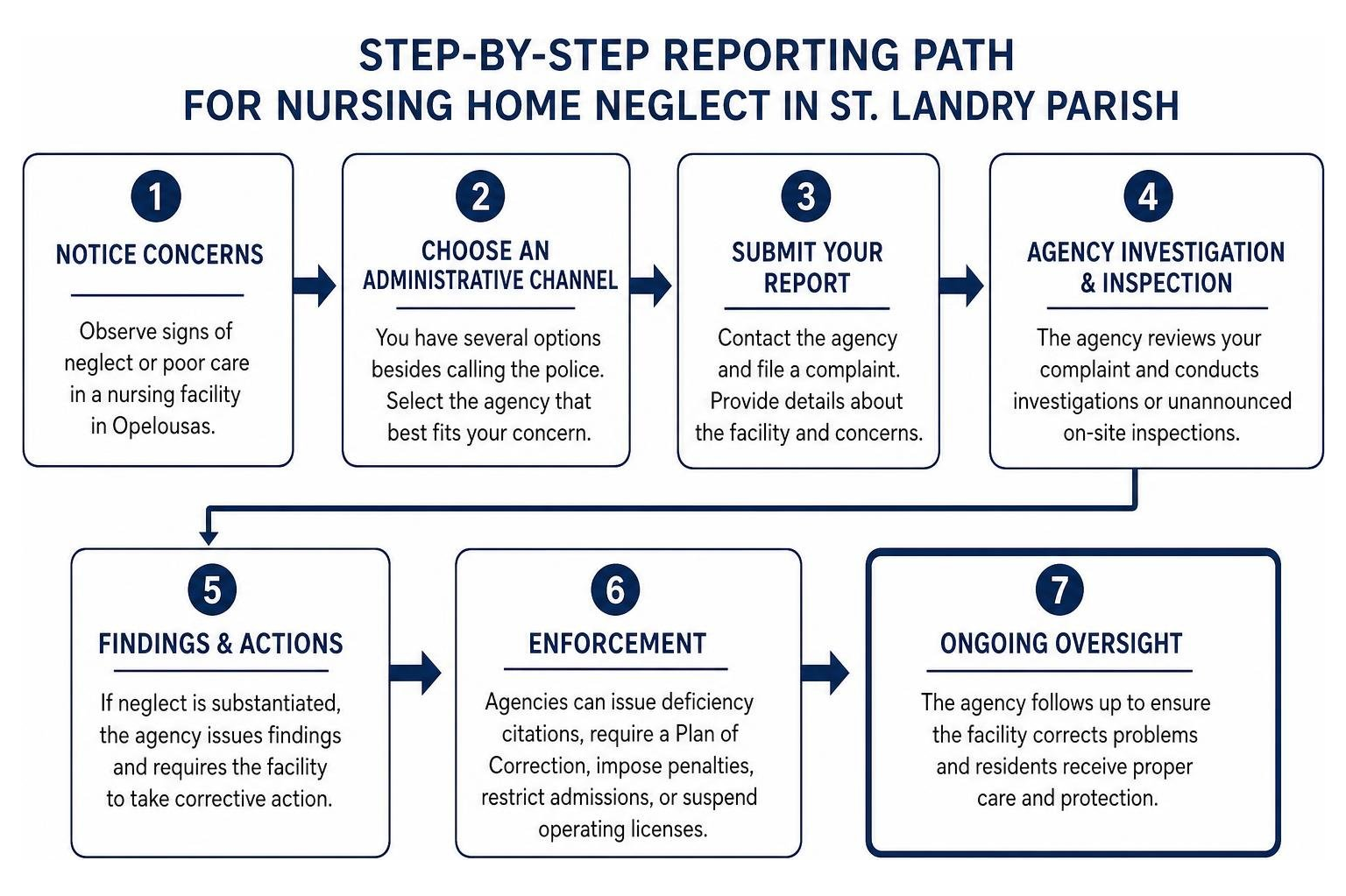
When you notice warning signs that a family member in an Opelousas skilled nursing facility is not receiving proper care, contacting local law enforcement is not your only path forward. Many families hesitate to dial 911 or call the St. Landry Parish Sheriff’s Office unless an immediate life-threatening emergency or overt physical violence has occurred. Fortunately, Louisiana maintains a comprehensive administrative and regulatory framework specifically built to investigate, penalize, and correct institutional neglect without requiring a police cruiser at the front door.
Administrative reporting channels exist to hold long-term care operators accountable to state and federal licensing standards. These specialized state bodies possess the statutory power to conduct unannounced, on-site inspections, examine resident medical charts, audit staffing ratios, issue formal deficiency citations, and levy civil monetary penalties against non-compliant facilities.
In Louisiana, several dedicated entities handle these matters:
- The Louisiana Department of Health (LDH) Health Standards Section (HSS) acts as the primary licensing and regulatory authority.
- The Louisiana Long-Term Care Ombudsman Program provides independent, confidential resident rights advocacy.
- Elderly Protective Services (EPS) and Adult Protective Services (APS) offer social service investigations for vulnerable adults.
- The Louisiana Attorney General’s Medicaid Fraud Control Unit (MFCU) prosecutes systemic patient mistreatment, abuse, and exploitation.
Reporting through administrative channels often produces rapid regulatory actions. When state inspectors substantiate neglect, they can force the nursing facility to submit and execute a mandatory plan of correction (POC), restrict new admissions, or even suspend operating licenses, ensuring your loved one receives the oversight and safety they deserve.
Which Louisiana Agencies Handle Nursing Home Neglect Complaints in Opelousas?
Navigating state government oversight can feel daunting when you are dealing with the emotional weight of a loved one’s declining health. In Opelousas, nursing homes are subject to multi-layered oversight by both state health regulators and independent advocacy programs. Understanding which agency manages your specific concern ensures your complaint reaches the correct desk without delay.
The table below outlines the primary state organizations responsible for receiving, evaluating, and investigating nursing home neglect reports in Louisiana.
| Agency | Jurisdiction & Focus | Contact Details | Filing Methods | Investigation Timeframe |
|---|---|---|---|---|
| LDH Health Standards Section (HSS) | Regulatory compliance, licensing violations, quality-of-care failures in licensed facilities | 1-888-810-1819 | Online portal, email, fax, mail | Within 5 days for immediate jeopardy; up to 30 days for routine complaints |
| Long-Term Care Ombudsman Program | Resident rights advocacy, care dispute resolution, mediation between family and administration | 1-866-632-0922 | Phone, email, regional coordinator intake | Prompt initial contact; active case advocacy until resolution |
| Elderly Protective Services (EPS) | Protective social services for adults aged 60+ facing abuse, neglect, or exploitation | 1-833-577-6532 | 24/7 hotline, online referral | Initiated within 24 hours to 10 business days based on risk |
| Adult Protective Services (APS) | Protective services for adults aged 18–59 with physical or mental disabilities | 1-800-898-4910 | Phone, email (apsreporting@la.gov) | Initiated within 24 hours to 10 business days; 30-day investigation goal |
| Medicaid Fraud Control Unit (MFCU) | Severe criminal neglect, systemic healthcare fraud, and patient mistreatment in Medicaid facilities | (225) 326-6210 | Phone, formal referral via Louisiana AG | Varies depending on formal prosecutorial and criminal timelines |
Role of the Louisiana Department of Health (LDH) Health Standards Section
The Health Standards Section within the Louisiana Department of Health functions as the primary regulatory body for all skilled nursing facilities operating in St. Landry Parish. HSS licenses nursing homes, enforces the Louisiana Sanitary Code, and ensures compliance with federal Medicare and Medicaid Conditions of Participation.
When you submit a complaint to HSS, you are alerting the state agency that holds the facility’s operating license in its hands. HSS surveyors have full legal authority to enter the facility unannounced, review clinical charts, cross-reference staffing rotas against mandated nurse-to-resident ratios, and interview caregivers under oath.
Role of the Louisiana Long-Term Care Ombudsman Program
Operating under the federal Older Americans Act and administered through the Governor’s Office of Elderly Affairs, the Long-Term Care Ombudsman Program serves as an independent resident advocate. Ombudsmen are not state facility inspectors or law enforcement officers; rather, they are dedicated resident advocates who investigate complaints regarding quality of life and resident rights.
Ombudsman services are completely free of charge and confidential. If an Opelousas nursing home resident is suffering from poor hygiene, missed meals, or retaliatory treatment from staff, an ombudsman can visit the facility in person, advocate on the resident’s behalf during care plan meetings, and negotiate directly with facility leadership to secure immediate changes.
Role of Adult and Elderly Protective Services
Protective services in Louisiana are divided by age and vulnerability. Elderly Protective Services focuses on individuals aged 60 and older, whereas Adult Protective Services covers vulnerable adults aged 18 through 59 with disabilities.
While HSS focuses on sanctioning the licensed facility itself, EPS and APS focus on assessing the immediate safety, health, and social welfare of the vulnerable individual. These protective service agencies frequently coordinate with family members, medical personnel, and state investigators to ensure a neglected resident is moved out of harm’s way or provided with immediate medical and social interventions.
How Do You File a Formal Complaint with the Health Standards Section?
Filing a formal administrative complaint against an Opelousas nursing home with the Health Standards Section creates an official regulatory paper trail. LDH provides several methods for submitting your grievance.
To expedite processing, families can access and complete the official Health Standards Section complaint form. While you can initiate a report through the Louisiana Department of Health complaint portal or over the phone, submitting a detailed written complaint with supporting documentation ensures state surveyors have the specific facts needed to conduct a targeted inspection.

What Information Must Be Included in Your Report?
To ensure your complaint triggers an immediate and thorough investigation, provide detailed, factual information rather than generalized grievances. State surveyors prioritize reports that contain verifiable dates, names, and medical details.
When drafting your complaint, be sure to include:
- Resident Identifiers: The full legal name, date of birth, room number, and specific wing of the resident.
- Facility Information: The exact legal name and physical address of the Opelousas nursing home.
- Key Dates and Shifts: The exact dates, times of day, and nursing shifts (e.g., night shift, weekend rotation) when the neglect occurred or was observed.
- Personnel Involved: The names, titles, and shift roles of staff members directly involved, including Certified Nursing Assistants (CNAs), Licensed Practical Nurses (LPNs), Registered Nurses (RNs), the Director of Nursing (DON), and the Facility Administrator.
- Specific Clinical Evidence: Clear, objective descriptions of the neglect. Include details regarding unstageable bedsores (pressure injuries), unexplained bruising, recurrent unassisted falls, significant unplanned weight loss, signs of severe dehydration, or missed doses of critical medications.
- Internal Grievance Records: Copies of any prior written grievances or communication logs submitted to the nursing home administrator, along with any written responses (or notes indicating a lack of response within 30 days).
What Happens After the Health Standards Section Receives Your Complaint?
Once received, the HSS Complaint Program Desk triages the report based on the severity of the alleged harm. Under La. Admin. Code tit. 50, § II-10165, allegations categorized as posing “immediate jeopardy”—situations where a resident’s health or safety is placed at risk of imminent death or severe bodily harm—must be referred immediately for an unannounced on-site investigation within five days.
For standard non-immediate jeopardy complaints, surveyors typically initiate inspections within 30 days. Surveyors arrive without prior warning, inspect resident rooms, observe meal deliveries, review internal charting and physician order records, and interview staff and fellow residents.
If the surveyors find the facility failed to meet state or federal care regulations, HSS issues a formal Form CMS-2567 statement of deficiencies. The nursing facility is legally required to respond with an acceptable plan of correction within strict timeframes (typically not exceeding 90 days), outlining how they will remediate the neglect and prevent recurrence.
How Can the Louisiana Long-Term Care Ombudsman Help Your Family in Opelousas?
While the Health Standards Section enforces regulatory compliance, the Louisiana Long-Term Care Ombudsman Program operates as a resident-directed advocate. If your loved one is capable of expressing their wishes, the ombudsman works strictly under their direction. If the resident cannot express their wishes due to cognitive decline, the ombudsman collaborates with the resident’s designated legal surrogate or family advocate.
Families in Opelousas can access the state ombudsman network by calling the toll-free statewide intake line at 1-866-632-0922. This connects you with the regional ombudsman coordinator assigned to St. Landry Parish.
Ombudsmen are trained mediators who address issues before they escalate into catastrophic injuries. They can resolve disputes involving:
- Unreasonable delays in answering call lights
- Inadequate assistance with bathing, dressing, and basic oral hygiene
- Poor meal quality or failure to assist residents who require feeding support
- Improper administration of daily physical therapy regimens
- Threats of involuntary transfer or retaliatory discharge due to unpaid balances or family complaints
When facility-level neglect causes severe physical trauma—such as deep Stage IV pressure ulcers, intracranial hemorrhages from unmonitored falls, or severe sepsis—advocacy through an ombudsman can be paired with formal legal representation. Families often consult a nursing home abuse attorney to ensure evidence is preserved while state ombudsmen and regulators address ongoing care.
Key Services Provided by Regional Ombudsmen
- Unannounced On-Site Visits: Ombudsmen regularly visit facilities to observe general living conditions and speak privately with residents in their rooms.
- Care Plan Meeting Representation: With resident or surrogate permission, an ombudsman can attend interdisciplinary care plan meetings to advocate for necessary adjustments in physical therapy, dietary plans, and staffing attention.
- Discharge and Transfer Appeals: If an Opelousas nursing home attempts to unlawfully discharge a resident, the ombudsman assists the family in filing an expedited administrative appeal to halt the eviction.
- Resident Rights Education: Ombudsmen educate families on the Louisiana Nursing Home Residents’ Bill of Rights, which guarantees the right to dignified care, privacy, freedom from chemical and physical restraints, and full access to medical information.
When Should You Contact Elderly Protective Services (EPS) or Adult Protective Services (APS)?
Understanding the division of labor between Elderly Protective Services and Adult Protective Services is essential for getting rapid assistance:
- Elderly Protective Services (EPS): Governed by the Governor’s Office of Elderly Affairs, EPS handles reports involving adults aged 60 and older. You can report directly to the EPS Statewide Hotline at 1-833-577-6532. Detailed criteria can be referenced in state Elderly Protective Services guidance and the EPS policy and procedure manual.
- Adult Protective Services (APS): Administered by the Louisiana Department of Health’s Office of Aging and Adult Services, APS handles reports involving vulnerable adults aged 18 to 59 with mental or physical disabilities. Reports can be made by calling 1-800-898-4910 or emailing
apsreporting@la.gov.
While the Health Standards Section investigates systemic licensing issues with the facility as an institution, EPS and APS step in when a vulnerable adult is at risk from individual caregivers, third-party contractors, or systemic institutional failure.
Understanding APS and EPS Investigation Timelines
Both APS and EPS operate under strict statutory prioritization timelines based on the immediate risk to the resident’s life and health:
- High-Risk Allegations (Immediate Danger): Intake caseworkers initiate investigations within 24 hours of report receipt.
- Standard-Risk Allegations: Caseworkers initiate contact and on-site assessments before or within 10 business days.
- Investigation Completion: Protective service investigations target case closure within 30 days. If ongoing protective services, guardianship interventions, or emergency relocations are needed, interventions are arranged within 90 to 120 days.
All reports made to EPS and APS are kept strictly confidential under Louisiana law. Investigation case records are shielded from general public records requests and are shared only with the victim, authorized legal representatives, and law enforcement agencies when criminal charges are warranted.
What Are the Mandatory Reporting Laws and Penalties for Nursing Home Neglect in Louisiana?
Louisiana law takes the protection of vulnerable adults seriously, establishing strict mandatory reporting requirements and criminal penalties for those who conceal or ignore abuse and neglect.
Under Louisiana Revised Statutes § 14:403.2, all citizens are required by law to report the abuse, neglect, exploitation, or extortion of vulnerable adults with disabilities when they have reasonable cause to believe such actions are occurring.
For licensed healthcare personnel, the standard is even more stringent. Under La. Admin. Code tit. 48, § I-9727, nursing home administrators, physicians, registered nurses, licensed practical nurses, and certified nurse aides are designated as mandatory reporters.
These individuals must report suspected violations according to strict statutory windows:
- Within 2 Hours: If the alleged abuse or neglect results in serious bodily injury.
- Within 24 Hours: For all other allegations of abuse, neglect, mistreatment, or misappropriation of resident property.
Any person who knowingly and willfully fails to report suspected abuse or neglect in a Louisiana healthcare facility can be prosecuted for a misdemeanor, facing fines of up to $500, imprisonment for up to six months, or both. Furthermore, individuals who commit intentional cruelty or negligent mistreatment that results in severe injury face felony charges carrying fines of up to $10,000 and imprisonment for up to ten years under Louisiana law.
Louisiana statutes also provide immunity from civil and criminal liability for any citizen who files a report in good faith. Nursing facilities are strictly prohibited by state regulation from taking retaliatory action against any resident, family member, or employee who lodges a complaint with HSS, EPS, or the Ombudsman Program.
When neglect escalates into profound harm—such as severe medication errors, unmonitored falls resulting in hip fractures, or fatal septic shock—regulatory penalties alone cannot compensate your family for hospital bills and suffering. In these serious situations, working with an Opelousas personal injury attorney or a medical malpractice lawyer allows families to initiate civil discovery, subpoena internal staffing logs, and demand compensation through the court system.
What Are the Most Common Questions About Reporting Nursing Home Neglect?
Can I File a Nursing Home Neglect Complaint Anonymously in Louisiana?
Yes. The Louisiana Department of Health Health Standards Section, Elderly Protective Services, and Adult Protective Services all accept anonymous complaints. State intake caseworkers will not compel you to disclose your identity if you wish to remain anonymous.
However, there is an important trade-off to consider: if you submit a report completely anonymously, state investigators will be unable to contact you for follow-up details, request clarifying medical records, or provide you with written copies of their official findings and deficiency reports. Providing your contact details while requesting formal confidentiality often strikes the best balance, as Louisiana law shields complainant identities from facility administrators.
How Quickly Does the State Respond to an Urgent Report of Nursing Home Neglect?
The speed of the state’s response depends entirely on how the intake intake desk classifies the risk:
- Immediate Jeopardy Cases: If the report demonstrates that a resident is facing imminent danger of severe harm, impairment, or death, HSS is mandated to conduct an unannounced on-site inspection within 5 calendar days.
- High-Risk APS/EPS Cases: Adult and Elderly Protective Services dispatch caseworkers within 24 hours for emergency situations.
- Non-Jeopardy Complaints: Standard complaints involving regulatory infractions or quality-of-life concerns are typically investigated within 30 days.
What Should You Do if the Nursing Home Fails to Fix Neglect After a State Investigation?
If state inspectors issue deficiency citations but the facility fails to correct the conditions within their 90-day plan of correction window, you should escalate the matter:
- Notify the State Survey Agency of Repeat Violations: File a secondary complaint with HSS detailing that the agreed plan of correction was not executed.
- Refer the Case to the Medicaid Fraud Control Unit (MFCU): Contact the Louisiana Attorney General’s MFCU at (225) 326-6210. The MFCU possesses prosecutorial power to investigate facilities that bill Medicaid for skilled nursing care while failing to provide basic human needs.
- Execute an Emergency Relocation: Collaborate with your regional ombudsman and local social workers to transfer your loved one to a higher-rated skilled nursing or assisted living facility.
- Pursue Civil Legal Action: When administrative complaints fail to protect a resident, civil litigation serves as a powerful mechanism to compel institutional change and secure financial recovery for medical expenses, corrective treatments, and pain and suffering.
Hold Negligent Facilities Accountable: How Doran & Cawthorne Protects Opelousas Families
Reporting nursing home neglect to administrative agencies like the Health Standards Section, Elderly Protective Services, and the Long-Term Care Ombudsman is an essential first step in protecting your loved one. These agencies create an official public record, enforce safety codes, and impose administrative sanctions. However, state regulators cannot recover compensation for the medical bills, rehabilitation costs, and emotional trauma your family has endured.
At Doran & Cawthorne, we stand by families in Opelousas and across St. Landry Parish who have trusted a long-term care facility only to see their loved one suffer from systemic understaffing, medication errors, untreated bedsores, and unassisted falls. Our legal team uses the findings from state administrative investigations to build compelling personal injury and medical malpractice claims against negligent nursing home corporations and their insurance carriers.
With office locations serving Opelousas, Lafayette, and Baton Rouge, our attorneys provide the local knowledge, aggressive advocacy, and compassionate guidance needed to achieve maximum recovery and demand institutional accountability.
If you suspect your family member is suffering from nursing home neglect in St. Landry Parish, do not wait for conditions to worsen. File your administrative reports, document every sign of poor care, and contact our team today for a free, confidential case evaluation.
Share this Blog
When You Need Real Talk & Results™
Louisiana Personal Injury Attorneys Committed to Advocating on Your Behalf

